The $492 Million Spectrum Auction That Started Everything
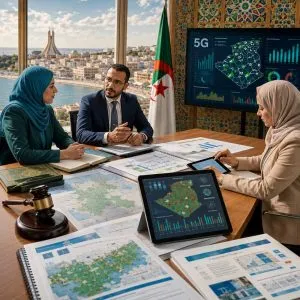
Algeria’s 5G journey moved from policy papers to commercial reality in 2025. After years of delays that saw neighboring Morocco and Tunisia move ahead with their own deployments, the Algerian government conducted a spectrum auction that generated $492 million (63.9 billion Algerian dinars) in license fees from the country’s three mobile operators. The licenses were formally published in the Official Gazette in July 2025, and commercial services went live on December 3, 2025.
The auction covered two frequency bands critical for 5G deployment: the 3.5 GHz mid-band, which offers the best balance of coverage and capacity for urban areas, and the 2.6 GHz TDD band, which provides additional capacity for dense deployments. Algeria’s telecom regulator ARPCE oversaw the process, setting binding coverage milestones tied to the license conditions.
Who Got What: Spectrum Allocation Breakdown
The three operators emerged from the auction with meaningfully different spectrum portfolios, which will shape their competitive positioning for years to come.
Djezzy secured the largest allocation: 170 MHz in the 3.5 GHz band, making it the biggest mid-band spectrum holder in Algeria’s 5G market. This contiguous block in the upper portion of the band gives Djezzy a theoretical throughput advantage for high-bandwidth enterprise applications and dense urban coverage.
Mobilis, the state-owned incumbent, received 100 MHz in the 3.5 GHz band plus 70 MHz in the 2.6 GHz TDD band. The dual-band strategy gives Mobilis flexibility to deploy capacity layers where demand concentrates. Mobilis CEO Chawki Boukhazani’s team had already demonstrated 1.2 Gbps speeds in February 2025 testing, positioning the operator as a first-mover in performance claims.
Ooredoo Algeria acquired a large contiguous mid-band block in the lower 3.5 GHz range, with a future allocation planned in the 2.6 GHz band. Ooredoo’s parent company brings 5G deployment experience from Qatar and other markets, potentially accelerating its network optimization.
The Rollout Roadmap: Eight Wilayas First
The license conditions mandate a phased deployment. Eight wilayas serve as pilot zones for the initial phase, including major population centers. The six-year national plan requires all three operators to achieve nationwide coverage by 2031.
This timeline is ambitious by regional standards. Morocco’s 5G rollout, which began earlier, still faces coverage gaps outside Casablanca and Rabat. Algeria’s challenge is compounded by its geographic scale — the largest country in Africa by area — and the concentration of infrastructure investment in northern coastal cities. Extending 5G to southern wilayas will require either significant tower investment or reliance on satellite backhaul solutions.
The pilot phase focuses on proving the commercial model. Operators need to demonstrate that 5G subscriptions can command a premium over 4G in a market where average revenue per user (ARPU) remains among the lowest in the MENA region. Without a meaningful price differential or exclusive 5G applications, the return on the $492 million spectrum investment becomes uncertain.
Advertisement
Enterprise Use Cases: Where the Real Value Lives
Consumer mobile broadband alone will not justify Algeria’s 5G investment. The transformational value lies in enterprise and industrial applications that require the low latency, high bandwidth, and network slicing capabilities that 5G enables.
Fixed wireless access (FWA) represents the most immediate opportunity. Algeria’s fiber penetration remains limited outside major cities, and 5G FWA can deliver broadband-equivalent speeds to businesses and residential customers without the time and cost of last-mile fiber deployment. Algeria Telecom’s existing fiber backbone can serve as 5G backhaul, creating a complementary rather than competitive dynamic.
Industrial IoT applications in oil and gas, manufacturing, and logistics stand to benefit from 5G’s ultra-reliable low-latency communication (URLLC) mode. Sonatrach’s operations in southern Algeria, where wired connectivity is limited, could leverage private 5G networks for remote monitoring and autonomous equipment management.
Smart city initiatives, particularly in Algiers, Constantine, and Oran, can use 5G to connect traffic management systems, environmental sensors, and public safety networks. The government’s digitalization agenda under Algeria Digital 2030 explicitly includes smart infrastructure as a priority.
Infrastructure Gaps and Challenges
The 5G launch, while milestone-worthy, faces structural challenges that will determine whether Algeria’s rollout succeeds or stalls.
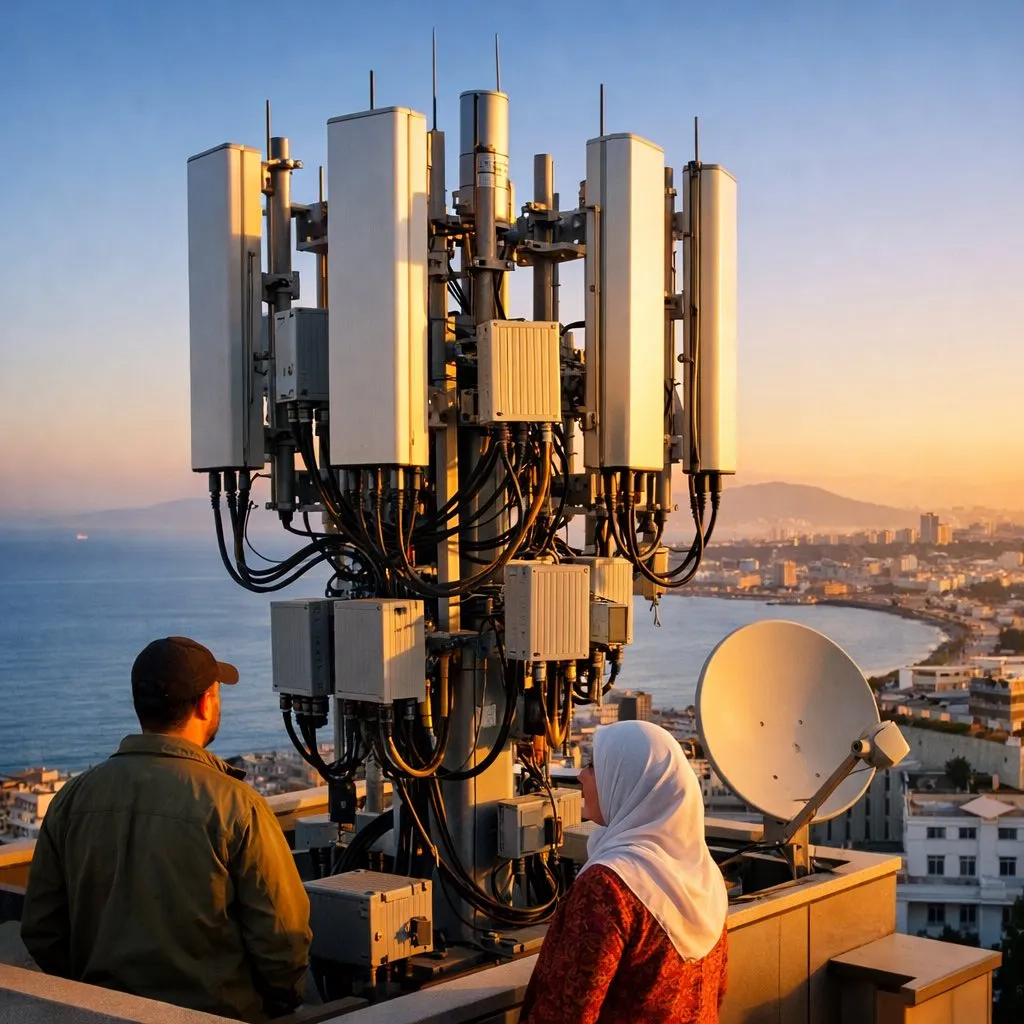
Backhaul capacity remains the critical bottleneck. 5G base stations require fiber or high-capacity microwave links to the core network. Algeria Telecom has expanded its fiber backbone, but last-mile connections to tower sites remain uneven. Without sufficient backhaul, 5G cells cannot deliver their promised speeds, effectively becoming expensive 4G towers.
Device ecosystem penetration is another constraint. 5G-capable smartphones remain premium-priced in the Algerian market, where most consumers purchase devices in the mid-range segment. Until 5G handsets reach price parity with 4G devices — likely within 18-24 months — consumer adoption will be limited to higher-income segments.
Regulatory clarity on 5G enterprise services — including spectrum leasing for private networks, data localization requirements for edge computing, and quality-of-service standards — still needs development. Enterprises evaluating 5G investments need predictable rules before committing capital.
What Comes After the Pilot Phase
The eight-wilaya pilot will generate the data that determines how fast the remaining deployment proceeds. Key metrics to watch include subscriber uptake rates, average speeds achieved in real-world conditions, and enterprise contract signings.
If operators demonstrate viable unit economics in the pilot wilayas, the expansion to secondary cities could accelerate beyond the 2031 target. If subscriber growth disappoints, operators may slow investment and focus on maximizing returns from existing 4G infrastructure — a pattern seen in several emerging markets where 5G launches preceded demand.
For Algeria’s digital economy ambitions, 5G is foundational but not sufficient. The technology enables new applications, but realizing their value requires parallel investments in cloud infrastructure, digital skills, and regulatory modernization. The $492 million spectrum auction was the entry ticket. The harder work starts now.
Frequently Asked Questions
Which wilayas have 5G coverage in Algeria’s pilot phase?
The initial deployment covers eight pilot wilayas, focusing on Algeria’s major population centers. The government’s six-year rollout plan mandates that all three operators — Mobilis, Djezzy, and Ooredoo — achieve nationwide coverage by 2031, but the specific pilot wilayas prioritize areas with the highest population density and enterprise activity.
How much spectrum did each Algerian operator receive for 5G?
Djezzy received the largest allocation with 170 MHz in the 3.5 GHz band. Mobilis received 100 MHz in the 3.5 GHz band plus 70 MHz in the 2.6 GHz TDD band. Ooredoo secured a large contiguous block in the lower 3.5 GHz range with additional 2.6 GHz spectrum planned. The total auction generated $492 million in license fees.
What speeds can Algerian users expect from 5G networks?
Mobilis demonstrated speeds of 1.2 Gbps during testing in February 2025, though real-world speeds will vary based on location, network load, and device capability. Mid-band 3.5 GHz deployments typically deliver 300-700 Mbps in real-world conditions, representing a significant upgrade from Algeria’s current 4G speeds that average well under 50 Mbps.
Sources & Further Reading
- Algeria to Get 5G as Mobilis, Djezzy and Ooredoo Commence Rollouts — Developing Telecoms
- Algeria Launches 5G Rollout — Connecting Africa
- Algeria Concludes 5G Spectrum Auction — Spectrum Tracker
- Algeria Rolls Out 5G Network with Six-Year Expansion Plan — North Africa Post
- 5G Officially Launched in Algeria — AL24 News
- Mobilis, Djezzy, Ooredoo Lead Algeria’s $492M 5G Rollout — ITWeb Africa