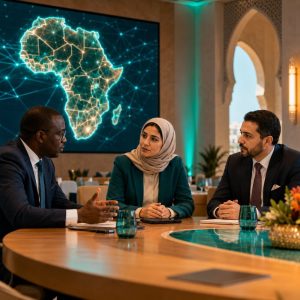
A Continental Consensus on Digital Sovereignty
More than 50 ministers from across Africa adopted the Algiers Declaration on African Telecommunications Sovereignty and Integrated Connectivity on March 30, 2026, the final day of the African Ministerial Telecommunications Summit during Global Africa Tech 2026. The 14-article political document reframes telecommunications infrastructure as “a strategic pillar for sovereignty, resilience, inclusion, and economic transformation” — elevating telecom policy from a technical domain to a matter of continental security.
The summit, held March 28-30 at the Centre International des Conferences in Algiers, convened 5,000+ participants from 45 countries for three days of strategic dialogue, policy discussions, and innovation showcases. President Abdelmadjid Tebboune placed the event under his high patronage, signaling Algeria’s strategic commitment to leading Africa’s digital sovereignty agenda. The declaration will be submitted to the upcoming African Union Summit for formal continental adoption.
What the 14 Articles Commit To
The Algiers Declaration establishes commitments across four domains with implementation spanning 2026-2030, aligned with the African Union’s Agenda 2063 and the Sustainable Development Goals.
Universal connectivity: Expanding meaningful and affordable access to all citizens, particularly in rural and underserved communities, through integrated continental infrastructure linking terrestrial, subsea, and satellite networks.
Critical infrastructure protection: Strengthening the security and resilience of telecommunications networks, including data centers, internet exchange points, and trusted cloud capabilities on African soil. This directly addresses the fact that most African internet traffic currently routes through servers in Europe and the United States.
Data sovereignty: Building sovereign digital ecosystems that keep African data under African governance. The declaration recognizes that digital sovereignty requires control across all connectivity domains — the summit was structured around four pillars: Land, Air, Sea, and Space.
Human capital development: Investing in local talent and industry to anchor long-term digital sovereignty. Infrastructure without the technical workforce to build, maintain, and govern it remains dependent on external providers.
Advertisement
The OTT Regulation Framework
One of the declaration’s most consequential elements is its groundwork for Africa-wide regulation of Over-The-Top platforms. Telecom operators across the continent have argued that they invest heavily in network infrastructure while large digital platforms — primarily from the United States, Europe, and China — collect most of the revenue generated over those networks.
The declaration outlines key principles for a unified framework to regulate OTT platforms that provide online content and communication services outside traditional telecom networks. The framework was drafted under the African Telecommunications Union (ATU) and has been submitted to the African Union for political approval.
This is not an abstract policy discussion. OTT services like WhatsApp, YouTube, and Netflix consume the majority of bandwidth on African networks but contribute nothing to infrastructure costs. If the framework leads to revenue-sharing mechanisms or local infrastructure investment requirements for OTT providers, it could fundamentally alter the economics of telecommunications across the continent.
Algeria at the Center
For Algeria, the declaration serves multiple objectives. Domestically, it validates the country’s substantial investment in telecommunications infrastructure. Algerie Telecom has reached 2.5 million FTTH subscribers as of September 2025, growing from just 53,000 in 2020 — a 2,730% increase in four years. The network spans over 140,000 kilometers of fiber optic cable with speeds up to 1.5 Gbps, positioning Algeria as Africa’s largest FTTH market. The government plans to phase out copper networks entirely by 2027.
Continentally, hosting Global Africa Tech positions Algeria as the intellectual and political center of Africa’s digital sovereignty movement. Internationally, the unified declaration establishes Africa’s position on digital governance ahead of negotiations in multilateral forums like the ITU, WIPO, and UN digital governance processes. Individual African countries have limited negotiating power with multinational tech platforms; a continental consensus backed by 50+ ministers creates collective leverage.
What This Means for Algeria’s Tech Sector
The Algiers Declaration creates both opportunities and obligations for Algeria’s technology sector. The emphasis on sovereign cloud solutions and local data centers validates existing investments and creates a framework for attracting additional infrastructure investment. The OTT regulation framework could generate new revenue streams for Algeria’s telecom operators.
The human capital development commitments reinforce the urgency of Algeria’s digital skills programs. Building continental digital sovereignty requires a workforce that can design, deploy, and manage the infrastructure — and Algeria is positioning itself to supply that workforce across the continent.
Frequently Asked Questions
What is the Algiers Declaration on Telecommunications Sovereignty?
The Algiers Declaration is a 14-article political document adopted by 50+ African ministers at Global Africa Tech 2026 in Algiers on March 30, 2026. It establishes continental commitments in universal connectivity, critical infrastructure protection, data sovereignty, and human capital development, with implementation planned for 2026-2030 and alignment to the AU’s Agenda 2063.
How does the declaration address OTT platform regulation?
The declaration outlines principles for a unified African framework to regulate Over-The-Top platforms that use telecom infrastructure without contributing to its costs. The framework was developed under the African Telecommunications Union and submitted to the African Union for political approval. If adopted, it could require OTT providers to share revenue or invest in local infrastructure.
Why is Algeria central to this initiative?
Algeria hosted Global Africa Tech 2026 under presidential patronage, convening 5,000+ participants from 45 countries. With 2.5 million FTTH subscribers, over 140,000 km of fiber optic cable, and Africa’s largest fiber-to-the-home market, Algeria has both the infrastructure credentials and political positioning to lead the continent’s digital sovereignty agenda.
Sources & Further Reading
- Ministerial Summit: Adoption of the Algiers Declaration — Africa News DZ
- Africa Adopts Algiers Declaration to Strengthen Telecom Sovereignty — TechAfrica News
- Algiers Declaration Lays Groundwork for Africa-Wide OTT Regulation — Ecofin Agency
- African Ministers Adopt Algiers Declaration — Telecompaper
- Algiers Declaration Signals Africa’s Shift Toward Digital Sovereignty — Middle East Observer
- Algerie Telecom Reaches 2.5 Million Fiber Optic Subscribers — Ecofin Agency