The Numbers That Tell the Story
In August 2025, Algeria’s Ministry of Higher Education and Scientific Research released the results of the first phase of university orientation for the 2025 baccalaureate cohort. The numbers were striking.
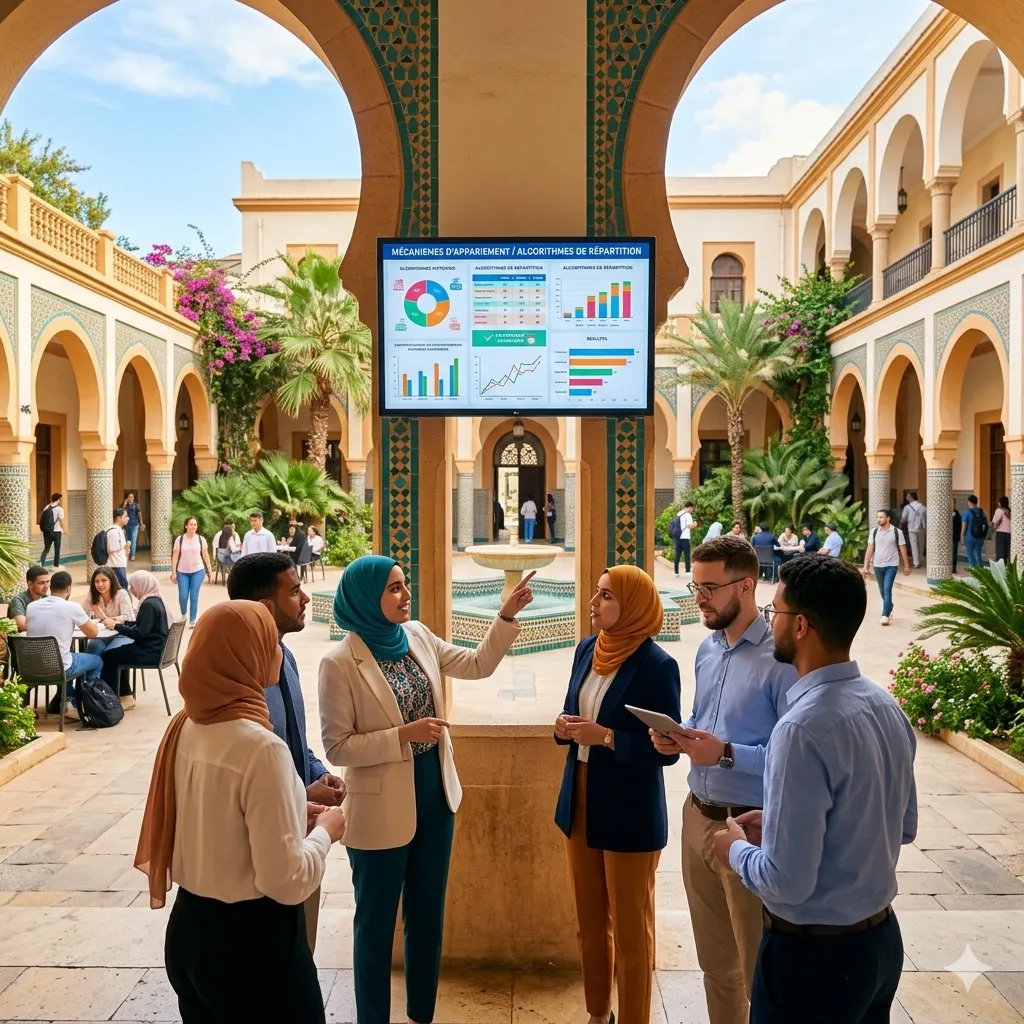
Out of 340,901 students who passed the national exam, more than 97% received university placements within the designated timeframe — a milestone attributed to the large-scale integration of AI-powered decision-making for the first time in Algeria’s university placement process.
Minister of Higher Education and Scientific Research Kamel Baddari announced that 70.38% of students secured admission to one of their top three choices, signaling a significant improvement in both efficiency and student satisfaction compared to the manual and semi-automated systems used in previous years.
Nearly 65.30% of new students enrolled in scientific and technological fields, with a noticeable decline in interest in literary and legal disciplines — a shift that aligns with Algeria’s national strategy to build a technology-driven knowledge economy.
And in a move that directly connects higher education to employment, the government announced that 13% of students will benefit from employment contracts in the national education and healthcare sectors upon completing their studies — approximately 44,000 graduates entering guaranteed career-track positions.
These are not projections or pilot program results. They represent a nationwide, operational AI deployment affecting more than a third of a million young Algerians — making it one of the largest real-world AI applications in the country’s history.
How the Algorithm Works
The Matching Problem
University placement is, at its core, a complex optimization problem. On one side: 340,901 students, each with academic scores, subject preferences, geographic constraints, and ranked choices among hundreds of university programs. On the other side: dozens of universities across 58 wilayas (provinces), each with intake capacities, program-specific prerequisites, and resource constraints.
The traditional approach — manual review, rule-based sorting, and administrative judgment — could handle this scale, but slowly, inconsistently, and with significant bottlenecks. Students would wait weeks for results. Administrative staff worked through mountains of files. Appeals and transfers clogged the system well into the academic year.
The AI Solution
The AI-powered system uses a matching algorithm that considers students’ preferences, academic performance, and universities’ intake capacities. While the Ministry has not published the full technical specification, the system operates on principles well-established in algorithmic matching theory:
Multi-criteria optimization: The algorithm simultaneously weighs multiple factors — baccalaureate scores, subject-specific grades, student-ranked preferences, geographic proximity, and program capacity — to find placements that maximize overall satisfaction while respecting constraints.
Preference-based matching: Students submit ranked lists of program choices. The algorithm processes these preferences systematically, ensuring that higher-ranked students (by score) receive priority access to competitive programs while still attempting to place every student in a program they actually want.
Capacity constraints: Each university program has a maximum intake. The algorithm respects these limits while distributing students across the national university network to avoid overcrowding in popular programs and underutilization in others.
Fairness mechanisms: By processing all 340,901 students through the same algorithmic framework, the system reduces the risk of favoritism, administrative errors, or inconsistent decision-making that can arise in manual processes.
Why 97% Is Remarkable
The 97% placement rate within the designated timeframe is significant not because placing students in universities is intrinsically difficult — eventually, spots can be found for nearly everyone — but because achieving this speed at this scale, while also maintaining 70.38% top-3 satisfaction, represents a genuine optimization achievement.
In previous years, the orientation process extended well into the academic semester, with late placements, appeals, and transfers disrupting both students and universities. The AI system compressed this process, reducing mid-cycle program transfers that place significant pressure on administrative and teaching resources.
The STEM Shift: 65.30% and Rising
A Structural Transformation in Student Preferences
The 65.30% STEM enrollment figure is arguably more significant than the placement algorithm itself. For years, Algerian higher education has been criticized for producing too many graduates in fields with limited employment prospects — particularly law, literature, and social sciences — while STEM programs struggled to attract sufficient enrollment.
The 2025 data suggests a structural shift. Emerging programs in drone technology, cybersecurity, nanotechnology, and quantum computing are rapidly gaining traction among baccalaureate graduates, reflecting both changing student preferences and the ministry’s deliberate effort to align education with labor market needs.
What Is Driving the STEM Shift
Several factors converge to explain this transformation:
National AI strategy signaling: Algeria’s target for AI to contribute 7% of GDP by 2027 — announced by Minister of Post and Telecommunications Sid Ali Zerrouki at the CTO Forum Algeria — and the high-profile creation of institutions like ENSIA have sent a clear signal to students and families that technology careers offer the best future prospects.
New specialized institutions: The creation of schools dedicated to artificial intelligence (ENSIA, opened 2021-22), cybersecurity, mathematics, nanotechnology, and autonomous systems at the Sidi Abdellah technology hub has expanded the menu of exciting, future-oriented programs available to students. The Ministry also approved 32 new training programs for the 2025 academic year, including translation, architecture, and material sciences.
Employment visibility: Algeria has deployed 124 incubators across higher education and research institutions, engaging 60,000 students in entrepreneurship-focused final-year projects and producing 1,600 micro-enterprises, 130 startups, and 2,800 patent filings — making technology entrepreneurship and employment more visible and accessible than in previous decades.
The employment guarantee: The 13% employment contract guarantee in education and healthcare creates a safety net that may encourage students to choose more challenging STEM programs, knowing that career-track employment awaits upon graduation.
Algorithm design: The placement algorithm itself may contribute by providing students with better information about available STEM programs and their employment outcomes, enabling more informed choices during the preference-ranking process. The Ministry launched three new digital tools for the 2025 cycle, including “Tawjihikoum,” an AI-powered orientation assistant that helps students discover and evaluate curricula.
The Employment Guarantee
Connecting Education to Employment
One of the most consequential aspects of the 2025 orientation process is the government’s guarantee of employment contracts for 13% of graduates in education and healthcare — approximately 44,000 students who will enter career-track positions upon completing their studies. This is not a vague promise of future employment — it is a structured pipeline connecting specific university programs to specific sector needs.
Algeria faces well-documented shortages in both education (particularly in technical subjects) and healthcare (particularly in rural areas). By guaranteeing placement, the government achieves two objectives simultaneously: it incentivizes enrollment in programs that address national needs, and it provides students with employment certainty that makes the investment in higher education more attractive.
The Employment Mismatch Problem
Algeria’s youth unemployment rate stands at approximately 29.76% as of 2024, according to World Bank data. University graduates in oversupplied fields — law, business administration, social sciences — often face years of job searching. Meanwhile, technical positions in education, healthcare, and technology go unfilled.
The employment guarantee, combined with the AI placement algorithm’s design to steer students toward high-demand fields, represents an attempt to use technology and policy in tandem to address this structural mismatch.
Which Sectors Benefit
The guaranteed employment covers two specific sectors — education and healthcare — which face Algeria’s most acute staffing shortages. Rural schools across the southern wilayas struggle to attract qualified teachers, particularly in mathematics, physics, and foreign languages. Healthcare facilities outside major cities face chronic shortages of doctors, nurses, and medical technicians.
By guaranteeing employment in these sectors, the government creates a powerful incentive structure: students who choose education or healthcare-track university programs gain certainty about their post-graduation employment, while Algeria addresses critical service delivery gaps in underserved regions. The AI placement algorithm becomes the mechanism that connects these policy objectives to individual student decisions at scale.
Technical Architecture and Scale
A Landmark AI Deployment in Education
Processing 340,901 students through an algorithmic matching system is not trivial. The system must handle:
- 340,901 student profiles with academic records, preferences, and constraints
- Hundreds of university programs across 58 wilayas with varying capacities
- Multiple optimization criteria that must be balanced simultaneously
- Real-time or near-real-time results publication to a national audience
- Appeals and reprocessing for students who contest their placement
For context, Hungary’s university admissions system — one of the most studied algorithmic placement systems in Europe, based on the Gale-Shapley stable matching algorithm — has been operating a centralized algorithmic approach since the early 2000s. Turkey’s OSYM system processes over 3 million university applicants annually through centralized algorithmic matching. Algeria’s system, while smaller in absolute volume than Turkey’s, is notable for being a first-year deployment that achieved high satisfaction rates immediately.
The Platform Infrastructure
The Ministry of Higher Education published orientation results through a digital platform on August 5, 2025 — a centralized, time-stamped release that replaced the fragmented, university-by-university notification processes used in earlier years.
Students access the platform through the ministry’s digital orientation system, where they had previously submitted their ranked preferences during the pre-registration phase (July 23-27). The system integrates pre-registration, orientation, and enrollment into a single digital pipeline under a “Zero Paper” initiative, reducing paperwork and accelerating the transition from exam results to university enrollment.
Advertisement
Lessons for Algeria’s Broader AI Strategy
Proof of Concept at Scale
The university placement algorithm is significant beyond education because it demonstrates that Algeria can deploy AI at genuine national scale. When policy discussions invoke AI targets — 7% of GDP by 2027, 20,000 startups, sovereign models — the question is always whether Algeria has the institutional capacity to execute. The placement system provides evidence that it does.
The system required coordination between the Ministry of Higher Education, dozens of universities, data infrastructure for processing hundreds of thousands of records, and a public-facing platform capable of serving results to millions of users (students, families, educators). That this worked — with 97% placement and 70.38% satisfaction — is a meaningful institutional achievement.
The Data Advantage
Unlike many AI initiatives that struggle with data scarcity, Algeria’s education system generates enormous quantities of structured data: baccalaureate scores, subject grades, geographic data, historical enrollment patterns, graduation rates, and employment outcomes. This data, when properly digitized and connected, provides a rich foundation for increasingly sophisticated AI applications.
Future iterations of the placement algorithm could incorporate employment outcome data (which fields actually lead to jobs?), regional economic projections (where will jobs be in four years?), and student aptitude indicators beyond exam scores. Each year’s cohort generates new training data that makes the system more accurate.
Replication Potential
The matching algorithm approach used for university placement could be adapted for other large-scale allocation problems in Algeria:
- Public housing allocation — matching families to available housing units based on need, family size, and geographic preference
- Teacher placement — assigning newly graduated teachers to schools based on subject need, teacher preference, and regional demand
- Healthcare worker distribution — deploying medical professionals across the national healthcare network based on specialization and regional shortages
- Civil service recruitment — matching candidates to government positions based on qualifications and agency needs
Each of these domains faces the same fundamental challenge — allocating limited resources to large populations based on multiple criteria — and could benefit from similar algorithmic approaches.
The Broader Education Technology Landscape
Houses of Artificial Intelligence
The university placement algorithm exists within a broader ecosystem of AI integration in Algerian higher education. The Ministry of Higher Education has established 17 “Houses of Artificial Intelligence” (Maisons de l’Intelligence Artificielle) across university campuses, providing students and researchers with access to AI tools, computing resources, and collaborative spaces. The first House of AI opened at the University of Algiers 1 (Benyoucef Benkhedda).
These Houses of AI serve as campus-level hubs where students can access computing power for AI projects, attend workshops on machine learning and data science, and collaborate with researchers from different disciplines on AI applications. They complement the formal AI curriculum by providing hands-on experimentation opportunities that extend beyond classroom instruction.
Innovation Infrastructure at Scale
Algeria’s university system has deployed 124 incubators across higher education and research institutions, engaging 60,000 students in final-year entrepreneurship projects. This infrastructure has supported 1,600 micro-enterprises, 130 startups, 1,175 certified innovative projects, and 2,800 patent filings with authorities. The country produces approximately 250,000 graduates annually, with over 110,000 in technical, scientific, and digital fields.
The placement algorithm benefits from — and contributes to — this ecosystem. Students placed in STEM programs through the AI system enter universities that increasingly have the innovation infrastructure to support their education and entrepreneurial ambitions. Additionally, 23 institutions have been selected for digitization as part of a push toward a fourth-generation university model.
Challenges and Areas for Improvement
Transparency and Explainability
While the 97% and 70.38% headline figures are impressive, students and families naturally want to understand why they received a specific placement. Algorithmic decisions that affect life trajectories — which university, which program, which city — demand transparency.
The Ministry has not published details about how the algorithm weighs different criteria, how ties are broken, or what role geographic factors play in placement decisions. Greater transparency would build public trust and enable academic scrutiny of the algorithm’s fairness properties.
Appeals and Edge Cases
The 3% of students not placed within the designated timeframe — approximately 10,000 individuals — represent the algorithm’s hardest cases: students with unusual profiles, geographic constraints, or preferences that cannot be satisfied within capacity limits. How the system handles these edge cases, and whether the appeals process is equally fair and efficient, is an important measure of the system’s overall equity.
Digital Divide Concerns
The orientation system requires internet access for preference submission and results checking. While Algeria’s internet penetration has grown substantially, disparities between urban and rural areas persist. Students in remote wilayas with limited connectivity may face disadvantages in accessing and using the digital platform compared to their peers in Algiers, Oran, or Constantine.
Measuring Long-Term Outcomes
The true test of the placement algorithm is not whether students are placed quickly, but whether they succeed. Tracking graduation rates, mid-program transfers, and employment outcomes for the 2025 cohort — and comparing them to pre-AI cohorts — will provide the definitive assessment of whether the algorithm improved outcomes or merely improved speed.
The Human Dimension
Behind the 340,901 figure are individual stories: a student from Ghardaia who gets into a cybersecurity program she ranked first. A student from Annaba who wanted medicine but received his fourth choice. A family in Tlemcen celebrating that their daughter was placed at the ENSIA campus in Sidi Abdellah.
The algorithm does not eliminate the human complexity of university admissions. What it does is process that complexity at scale, with consistency, speed, and a degree of fairness that manual systems struggle to match. It is a tool — powerful and imperfect — that serves the human goal of connecting young Algerians with the educational opportunities they need to build their futures.
Minister Baddari’s framing is telling: this is not just about efficiency, but about aligning education with job market needs. The AI system is one component of a broader vision to transform Algerian higher education from a credential-granting institution into a talent development pipeline that serves the nation’s economic transformation.
What Comes Next
The 2025 cohort is the first to pass through the AI-powered placement system. Its results — strong by any measure — provide a foundation for iteration and improvement. Key areas for the next cycle include:
Enhanced preference modeling: Incorporating more granular data about student interests, aptitudes, and career aspirations beyond raw exam scores.
Predictive analytics: Using historical graduation and employment data to advise students on which programs offer the best outcomes for their profiles.
Real-time feedback: Providing students with probability estimates for their ranked choices before final submission, enabling more informed decision-making.
Integration with the employment guarantee: Connecting the placement algorithm directly to the employment pipeline, so that students choosing guaranteed-employment programs receive priority information and support.
Algeria has demonstrated that it can deploy AI at national scale in one of the most consequential domains — the transition from secondary school to university. The challenge now is to build on this foundation, refining the algorithm, expanding its capabilities, and demonstrating that AI-powered public services can deliver measurably better outcomes for Algerian citizens.
Frequently Asked Questions
How does Algeria’s AI university placement algorithm work?
The system uses a matching algorithm that considers students’ baccalaureate scores, subject-specific grades, ranked program preferences, geographic proximity, and university intake capacities. All 340,901 students are processed through the same algorithmic framework to maximize placement satisfaction while respecting capacity constraints.
What is the success rate of the AI placement system?
In its first deployment for the 2025 cohort, the system achieved a 97% placement rate within the designated timeframe, with 70.38% of students receiving one of their top three program choices — a significant improvement over previous manual processes.
What is the 13% employment guarantee for graduates?
The Ministry of Higher Education announced that 13% of the 2025 cohort — approximately 44,000 students — will receive guaranteed employment contracts in the national education and healthcare sectors upon completing their university studies. This directly connects enrollment in specific programs to post-graduation career placement.
Why are 65.30% of students choosing STEM fields?
Multiple factors drive this shift: Algeria’s national AI strategy targeting 7% GDP contribution by 2027, the creation of specialized institutions like ENSIA for AI and cybersecurity schools at Sidi Abdellah, the visibility of 124 university incubators, and the employment guarantee that reduces the risk of choosing technically demanding programs.
Sources & Further Reading
- Algeria Uses AI to Streamline University Placements and Align Education With Job Market Needs — iAfrica
- The Minister Announces the Results of the 2025 Baccalaureate Orientation — Ministry of Higher Education (MESRS)
- AI Streamlines First-Year Student University Placements — University World News
- Algeria Deploys AI to Guide Varsity Placement for Baccalaureate Graduates — APA News
- Algeria Rolls Out AI-Driven System to Streamline University Placements — Muslim Network TV
- Pre-Registration, Orientation Process for New Baccalaureate Holders — DzairTube
- Algeria Targets 7% GDP from AI by 2027 — We Are Tech Africa
- Algeria Targets 20,000 Startups by 2029 Through University Incubators — We Are Tech Africa