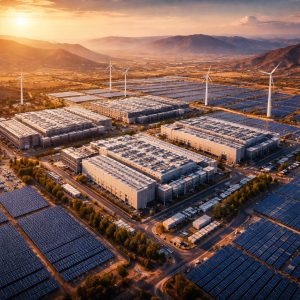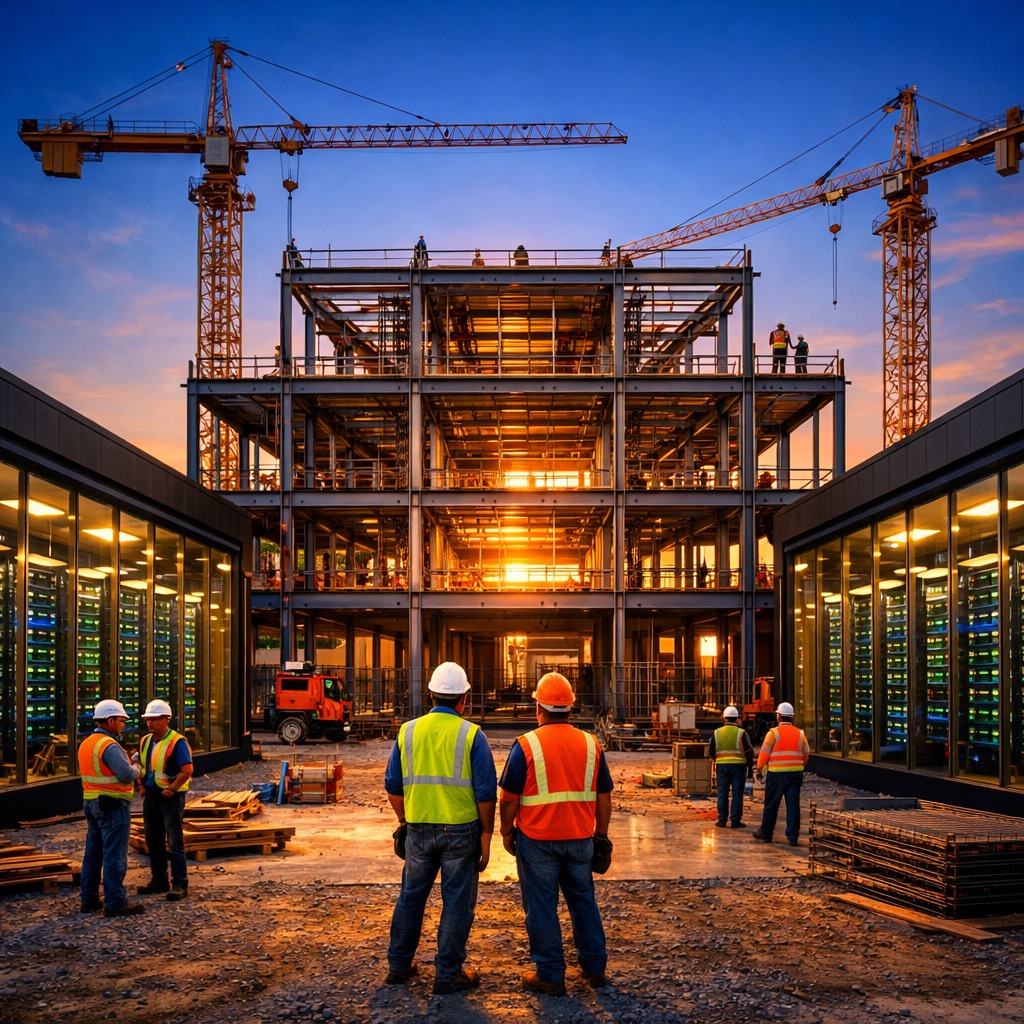
In January 2026, the United States broke every record in the book. Data center construction starts totaled $25.2 billion in a single month, according to ConstructConnect project data — the highest monthly figure since the firm began tracking the sector in 2020. Twenty new projects broke ground, including two individual developments valued at $10 billion each, alongside others costing $1.8 billion and $1.3 billion respectively.
This was not an anomaly. It was the peak of a wave that has been building for two years and shows no sign of cresting. The trailing twelve-month spending total now stands at $103.7 billion, and ConstructConnect is tracking another 65 projects valued at a combined $92.1 billion with potential start dates in the next six months.
The question is no longer whether the US will build enough data centers. It is whether it can build them fast enough.
A Fivefold Surge in Two Years
The scale of acceleration is difficult to overstate. Total spending on US data center construction starts reached an estimated $77.7 billion in 2025, a 190% year-over-year increase, according to ConstructConnect’s February 2026 report. Census Bureau data tells a complementary story: construction spending on data centers soared 31% from already elevated levels a year prior, reaching a seasonally adjusted annual rate of $47 billion — up 409% since the beginning of 2021.
The average cost per data center project has also climbed sharply. The 12-month trailing average now sits at $220 million, only the third time in ConstructConnect’s historical records that the figure has exceeded $200 million. These are not modest server farms. They are industrial megaprojects on par with petrochemical plants and semiconductor fabs.
The Hyperscaler Arms Race
Behind the construction boom sits an unprecedented capital expenditure commitment from the world’s largest technology companies. Five firms alone — Amazon, Alphabet, Microsoft, Meta, and Oracle — have announced plans for roughly $700 billion in capital expenditures for 2026, the vast majority directed at AI-related infrastructure.
CreditSights estimates the top five hyperscalers will spend approximately $602 billion in 2026, up 36% year-over-year. More striking still, approximately 75% of aggregate hyperscaler capex is now going toward AI-specific infrastructure, representing roughly $450 billion in AI-directed spending as demand for training and inference capacity accelerates.
Only a fraction of these headline capex numbers translate directly into construction costs — the rest covers GPUs, networking hardware, cooling systems, and operational expenses. But even that fraction is reshaping the entire US construction industry.
Where the Concrete Is Being Poured
The geographic concentration of this boom reveals a strategic logic shaped by power availability, fiber connectivity, and regulatory conditions.
The Southeast dominates. Over 56% of near-term potential spending is concentrated in southern states, driven by favorable energy access and permitting environments. Virginia alone accounts for 136 data centers under construction, anchored by the Northern Virginia “Data Center Alley” — one of the world’s most important internet exchange points, home to dense fiber networks and major AWS, Google, and Microsoft campuses.
Texas leads by a razor-thin margin with 140 projects under construction, narrowly ahead of Virginia. Dallas remains a major hub with nearly 200 existing data centers, and new mega-scale investments continue to arrive, including gigawatt-class campus developments from major providers.
The Midwest is the emerging frontier. January’s record month allocated $12.2 billion across Minnesota, Illinois, Michigan, and Ohio. The Stargate initiative has announced buildouts spanning Texas, New Mexico, and Ohio. After Virginia and Texas, Georgia (56 projects) and Ohio (51 projects) form the next tier.
The remaining $800 million of January’s starts were focused west of Minnesota, primarily in Texas and Arizona.
Advertisement
The Power Grid Cannot Keep Up
Every data center needs electricity — enormous quantities of it. And the grid is struggling to deliver.
A single AI-related query can consume up to 1,000 times more electricity than a traditional web search. Goldman Sachs projects a 15% compound annual growth rate in US data center power demand through 2030, with data centers consuming 8% of all US electricity by that year. Virginia alone already draws 24 TWh annually for data center operations, followed by Texas at 17 TWh and Illinois at 12 TWh.
The bottleneck is becoming acute. PJM Interconnection, the largest US grid operator serving over 65 million people across 13 states, projects it will be a full six gigawatts short of its reliability requirements by 2027. Gartner predicts that power shortages will operationally constrain 40% of AI data centers by the same year.
The financial ripple effects are already materializing. Goldman Sachs projects that data center power consumption will add 0.1 percentage points to core inflation in both 2026 and 2027. Carnegie Mellon researchers estimate that data centers and cryptocurrency mining could push average US electricity bills up by 8% by 2030, with increases exceeding 25% in the most concentrated markets of central and northern Virginia.
Capital deployment is increasingly dictated by where megawatts are available, not where fiber already exists. The Midwest’s rise as a data center corridor is a direct consequence of this power-first site selection strategy.
A 439,000-Worker Gap
The construction industry entered 2026 already short approximately 439,000 workers, according to ITIF, with the data center boom intensifying the squeeze on electricians, pipe layers, and specialized technicians. More than half of data center construction sites now report disruptions due to staffing shortages, and project backlogs stretch close to a year.
The numbers are stark: 82% of construction firms report difficulty filling hourly craft positions, and only 15% of applicants meet minimum qualifications for modern data center construction roles. Unfilled positions are projected to reach 350,000 by the end of 2026 without major intervention, according to the Associated Builders and Contractors.
Hyperscalers are responding with their own workforce programs. Amazon has committed substantial funding to workforce development programs across its data center regions. Microsoft has partnered with community colleges to produce 8,500 certified technicians annually. Google has pledged $50 million in apprenticeship programs across 12 metropolitan areas.
Whether these programs can close the gap fast enough to match the pace of capital deployment remains an open question.
What $7 Trillion Buys
McKinsey estimated in April 2025 that $7 trillion in cumulative capital expenditures will flow to global data center infrastructure by 2030, with over 40% of that spending concentrated in the United States. January 2026’s $25.2 billion record suggests that estimate may prove conservative.
The US data center construction boom is no longer a sector story. It is an industrial policy story, an energy story, and a workforce story. The concrete is being poured at a pace that would have seemed implausible three years ago. The harder question — whether the power grid, the labor force, and the regulatory apparatus can absorb this scale of investment without breaking — does not yet have a clear answer.
What is clear is that this is the single largest infrastructure buildout in the United States since the interstate highway system. And unlike highways, it is being financed almost entirely by private capital, on a timeline measured in quarters rather than decades.
Frequently Asked Questions
Why did US data center construction spending surge fivefold in two years?
The surge is driven by unprecedented capital expenditure commitments from hyperscalers. Five companies alone — Amazon, Alphabet, Microsoft, Meta, and Oracle — announced plans for roughly $700 billion in capex for 2026, with approximately 75% directed at AI-specific infrastructure. The shift from cloud computing to AI training and inference workloads requires fundamentally larger and more power-hungry facilities than traditional data centers, pushing both the number and the cost of projects to record levels.
How does the US power grid shortage affect the global data center market?
The US faces a potential 44-gigawatt power shortfall through 2028, with Gartner predicting that power shortages will constrain 40% of AI data centers by 2027. This is pushing data center construction to regions with available power — from Virginia and Texas to the Midwest — and is beginning to redirect investment to international markets where power is more accessible. For countries like Algeria, which has energy resources, this dynamic could eventually create opportunities to attract data center investment if supporting infrastructure (fiber, cooling, talent) is in place.
What does a $25 billion construction month look like in practice?
January 2026 saw 20 new data center projects break ground, including two individual developments valued at $10 billion each. These are industrial megaprojects comparable to petrochemical plants and semiconductor fabrication facilities. They require thousands of specialized workers, massive electrical substations, cooling infrastructure, and fiber connectivity. The trailing twelve-month average project cost now exceeds $220 million — only the third time that threshold has been crossed in recorded history.
Sources & Further Reading
- March 2026 Data Center Report: Year Begins with Record Construction Starts — ConstructConnect
- January 2026 Data Center Report: Spending Surges Fivefold in Two Years — ConstructConnect
- Construction of Data Centers, Power Plants, Factories, and Office Buildings: Boom & Bust — Wolf Street
- Construction Industry Facing a 439,000-Worker Shortage Driven by Growth of Data Centers — ITIF
- The Cost of Compute: A $7 Trillion Race to Scale Data Centers — McKinsey
- AI Data Center Grid Strain: Power Halts Growth in 2026 — Enki AI
- 2026 Forecast: Megaprojects, Data Centers Spur Growth Amid Shifting Policies — Engineering News-Record
🔗 Related Intelligence

Data Engineering: The Most In-Demand Infrastructure Role Nobody Talks About
Data Centers Are Draining Aquifers: The Water War Big Tech Doesn’t Want You to See
Orbital Computing: The Startups Bringing Data Centers to Space
Texas vs. Virginia: The Data Center Capital of the World Is Shifting