
The Rise of Private Power Empires
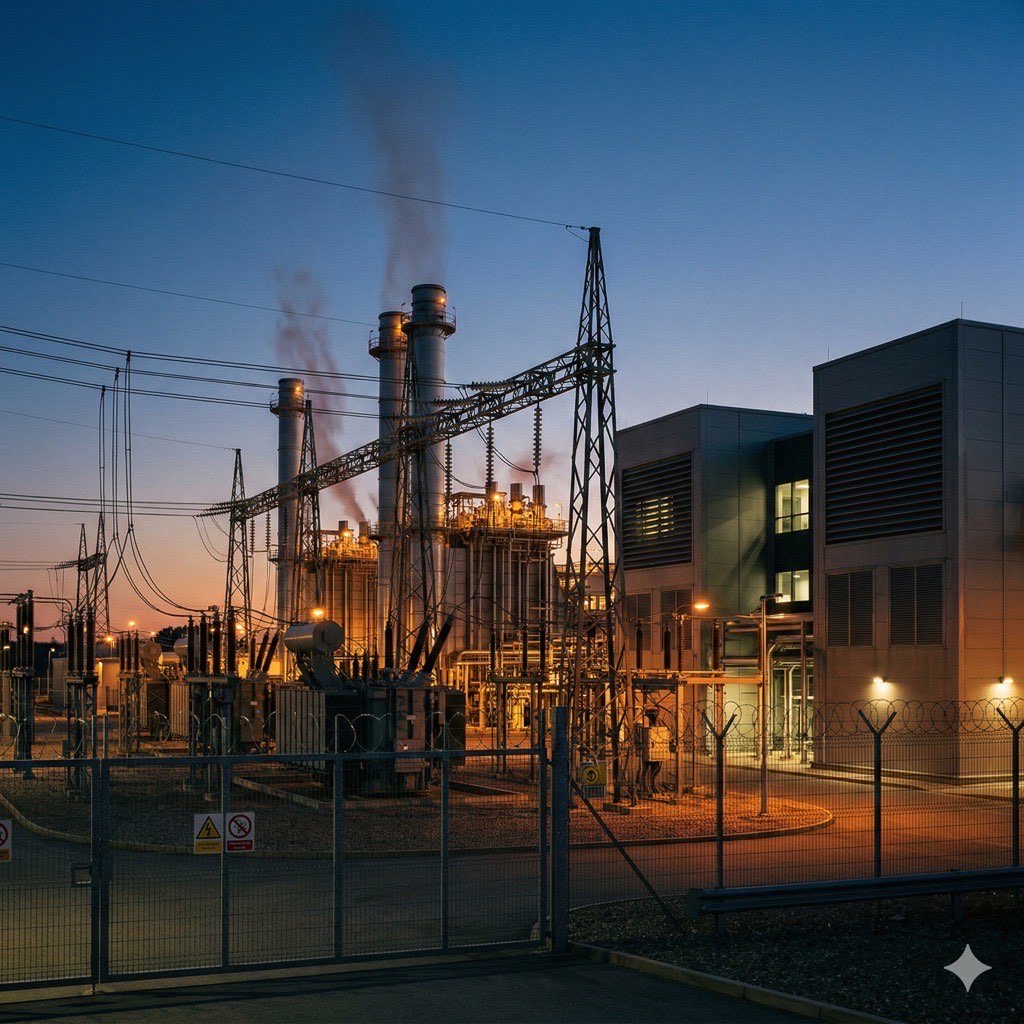
In the Permian Basin of West Texas, a project known as GW Ranch is taking shape on over 8,000 acres. Developed by Pacifico Energy, it is designed to deliver 5 gigawatts of off-grid power at full build-out — enough to rival the electricity consumption of a mid-sized country. Not a single watt will flow through the public grid. Instead, the facility will generate its own electricity from on-site natural gas turbines and solar, operating entirely “behind the meter,” largely invisible to regulators, grid operators, and the surrounding communities.
GW Ranch is not an anomaly. It is the most visible manifestation of a profound shift in how the world’s largest technology companies procure energy. As artificial intelligence workloads have sent data center power demand into exponential growth, hyperscalers have concluded that the public electric grid cannot deliver power fast enough, reliably enough, or cheaply enough to meet their needs. Their solution: build a shadow power grid of their own.
According to Cleanview, a data analytics firm tracking the energy transition, at least 46 behind-the-meter data center power projects with a combined capacity of 56 gigawatts have been identified across the United States — either under construction or in advanced planning. These projects represent enough generation capacity to power entire countries, operating entirely outside the traditional utility framework. The companies behind them include Amazon Web Services, Google, Microsoft, Meta, and a growing roster of AI-focused hyperscalers racing to secure compute capacity.
The implications extend far beyond the technology sector. When the world’s wealthiest corporations build private energy infrastructure that bypasses public oversight, it raises fundamental questions about grid equity, environmental accountability, and the future of the utility model that has powered American prosperity for a century.
Why the Grid Cannot Keep Up
To understand why hyperscalers are going off-grid, you need to understand the scale of the problem they face. AI training and inference workloads have fundamentally altered the power profile of data centers. A single AI training cluster can consume 50 to 100 megawatts of continuous power. The largest planned AI campuses envision power envelopes exceeding one gigawatt — more than a nuclear power plant produces.
The traditional process for connecting a large load to the electric grid involves years of planning, environmental review, permitting, and infrastructure construction. A new transmission line can take seven to twelve years from proposal to energization. A new substation might take three to five years. Even upgrading an existing interconnection to handle more capacity requires 18 to 36 months of utility engineering and construction. Year over year, interconnection requests for gas generators have jumped nearly 160%, overwhelming the queue.
Hyperscalers operate on a fundamentally different timeline. In the AI arms race, being six months late to deploy a training cluster can mean billions of dollars in competitive disadvantage. When a company like Microsoft or Google identifies a site for a new data center campus, they need power available in 12 to 18 months, not five to ten years.
Behind-the-meter generation solves this timeline problem. A natural gas turbine installation can be designed, permitted, constructed, and commissioned in 18 to 24 months. Because the power never enters the public grid, it avoids most of the regulatory approvals, interconnection studies, and environmental reviews that govern grid-connected generation. The hyperscaler builds the power plant, builds the data center, connects them with a short private cable, and begins operations — all without waiting for the grid to catch up.
The economics are equally compelling. Wholesale electricity prices in major data center markets have been rising as demand outpaces supply. In the PJM Interconnection region (covering the Mid-Atlantic, including Northern Virginia — the world’s largest data center market), the grid operator is now paying $14.7 billion for power in the 2025/26 delivery year, compared to $2.2 billion the year before. Behind-the-meter generation, particularly from efficient combined-cycle natural gas turbines, can deliver electricity at a predictable, long-term cost that insulates the operator from this grid price volatility.
The Scale of the Shadow Grid
The scope of behind-the-meter data center power development is staggering. The 46 identified projects with 56 GW of combined capacity represent a conservative count — the actual number is likely higher, as many projects are developed under shell companies and limited liability structures that obscure their connection to major technology firms.
In Texas, the epicenter of behind-the-meter development, projects benefit from the state’s deregulated energy market and ERCOT’s relatively permissive approach to large-load connections. GW Ranch alone represents a 5 GW commitment over its phased buildout, with 1 GW of natural gas power targeted for delivery by 2028 and full 5 GW capacity by 2030. The project also incorporates 1.8 GW of energy storage and on-site solar. Its air pollution permit, already issued by TCEQ, authorizes up to 12,000 tons per year of regulated air pollutants and 33 million tons per year of greenhouse gases — equivalent to nearly 5% of Canada’s total annual emissions.
Meta’s under-construction data center in El Paso, Texas, is another landmark project: a 1 GW facility powered behind-the-meter by a 366 MW array of 813 modular natural gas generators, slated to come online by 2027. The modular approach — deploying hundreds of smaller units rather than a few large turbines — enables faster deployment and more flexible scaling.
The fuel of choice is overwhelmingly natural gas. Despite corporate commitments to carbon neutrality and renewable energy, the physics of AI data centers favor dispatchable, high-density generation. Solar and wind cannot provide the 24/7, 99.999% reliable power that data centers require without massive — and currently uneconomical — battery storage. Nuclear power, while ideal in many respects, faces even longer development timelines than grid transmission. Natural gas turbines, particularly modern combined-cycle configurations achieving 60% or greater thermal efficiency, provide the density, reliability, and rapid deployment that hyperscalers need.
Some projects incorporate partial renewable components. On-site solar arrays might provide daytime supplemental power, reducing gas consumption during peak solar hours. But the baseload generation for these facilities is fossil fuel, a fact that sits uneasily alongside the net-zero pledges that every major technology company has made.
If all planned new gas-fired power capacity worldwide starts operation in 2026, it could exceed the previous record of 100 GW added in 2002, according to the Global Energy Monitor. Globally, gas-fired power capacity in development rose 31% in 2025 alone, reaching a total of 1,047 GW — with data center demand as a primary driver.
The Nuclear Horizon: SMRs as the Long-Term Answer
A smaller but growing number of projects are exploring small modular nuclear reactors (SMRs) for behind-the-meter data center power. The appeal is obvious: carbon-free, always-on, high-density generation that matches the data center load profile perfectly.
NuScale Power holds the first NRC-certified SMR design, with each module generating 77 MWe and scalable plants reaching up to 924 MWe. In September 2025, NuScale announced a partnership with ENTRA1 Energy and the Tennessee Valley Authority for a 6 GW SMR deployment program. However, its keystone project in Romania has slipped to a 2033 start date, down from the originally planned 2030.
Oklo, backed by Sam Altman’s investment, has secured a master power agreement to supply up to 12 GW to data center giant Switch. In January 2026, Oklo and Meta signed an agreement to build a 1.2 GW nuclear power campus in Ohio, with early site work starting in 2026 and first-phase power production targeted for 2030. Oklo recently upsized its reactor design to 75 MWe to meet AI demand, though the company remains pre-revenue and is not expected to generate income until at least 2027.
The realistic timeline for operational SMRs powering data centers is 2028-2030 at the earliest, with most larger deployments expected in the 2030s. For the foreseeable future, behind-the-meter means behind-the-meter gas.
Advertisement
The Environmental Reckoning
The environmental implications of the shadow power grid are complex and, for the most part, troubling.
On one hand, modern combined-cycle natural gas turbines are among the most efficient fossil fuel generators available. They produce roughly half the carbon dioxide per kilowatt-hour of coal-fired power plants, and their emissions of criteria pollutants like sulfur dioxide and particulate matter are minimal.
On the other hand, the sheer scale of planned behind-the-meter generation represents a massive new source of fossil fuel emissions at precisely the moment when the global energy system needs to be decarbonizing rapidly. GW Ranch’s permitted 33 million tons per year of greenhouse gas emissions alone illustrates the magnitude. Each gigawatt of behind-the-meter gas capacity will emit millions of tons of carbon dioxide over its operational lifetime. These emissions may not appear in the hyperscalers’ Scope 1 or Scope 2 emissions reporting if the power plants are owned by third-party developers, creating an accounting loophole that could allow technology companies to claim clean energy progress while their actual energy consumption grows dirtier.
Water consumption is another environmental concern. Combined-cycle gas turbines require cooling water, and many behind-the-meter installations in water-stressed regions like West Texas will compete with agriculture and municipal use for scarce water resources. The cumulative water demand of dozens of multi-gigawatt power plants in arid regions is not trivial.
Local air quality impacts, while modest per facility, accumulate as projects cluster in favorable jurisdictions. Communities near behind-the-meter data center complexes may experience measurable increases in nitrogen oxide and volatile organic compound concentrations, particularly during periods of atmospheric inversion when pollutants fail to disperse. The Texas Observer has noted that GW Ranch received the country’s largest air pollution permit, raising alarm among local environmental groups.
Perhaps most troubling is the lack of transparency. Because behind-the-meter generation does not interface with the public grid, it is often exempt from the emissions reporting, environmental monitoring, and community notification requirements that apply to grid-connected power plants. The public may not know how much fuel these facilities consume, how much carbon they emit, or what local environmental impacts they produce.
Grid Equity and the Regulatory Backlash
The behind-the-meter trend raises profound questions about grid equity — who pays for the shared infrastructure that powers society.
The electric grid is a public good maintained through rates paid by all connected customers. When large industrial loads leave the grid, the fixed costs of maintaining transmission lines, substations, and distribution infrastructure must be spread across a smaller base of remaining customers. This is the “utility death spiral” that energy economists have long warned about: as large customers defect, rates rise for everyone else, prompting more defection, in a self-reinforcing cycle.
The equity implications are stark. A technology company worth trillions of dollars builds its own power plant to avoid grid costs. The small businesses, hospitals, schools, and homes in the surrounding community continue to pay grid rates that must now be higher to compensate for the lost load. In the PJM region, projected rate increases of up to 20% are being attributed in part to data center demand dynamics.
The regulatory backlash is now materializing at scale. In early 2026, more than 300 state data center legislation bills were filed across over 30 states in just six weeks — a dramatic shift from incentive-focused policies to regulatory oversight. At least 18 states have introduced bills creating special rate classes for large energy users.
Specific state actions illustrate the trend. Virginia enacted VA HB 2084, directing state regulators to create a special rate class for data centers. Texas passed legislation expanding oversight over large loads and requiring curtailment during grid emergencies. Minnesota mandated that infrastructure investments to serve large data center loads — including transmission and distribution upgrades — be directly allocated to those customers rather than socialized across residential ratepayers. Florida proposed requiring large-load customers to fund system upgrades triggered by their interconnection. Washington and Oregon are advancing legislation that explicitly requires data centers to pay for grid infrastructure upgrades their facilities necessitate.
At the federal level, FERC ordered the PJM Interconnection to reform its tariff for co-located generation and load in January 2026, addressing the specific scenario of behind-the-meter data center power. US Senator Elizabeth Warren sent letters to major data center companies demanding transparency on utility cost impacts. California signed ratepayer protection legislation specifically addressing data center energy costs.
Engineering Challenges and Reliability Questions
Building and operating private power plants at data center scale is not a trivial engineering challenge. Most technology companies have deep expertise in computing, networking, and software, but limited experience in power generation operations.
Gas turbine operations require specialized maintenance, fuel supply chain management, and environmental compliance expertise. A data center that depends on on-site generation for its primary power has no utility to call when equipment fails. Redundancy must be built into the generation fleet, with enough spare capacity to maintain operations during maintenance outages and unplanned equipment failures.
Fuel supply is another concern. Behind-the-meter gas plants need pipeline connections capable of delivering enormous volumes of natural gas continuously. MPLX, a major midstream operator, has begun providing dedicated natural gas infrastructure for behind-the-meter data center projects in Texas. In some locations, the gas pipeline infrastructure is no more available than the electric grid infrastructure, creating a chicken-and-egg problem. Several planned projects have required construction of dedicated gas pipelines, adding cost and timeline.
The intersection of power generation and data center operations creates novel failure modes. A data center connected to the grid can survive a local power disruption by drawing from the broader grid and its backup generators. A data center dependent on on-site generation must manage all contingencies internally, from fuel supply disruptions to turbine failures to environmental events that might affect generation capacity. Meta’s choice of 813 modular gas units rather than a handful of large turbines in El Paso reflects one strategy for managing this risk — if a few units fail, the remainder can carry the load.
What Comes Next: Regulation, Innovation, or Both
The shadow power grid phenomenon is still in its early stages, but the regulatory and technological response is now accelerating on multiple fronts.
On the technology front, the development of commercially viable small modular nuclear reactors could transform the calculus within this decade. SMRs would provide the carbon-free, high-density, always-on power that data centers need without the emissions of natural gas. But the 2028-2030 earliest operational timeline means natural gas will dominate behind-the-meter generation for at least the next several years.
Advanced battery storage, particularly iron-air and other long-duration chemistries, could eventually make renewable-powered data centers viable without fossil fuel backup. However, the storage capacities needed for gigawatt-scale data centers with 99.999% reliability requirements are orders of magnitude beyond current deployments.
Regulatory response is already intensifying. The wave of 300+ state bills in early 2026, FERC’s tariff reforms, and Congressional scrutiny signal that the era of unregulated behind-the-meter data center power is ending. The question is whether regulation will be designed thoughtfully to balance innovation with equity, or whether it will become a patchwork of conflicting state rules that slows deployment without solving the underlying problems.
The technology industry’s credibility on clean energy is at stake. Companies that have built powerful brands around sustainability and climate leadership cannot indefinitely build gas-fired power plants at gigawatt scale without facing reputational and regulatory consequences. The resolution of this tension — between the urgent demand for AI compute power and the urgent need for decarbonization — will be one of the defining infrastructure challenges of the decade.
Advertisement
🧭 Decision Radar (Algeria Lens)
| Dimension | Assessment |
|---|---|
| Relevance for Algeria | Medium-High — Algeria is Africa’s largest natural gas producer and a major LNG exporter. The global trend of gas-powered data centers creates both a demand opportunity for Algerian gas exports and a cautionary lesson for domestic energy planning. As Algeria develops its own data center infrastructure, the behind-the-meter model offers a potential fast-track using domestic gas resources |
| Infrastructure Ready? | Partial — Algeria has abundant natural gas reserves and pipeline infrastructure (Sonatrach), but lacks the gas turbine manufacturing, combined-cycle plant construction expertise, and data center engineering capabilities needed for behind-the-meter deployments. Grid reliability issues in some regions could make on-site generation attractive for future Algerian data centers |
| Skills Available? | Partial — Algeria has petroleum engineering and power generation talent through Sonatrach and Sonelgaz, but limited intersection between power generation expertise and data center operations. This cross-disciplinary gap would need to be bridged through training or international partnerships |
| Action Timeline | 12-24 months — Monitor the US regulatory and environmental outcomes; begin feasibility studies if Algeria plans any large-scale data center projects above 10 MW. Algeria’s gas-to-power expertise via Sonelgaz could be repurposed for data center applications |
| Key Stakeholders | Sonatrach (gas supply), Sonelgaz (power generation), Ministry of Energy, Ministry of Digital Technology, Algerie Telecom, foreign hyperscaler partners evaluating North Africa locations |
| Decision Type | Strategic — Algeria could position itself as a natural gas-to-compute hub for AI infrastructure serving the Mediterranean and African markets, but only if it learns from the US experience on environmental and equity pitfalls |
Quick Take: The behind-the-meter data center trend is directly relevant to Algeria’s strategic interests as a gas-producing nation. While the US debate centers on environmental costs, Algeria could view this as a value-addition opportunity — converting gas domestically into compute services rather than exporting raw LNG, similar to how petrochemical nations moved up the value chain. However, Algeria must study the regulatory backlash now emerging in the US to avoid replicating grid equity and environmental problems domestically.
Sources & Further Reading
- Betting Big on Data Centers, U.S. Now Leads World for New Gas Power Development — Global Energy Monitor
- Data Center Developers Turn to Distributed Behind-the-Meter Power — S&P Global
- Meta to Deploy 366MW of Modular Gas Units to Power 1GW Data Center in El Paso — Datacenter Dynamics
- Pacifico Energy Unveils 5GW Off-Grid Natural Gas Project in Texas — Datacenter Dynamics
- State Data Center Legislation in 2026 Tackles Energy and Tax Issues — MultiState
- With Electricity Bills Rising, Some States Consider New Data Center Laws — Stateline
- Data Centers Are Scrambling to Power the AI Boom with Natural Gas — Grist
🔗 Related Intelligence

Nuclear-Powered Data Centers: Microsoft, Google, and the AI Energy Gamble
The Bare Metal Comeback: Why AI Workloads Are Leaving Virtual Machines

Green Cloud: How Hyperscalers Are (and Aren’t) Going Carbon Neutral
Shadow AI: The Silent Data Exfiltration Risk Inside Every Company






Advertisement