

The Experiment That Ran Itself
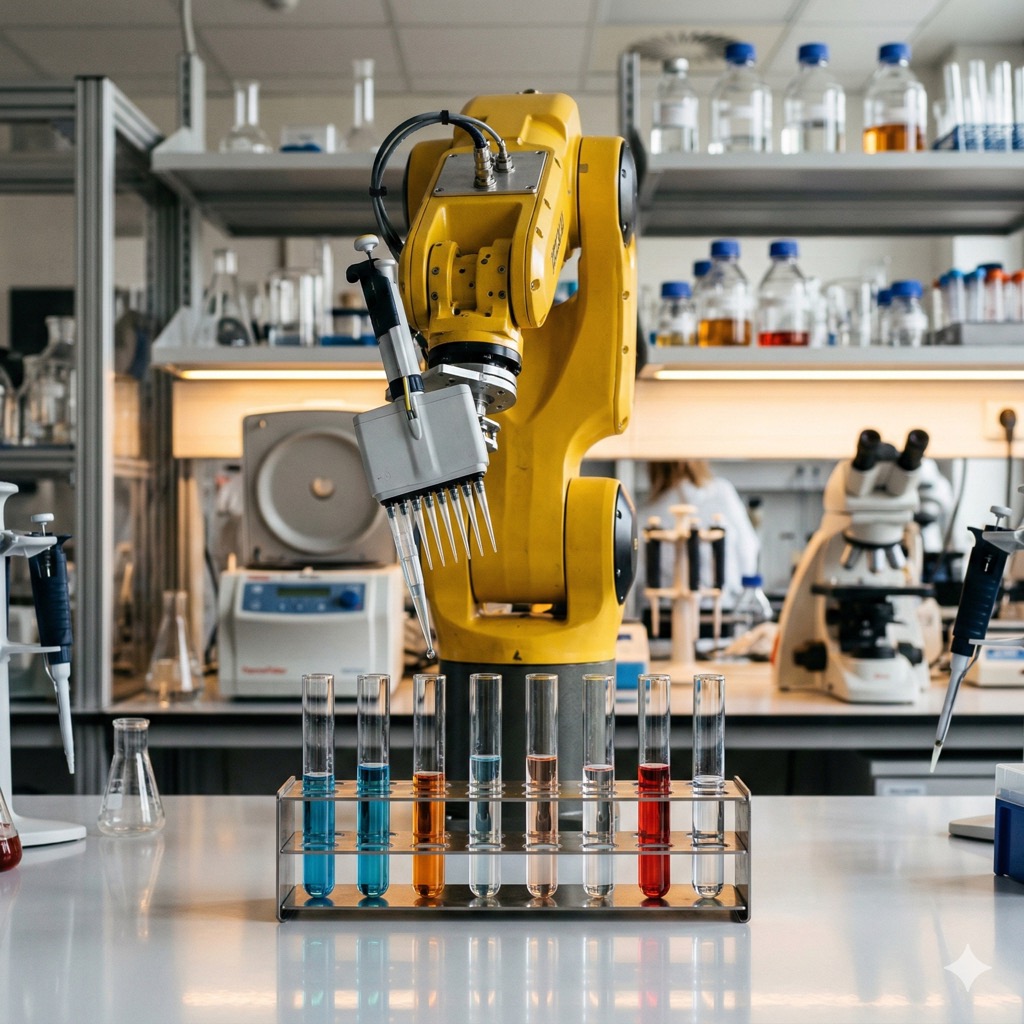
On February 5, 2026, Ginkgo Bioworks and OpenAI announced something that would have seemed like science fiction a decade ago: a fully autonomous laboratory system where GPT-5 designed its own experiments, executed them through robotic instruments, analyzed the results, and used those results to design the next round of experiments — all with minimal human intervention.
The system operated in the domain of cell-free protein synthesis (CFPS), a technique critical to pharmaceuticals, industrial chemistry, and synthetic biology. Over six rounds of closed-loop experimentation spanning six months, the autonomous lab tested more than 36,000 unique CFPS reaction compositions across 580 automated plates. The benchmark target was superfolder green fluorescent protein (sfGFP), a standard in the field. The system drove production costs down to $422 per gram of protein in total reaction component costs, compared to a previously reported state of the art of $698 per gram — a 40% reduction in production cost and a 57% improvement in reagent cost.
The system ran on Ginkgo’s cloud laboratory infrastructure, built from its reconfigurable automation carts (RAC) technology and Catalyst automation software, with GPT-5 handling the cognitive layer: data analysis, biochemical reasoning, hypothesis generation, and experimental design. Ginkgo is already selling the AI-improved cell-free reaction mix through its reagents store, signaling that the result is commercially viable rather than purely academic.
The Ginkgo/OpenAI collaboration was the highest-profile demonstration, but it was far from the only one. At the SLAS 2026 conference (Society for Laboratory Automation and Screening), held February 7-11 in Boston, autonomous lab demonstrations proliferated. ABB Robotics showcased its Autonomous Versatile Robotics (AVR) platform using GoFa collaborative robots in multi-step analytical workflows with partners Agilent and Mettler Toledo. Opentrons and NVIDIA announced a partnership leveraging NVIDIA Isaac and Cosmos platforms to develop physical AI for Opentrons’ global fleet of more than 10,000 deployed robotic systems. Three orchestration startups — Automata, UniteLabs, and Atinary — launched competing “Lab OS” platforms in the same week, each offering a different answer to who controls the software layer that coordinates hardware, models, and workflow decisions.
The message from the conference was unmistakable: the self-driving laboratory is no longer a research concept. It is an engineering reality, and its adoption is accelerating.
How Self-Driving Labs Actually Work
An autonomous laboratory integrates three capabilities that have individually matured but are now being combined into closed-loop systems. The first is robotic execution: automated instruments that can perform physical experimental operations — dispensing liquids, controlling temperatures, measuring outputs — with precision and speed that far exceed human capabilities.
The second is AI-driven experiment design. Machine learning models, trained on historical experimental data and scientific literature, generate hypotheses about which experimental conditions are most likely to yield useful results. These models use techniques from Bayesian optimization, active learning, and reinforcement learning to navigate the experimental search space efficiently, focusing resources on the most promising regions while maintaining enough exploration to discover unexpected results.
The third is automated data analysis. As experiments complete, their results are automatically processed, quality-checked, and fed back into the AI planning system. The system identifies patterns, updates its models, and generates the next batch of experiments. This closed-loop architecture means the lab operates continuously, with each experiment informing the next, and no human bottleneck between results and planning.
The Ginkgo/OpenAI system integrated these components into what the researchers described as an “agentic scientific workflow.” GPT-5 maintained an internal model of the experimental search space, tracked which regions had been explored, identified the most informative next experiments, and communicated instructions to the robotic system in the form of standardized experimental protocols. The system included strict programmatic validation before any experiment ran, preventing “paper experiments” that cannot be carried out in a robotic workflow. The agent could also recognize when experimental results were anomalous — indicating either a genuine discovery or an instrument malfunction — and adjust its behavior accordingly.
What distinguished the Ginkgo/OpenAI approach from earlier autonomous lab systems was the sophistication of the AI planning component. Previous systems used relatively simple optimization algorithms. GPT-5 employed large language model reasoning capabilities to contextualize experimental results within broader scientific knowledge, generate natural-language hypotheses about underlying mechanisms, and design experiments that tested those hypotheses rather than simply optimizing a single objective function. Notably, the model proposed and prioritized new reagents to test, some of which independently anticipated findings from published research it had not been given access to.
The Scale Advantage
The most striking aspect of autonomous lab systems is the sheer scale of experimentation they enable. Traditional scientific research is constrained by the throughput of human researchers. A skilled bench scientist might design and execute 10-20 experiments per day, carefully recording results and planning the next steps. An autonomous system can run thousands of experiments per day, limited only by the speed of the robotic instruments and the time required for each individual measurement.
This scale difference is not merely incremental — it is transformative. Many scientific problems are fundamentally about search: finding the right combination of variables in a vast space of possibilities. In protein engineering, the space of possible amino acid sequences for even a modest protein is astronomically large. In materials science, the combinations of elements, processing conditions, and structures are effectively infinite. In drug discovery, the number of potential molecular candidates dwarfs what any team of human chemists could evaluate in a lifetime.
For these search-dominated problems, autonomous labs offer a qualitative rather than quantitative advantage. They do not simply do the same science faster — they enable a different kind of science. Where human researchers must rely on intuition, prior knowledge, and educated guesses to focus their efforts on a tiny fraction of the search space, autonomous systems can explore the space systematically and comprehensively.
The Ginkgo/OpenAI results illustrated this advantage concretely. The 36,000 reaction compositions tested represented a search coverage that would have taken a team of human scientists months or years to achieve. Several of the protein synthesis configurations identified by the system showed properties that the researchers described as unexpected — combinations that no human expert would have prioritized based on existing knowledge, but that the systematic search revealed as highly effective. GPT-5 took just three rounds of experimentation to establish a new state of the art for the benchmark.
Advertisement
The Pushback from the Scientific Community
Not everyone in the scientific community is celebrating the rise of autonomous labs. The pushback falls into several categories, some practical and some philosophical. Nature’s February 2026 article “Will self-driving ‘robot labs’ replace biologists?” captured the debate vividly.
The practical concerns center on reliability and reproducibility. Autonomous systems generate data at rates that make human quality checking infeasible. If the robotic instruments malfunction, produce systematic errors, or drift in calibration, the AI planning system may build on flawed data, leading to unreliable conclusions. Several researchers have pointed out that the history of high-throughput screening is littered with examples of false positives and irreproducible results, and that fully autonomous systems may exacerbate these problems by removing the human judgment that catches anomalies.
There are also concerns about the nature of the science that autonomous labs produce. Traditional scientific research is not just about generating data — it is about understanding. A human scientist who designs an experiment based on a mechanistic hypothesis is building a conceptual model of how nature works. An AI system that optimizes an objective function may find effective solutions without understanding why they work. Some researchers worry that autonomous labs will produce a glut of empirical results without the theoretical understanding needed to generalize those results to new contexts.
The philosophical concerns go deeper. If AI systems can design and execute experiments more efficiently than human scientists, what role remains for the human researcher? Defenders of the technology point out that while GPT-5 played a clear role in the Ginkgo experiments, the scientific direction and objective were conceived by humans who brainstormed which problems should be tackled. Humans remain essential for picking the scientific questions. Others see autonomous labs as a step toward the automation of scientific discovery itself, with implications for employment, training, and the culture of science that are difficult to predict.
The Employment Question
The employment implications of autonomous labs are significant and politically sensitive. Laboratory science is a major employer of highly educated workers. In the United States alone, there are approximately 83,000 biological technicians and 57,000 chemical technicians — roughly 140,000 workers combined who perform the kind of experimental work that autonomous systems are designed to augment or replace. Graduate students and postdoctoral researchers, who perform much of the benchwork in academic labs, could see their roles fundamentally redefined.
The optimistic view is that autonomous labs will shift employment rather than reduce it. As routine experimental execution becomes automated, demand will increase for the skills needed to build, maintain, and direct autonomous systems — programming, data science, robotics engineering, and scientific domain expertise at the highest levels. The total number of jobs in scientific research may even increase if autonomous labs dramatically expand the volume of science that gets done.
The pessimistic view notes that the new jobs require different and often more advanced skills than the jobs they replace. A laboratory technician skilled at manual pipetting and cell culture may not easily transition to programming robotic systems or training machine learning models. The mismatch between displaced skills and demanded skills could create a painful transition period, particularly in regions and institutions with less access to retraining resources.
What Comes Next
The autonomous lab revolution is still in its early stages, but the trajectory is clear. The technology works, the economics are favorable, and the leading research institutions and biotechnology companies are investing aggressively in autonomous capabilities.
In the near term, expect autonomous labs to become standard in high-throughput domains like drug discovery, materials science, and synthetic biology — fields where the value of exhaustive search is high and the experimental protocols are well-established enough to automate. Pharmaceutical companies are already deploying autonomous screening systems, and several major materials science initiatives have adopted closed-loop autonomous approaches. A 2025 Royal Society Open Science review documented how today’s most capable self-driving labs automate nearly the entire scientific method, from hypothesis generation through experimental execution to drawing conclusions.
In the medium term, the technology will expand into domains that currently require more human judgment: organic synthesis, biological assays with complex readouts, and multi-step experimental workflows. Advances in robotic dexterity, AI planning sophistication, and sensor technology will progressively expand the range of experiments that can be fully automated. The “Lab OS wars” that erupted at SLAS 2026 — with multiple competing platforms vying to become the operating system for autonomous labs — suggest that the infrastructure layer is maturing rapidly.
The long-term vision — articulated by researchers at several SLAS 2026 presentations — is what some are calling “self-driving science”: AI systems that not only execute experiments but formulate research questions, design experimental programs, and advance scientific understanding autonomously. Whether that vision is achievable, and whether it is desirable, is a question that the scientific community is only beginning to grapple with. What is no longer in question is that the self-driving lab is here, and it is already changing how science is done.
Advertisement
🧭 Decision Radar (Algeria Lens)
| Dimension | Assessment |
|---|---|
| Relevance for Algeria | Medium — Algeria’s pharmaceutical and petrochemical sectors could benefit from autonomous lab adoption, but current R&D infrastructure is limited |
| Infrastructure Ready? | No — Algeria lacks the cloud lab infrastructure, high-throughput robotic platforms, and reliable high-speed connectivity that autonomous labs require |
| Skills Available? | Partial — Algerian universities produce capable scientists and engineers, but the intersection of robotics, AI/ML, and laboratory science is a niche skill set not widely taught |
| Action Timeline | 12-24 months — Monitor developments and invest in foundational skills; direct autonomous lab adoption is a 5+ year horizon for Algerian institutions |
| Key Stakeholders | DGRSDT (research directorate), Sonatrach R&D, pharmaceutical companies (Saidal, Biopharm), university research labs, Ministry of Higher Education |
| Decision Type | Educational — Understand the technology trajectory and begin preparing workforce skills |
Quick Take: Self-driving labs are reshaping how science is done in wealthy nations, and Algeria should track this trend closely. The immediate priority is not building autonomous labs but investing in the foundational skills — data science, robotics, and AI-driven experiment design — that will be prerequisites when the technology becomes accessible to developing-country institutions. Algerian researchers partnering with international autonomous lab consortia could accelerate readiness.
Sources & Further Reading
- GPT-5 Lowers the Cost of Cell-Free Protein Synthesis — OpenAI
- Ginkgo Bioworks Autonomous Lab Achieves 40% Improvement — PR Newswire
- Using a GPT-5-Driven Autonomous Lab to Optimize Cell-Free Protein Synthesis — bioRxiv
- Will Self-Driving Robot Labs Replace Biologists? — Nature
- The Lab OS Wars: 15 Companies Vying to Enable AI-Enabled Labs at SLAS 2026 — RD World
- ABB Showcases AI-Powered Lab Automation at SLAS 2026 — Robotics and Automation News
- Opentrons Accelerates AI-Based Laboratory Robotics with NVIDIA — Opentrons
- Autonomous Self-Driving Laboratories: A Review — Royal Society Open Science
🔗 Related Intelligence

Robotics Foundation Models: The Real Breakthrough Is Software, Not Hardware
The Humanoid Robot Race: How AI Is Powering the Next Generation of Physical Automation
Self-Evolving AI Agents: The Group Intelligence Breakthrough
The $19 Billion Month: Physical AI and Autonomous Systems Hit Escape Velocity






Advertisement