The End of DIY DevOps
Platform engineering has crossed from experiment to enterprise standard. Gartner forecasts that 80% of large engineering organizations will establish platform teams by 2026, up from 45% in 2022. By 2028, 85% of those platform teams will provide Internal Developer Portals (IDPs), according to Gartner’s Market Guide for Internal Developer Portals.
The driving force is not abstract efficiency gains — it is a concrete problem that every engineering organization has been unable to solve through cultural initiatives alone: cognitive load. As cloud-native architectures grow more complex, developers spend increasing amounts of time navigating infrastructure tooling, reading tribal documentation, and troubleshooting deployment configurations instead of writing application code.
Platform Engineering Day at KubeCon Europe 2026 marked the discipline’s arrival as an established practice, with platform engineering recognized as the organizing principle for how modern companies deliver software.
What Internal Developer Portals Actually Solve
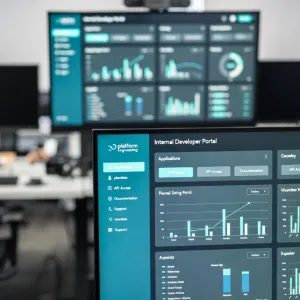
An IDP is a self-service layer that sits between developers and the underlying infrastructure. Instead of requiring every developer to become an expert in Kubernetes, cloud networking, security policies, and CI/CD pipeline configuration, the platform team abstracts this complexity into standardized, self-service workflows.
The measurable impact is significant. According to platform engineering metrics research, a fintech startup reduced its onboarding time from three days to two hours by implementing a self-service platform with pre-configured environments, automated dependency management, and embedded documentation. The same implementation produced a 30% reduction in configuration-related incidents.
DORA research confirms that organizations embedding platform engineering practices correlate with elite performance across all four DORA metrics: deployment frequency, lead time for changes, change failure rate, and time to restore service. Beyond DORA, the key metrics proving platform value include time to first deploy, onboarding duration, platform adoption rates, and the frequency of manual interventions.
Advertisement
The Backstage Dominance
The IDP market has a clear leader. Backstage, originally built by Spotify and now a CNCF incubating project, holds approximately 89% market share among organizations that have adopted an IDP. With over 100 public adopters listed and many more behind corporate firewalls, Backstage has become the de facto standard for developer portals.
Commercial alternatives are gaining ground, though from a much smaller base. Port has captured approximately 8% of the market, while Cortex holds about 5%. Other players including Humanitec, OpsLevel, and Roadie compete for share, often positioning themselves as managed alternatives that reduce the operational burden of running Backstage in-house.
A notable trend in 2026 is the shift away from purely self-hosted Backstage implementations. Roadie’s analysis argues that “DIY is dead” for platform engineering, noting that the operational cost of maintaining a custom Backstage deployment often exceeds the cost of using a managed platform. This mirrors the broader cloud-native pattern where open-source tools gain dominance, then managed services capture the market for organizations that cannot justify dedicated platform operations teams.
The Build vs. Buy Calculus
For engineering leaders evaluating platform engineering adoption, the build-versus-buy decision remains the primary strategic question. The Platform Engineering Cost Calculator estimates that a fully staffed internal platform team costs between $500,000 and $1.5 million annually when factoring in engineer salaries, infrastructure, and opportunity cost — before producing a single developer-facing feature.
Managed IDP providers offer a faster path to value, typically measured in weeks rather than quarters. However, they trade customization for speed and lock organizations into a vendor’s roadmap. The Backstage ecosystem’s plugin architecture offers a middle ground: organizations can start with the open-source framework and extend it with custom plugins, but they bear the operational burden.
The determining factors usually come down to organizational scale and engineering culture. Companies with fewer than 200 developers rarely justify a custom build. Companies with more than 500 developers often need customization that managed providers cannot deliver. The 200-500 developer range is where the decision is genuinely difficult.
The Developer Resistance Problem
Despite strong top-down adoption momentum, 45.3% of organizations report developer resistance as their primary barrier to platform engineering success. Developers who have built expertise navigating existing infrastructure may view the platform as constraining their autonomy or as an abstraction that hides important operational details.
Successful platform teams treat their internal developers as customers, not subordinates. This means measuring adoption through voluntary usage metrics rather than mandates, iterating on developer feedback loops, and ensuring the platform’s self-service workflows genuinely reduce friction rather than merely relocating it.
Frequently Asked Questions
What is an Internal Developer Portal and how does it differ from a CI/CD pipeline?
An Internal Developer Portal (IDP) is a self-service layer that gives developers a single interface to discover services, provision infrastructure, deploy code, and access documentation. Unlike a CI/CD pipeline, which automates the build-test-deploy process for a specific application, an IDP abstracts the entire developer experience across all services and infrastructure. Backstage, with 89% market share, is the most widely adopted IDP.
Why does Gartner predict 80% of large organizations will adopt platform engineering by 2026?
As cloud-native architectures grow more complex, developers spend increasing time navigating infrastructure instead of writing code. Platform engineering solves this by abstracting complexity into standardized, self-service workflows. Measurable results include reduced onboarding time (one fintech reduced from three days to two hours), 30% fewer configuration incidents, and correlation with elite DORA metrics performance.
Should a development team build or buy their Internal Developer Portal?
Companies with fewer than 200 developers rarely justify custom builds due to the $500K-$1.5M annual cost of a platform team. Companies with more than 500 developers often need customization beyond what managed providers offer. In the 200-500 range, the decision depends on engineering culture and willingness to manage operational overhead. Managed options like Port, Cortex, and Roadie offer faster time-to-value but less customization.
Sources & Further Reading
- Unlock Infrastructure Efficiency with Platform Engineering — Gartner
- Platform Engineering in 2026: Why DIY Is Dead — Roadie
- Port vs Backstage vs Cortex: Developer Portal Comparison 2026 — Tasrie IT
- The Metrics That Prove Platform Engineering Delivers Value — Platform Engineering
- DORA Capabilities: Platform Engineering — DORA
- Platform Engineering Has Left the Lab — WebProNews