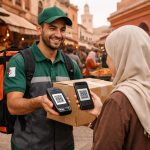
Five years ago, hailing a cab in Algiers meant standing on a street corner, negotiating a fare in the summer heat, and hoping the driver actually knew the route. Today, millions of Algerians tap a screen, watch a car icon glide toward their pin, and pay a pre-set price. That transformation — driven primarily by Yassir — was only the opening act. Algeria’s on-demand economy is now pushing into food delivery, grocery logistics, home repairs, tutoring, and professional freelance services, reshaping daily commerce in a country of 47.1 million people and 36.2 million internet users.
This article maps the full on-demand services ecosystem in Algeria as of early 2026: who the key players are, where the money flows, what structural barriers remain, and how the market compares to regional peers in Egypt and Morocco.
The Foundation: Ride-Hailing as Market Educator
Before anything else could be delivered on-demand, Algerians had to learn the basic behavior: open an app, request a service, wait for a match, and pay. Ride-hailing provided that education at massive scale.
Yassir: The Undisputed Market Leader
Founded in 2017 by Noureddine Tayebi and El Mahdi Yettou, Yassir has grown from an Algiers ride-hailing startup into a multi-vertical super app operating across North Africa, West Africa, and parts of Europe and Canada. The company was the first Algerian startup accepted into Y Combinator. Tayebi, a Stanford PhD in electrical engineering who worked at Intel’s R&D laboratory in Silicon Valley, brought deep technical credibility; Yettou, a graduate of the National Polytechnique School of Algiers and France’s National Superior School of Aeronautics and Space, brought engineering rigor.
Yassir raised $150 million in Series B funding in November 2022, led by Bond (Mary Meeker’s firm), bringing total funding to approximately $200 million. The company reported $225.9 million in revenue in 2024, operates across 45+ cities in six countries, and boasts over 8 million users and 100,000+ drivers globally.
In Algeria specifically, Yassir dominates urban transportation in Algiers, Oran, Constantine, Annaba, and Setif. Sensor Tower data from Q1 2025 shows Yassir’s weekly downloads in Algeria peaking at around 64,000, with active users rising from approximately 1.3 million to 1.6 million over the quarter. More importantly, Yassir normalized three behaviors that underpin the entire on-demand economy:
- App-based service requests — training users to trust digital intermediaries
- Driver/provider ratings — introducing accountability where informal markets had none
- Digital payment acceptance — gradually shifting users from cash-only mindsets toward CIB and Edahabia card payments, supported by Yassir Cash, the company’s digital wallet backed by over 5,000 agents nationwide
TemTem: The Super-App Challenger
TemTem, another Algerian-born platform founded in 2017 by Kamel Haddar, has carved out a significant position in the market. Having raised $5.7 million in total funding ($1.7 million seed plus a $4 million Series A from Tell Venture Automotive and other investors), TemTem now operates in 21 of Algeria’s 48 wilayas with over 200,000 clients and 4,000+ drivers.
What sets TemTem apart is its ambitious super-app vision. TemTem One, launched in October 2020, bundles ride-hailing, carpooling, e-commerce, home delivery, home healthcare, home-fixing services, and a unique “Diaspora” feature that lets Algerians living abroad purchase goods and services for family back home — delivered within hours. The platform has secured partnerships with major retail brands including Adidas, Puma, Huawei, Ooredoo, and Decathlon.
InDrive: The Price-Negotiation Alternative
InDrive, the Russian-founded global platform, entered Algeria with a differentiated model: passengers propose their price, and drivers accept or counter-offer. This “negotiation” mechanic resonated in a culture where haggling over taxi fares is second nature. Sensor Tower Q1 2025 data shows InDrive reached approximately 461,000 active users in Algeria with weekly downloads peaking at 58,000 in late February — significant traction, though well behind Yassir’s 1.6 million active users.
iTAXI: Digitizing the Traditional Sector
A fourth player worth noting is iTAXI, which operates primarily in Algiers, Oran, and Constantine. Rather than disrupting traditional taxis, iTAXI digitizes them — connecting users to licensed taxi drivers via a minimalist app at official regulated fares (averaging $2-4 per ride). The platform appeals to older demographics, families, and professionals who prefer the predictability of regulated pricing.
Together, these four platforms have created a ride-hailing ecosystem that serves as the on-ramp for every other on-demand vertical.
Food Delivery: The Second Wave
Once Algerians were comfortable ordering rides through an app, food delivery was the natural next step. But the path has been bumpier than the ride-hailing journey.
Yassir Eat: Leveraging the Existing Network
Yassir’s expansion into food delivery through Yassir Eat was a textbook super-app play. With millions of existing users and a fleet of registered drivers, the marginal cost of adding food delivery was far lower than building from scratch. By 2025, Yassir Eat was active in Algiers, Oran, and Constantine, partnering with hundreds of restaurants ranging from fast-food chains to local favorites.
The economics are challenging, however. Average order values in Algeria remain lower than in Gulf states or European markets — a typical meal order runs DZD 1,500 to DZD 3,000 ($10-20 at parallel market rates). Delivery fees that feel reasonable on a $40 order in Paris feel punishing on a $12 order in Algiers. Yassir has experimented with subsidized delivery, free-delivery promotions, and subscription models to drive order frequency.
Jumia’s Exit and the Gap It Left
Jumia, the pan-African e-commerce giant, fully exited Algeria in Q1 2026 as part of a strategic profitability push — having also withdrawn from South Africa and Tunisia. Algeria had accounted for approximately 2% of Jumia’s gross merchandise value, but challenges including restrictive trade policies, import controls, and the cash-heavy economy made unit economics difficult to sustain.
Jumia’s experience illustrated a key challenge that persists: restaurant onboarding. Many Algerian restaurants lack digital menus, standardized pricing, or even reliable phone lines, let alone POS integration. The operational overhead of photographing menus, negotiating commission rates, and managing refunds for incorrect orders proved expensive relative to order volumes.
Jumia’s departure left a vacuum that Yassir Eat and smaller local players are racing to fill. As one industry analyst noted, Yassir’s subsequent acquisition of Uno hypermarkets was partly designed to fill “the Jumia-shaped hole” in Algerian e-commerce.
Emerging Local Platforms and Cloud Kitchens
Several smaller Algerian startups are targeting food delivery in niche segments. Some focus exclusively on fast food and street food — the most ordered categories — keeping restaurant counts small but delivery times fast. Others are experimenting with cloud kitchen models, where delivery-only kitchens produce food for multiple virtual brands, reducing overhead.
The cloud kitchen model is particularly interesting for Algeria, where commercial real estate in prime dining locations is expensive. Algeria’s cloud kitchen segment already reaches an estimated 1.5 million users, according to industry data, and the broader Middle East and Africa cloud kitchen market is projected to grow from $427 million in 2024 to $1.07 billion by 2030. A cloud kitchen in an Algerian industrial zone can serve the same delivery radius at a fraction of the rent, though the concept remains in its early stages locally.
Grocery and Retail Delivery: The Yassir Market Gambit
From Yassir Express to Uno Acquisition
The most dramatic development in Algeria’s on-demand economy in 2026 has been Yassir’s acquisition of the Uno hypermarket chain from industrial conglomerate Cevital. Uno, established in 2007, operates 23 outlets across Algeria — five hypermarkets, one supermarket, sixteen motorway-adjacent stores, and one convenience shop.
Yassir plans to rebrand these stores as “Yassir Market” and integrate its full digital ecosystem into the retail experience. The flagship location at the Bab Ezzouar shopping centre in Algiers is set to reopen during Ramadan 2026, featuring click-and-collect grocery fulfillment, in-store digital kiosks, and payment processing through Yassir Cash.
This acquisition represents a fundamental shift in strategy. Rather than building quick commerce logistics from scratch — the approach taken by Gorillas, Getir, and Gopuff in Europe — Yassir is acquiring existing physical retail infrastructure and layering digital capabilities on top. The product mix is being expanded to include premium goods, beauty corners, bakeries, fast food counters, and catering services.
Just five days after the Uno deal, Yassir also acquired Paris-based adtech firm Kawarizmi, which handles approximately 600 million monthly ad impressions. This move signals Yassir’s intention to build a retail media business — monetizing first-party consumer data from rides, food orders, and grocery purchases through programmatic advertising across EMEA.
The Quick Commerce Challenge
For users, the promise is compelling: order groceries, household supplies, and convenience items through the Yassir app with delivery within 30-60 minutes. In Algerian cities, this model addresses a real pain point. Grocery shopping typically means visiting multiple specialty shops — the vegetable market, the butcher, the bakery, the general store — a time-consuming errand.
The challenges are substantial. Grocery margins are razor-thin, cold-chain logistics for perishables are underdeveloped, and inventory management across thousands of SKUs from independent shops is operationally complex. But the Uno acquisition gives Yassir something its quick-commerce predecessors in Europe lacked: an existing supply chain, established supplier relationships, and physical locations that can double as fulfillment centers.
Home Services: The Untapped Opportunity
If ride-hailing is established and food delivery is growing, home services represent the next major frontier for Algeria’s on-demand economy. This category — plumbing, electrical work, cleaning, painting, appliance repair, tutoring — is enormous in terms of addressable market but deeply fragmented.
The Current Reality
Finding a reliable plumber in Algiers today typically involves one of three methods: asking neighbors for recommendations, posting in Facebook groups, or calling numbers from handwritten ads taped to building lobbies. Quality is unpredictable, pricing is opaque, scheduling is approximate (“I’ll come between 9 and 12”), and there is zero recourse if the work is substandard.
This is not unique to Algeria — it describes home services in most developing markets before platform intervention. But the opportunity is particularly large in Algeria because of the country’s massive housing stock. With millions of apartments in buildings ranging from French colonial-era structures to modern AADL social housing developments, maintenance demand is constant and growing.
TemTem’s Early Mover Position
TemTem One already includes home-fixing services (plumbing, electricians) and home healthcare within its super-app bundle. While neither service has reached the scale of its ride-hailing operations, TemTem’s existing user base of 200,000+ and its presence in 21 wilayas gives it a distribution advantage.
The typical platform model involves:
- Provider onboarding: Vetting and registering tradespeople, verifying qualifications where possible, collecting ID documents
- Service listing: Standardizing offerings (e.g., “kitchen faucet replacement” as a defined service with an estimated price range)
- Matching and scheduling: Connecting users with available providers based on location, availability, and ratings
- Payment and reviews: Processing payments (mostly COD initially) and collecting user feedback
The main obstacle is supply-side quality control. Unlike a ride-hailing driver who needs a car and a license, a plumber or electrician’s skill level is difficult to verify before the work is done. Platforms must invest heavily in vetting, training, and quality assurance — or risk their brand being associated with bad service.
Tutoring and Professional Services
The tutoring segment deserves special mention. Algeria’s education-obsessed culture, where BAC exam preparation generates an entire shadow economy of private tutoring, creates natural demand for an on-demand tutoring platform. Parents currently find tutors through word of mouth, and pricing varies wildly.
A platform that could match students with vetted tutors, standardize pricing, enable scheduling, and eventually support online tutoring sessions would address a market worth billions of dinars annually. Several small players are experimenting in this space, though none have broken out yet.
Payment Infrastructure: The Persistent Challenge
Every on-demand services discussion in Algeria eventually arrives at the payment question. Cash on delivery (COD) remains the dominant payment method across all verticals, creating operational headaches and economic inefficiencies.
The COD Problem
When a customer pays cash to a delivery driver, the platform must later collect that cash from the driver, typically through daily or weekly settlements at physical collection points. This creates:
- Float risk: Drivers holding platform cash between settlement cycles
- Operational overhead: Managing collection points, reconciliation, and disputes
- Working capital strain: Platforms paying restaurants/merchants before collecting from drivers
- Fraud opportunities: Drivers or customers disputing deliveries with no digital proof of payment
Digital Payment Progress
Algeria’s digital payment landscape has improved significantly in recent years. The numbers tell the story: Edahabia card circulation has grown from 6 million in 2020 to over 14.3 million by the end of 2024 — more than doubling in four years. Algerie Poste’s BaridiMob mobile payment app has surpassed 5 million downloads on Android alone, with transaction volumes increasing 24-fold and transaction values increasing 6-fold between 2020 and 2022.
CIB and Edahabia online transactions reached 1.78 million in Q1 2021, a 340% increase over Q1 2020. Mobile money operations hit 12.5 million in Q1 2024 alone. The trajectory is unmistakable, even if cash remains the default.
However, digital payment adoption varies dramatically by vertical and city. Ride-hailing users in Algiers are more likely to pay digitally than food delivery customers in Constantine. The shift is accelerating, but it will take years before cash becomes the minority payment method.
The Super-App Wallet Play
For on-demand platforms, the ideal scenario is a wallet that users top up once and spend across rides, food, groceries, and services. Yassir Cash, backed by its network of over 5,000 agents where users can deposit and withdraw funds, is building precisely this capability. With the Uno/Yassir Market acquisition adding physical retail to the ecosystem, Yassir Cash could become the default payment method across an increasingly wide range of daily transactions — potentially the most significant fintech development in Algeria’s consumer economy.
Advertisement
Regional Comparison: Egypt and Morocco
Egypt: Scale and Competition
Egypt’s on-demand economy is more mature than Algeria’s, reflecting its larger population (110 million), more developed venture capital ecosystem, and earlier startup culture. Key differences:
- Ride-hailing: Uber and Careem (now part of Uber) dominate, with Swvl having pioneered bus-hailing. Algeria’s market is more locally controlled — a notable advantage for domestic startups.
- Food delivery: Talabat (Delivery Hero) and Elmenus are major players alongside smaller locals. Competition is fierce, driving down prices but also margins.
- Digital payments: Egypt’s fintech sector is more advanced, with mobile wallets like Fawry and Vodafone Cash seeing mass adoption. This gives Egyptian platforms a payment advantage.
Morocco: Glovo’s Dominance Under Pressure
Morocco’s on-demand delivery market has been shaped significantly by Glovo, the Barcelona-based platform (now fully integrated under Delivery Hero) that invested heavily in the Moroccan market. Morocco is Glovo’s fourth-largest market globally, with over 6,500 business partners and 4,500 couriers.
However, Glovo Morocco faces headwinds. In 2025, the Moroccan Competition Council forced a settlement requiring Glovo to remove restaurant exclusivity clauses, cap commissions at 30%, and improve courier pay. In early 2026, all seven of Glovo’s dark stores in Morocco were suspended following an administrative order, though restaurant and retail delivery continues.
Morocco also benefits from deeper European integration — many Moroccan startups have dual Casablanca-Paris operations and access to European venture capital. This gives the Moroccan ecosystem a funding and talent advantage over Algeria’s.
Algeria’s Unique Position
Algeria’s on-demand market differs from both neighbors in several key ways:
- Larger population than Morocco (47.1M vs 37M), providing a bigger addressable market
- Lower foreign platform penetration — Uber never launched in Algeria, and Glovo has not entered, leaving the field to domestic players like Yassir and TemTem
- Stronger cash dependency — both Egypt and Morocco are further along in digital payment adoption
- Higher regulatory uncertainty — Algeria’s regulatory framework for gig economy platforms remains unclear
- Domestic champion advantage — Yassir’s $225.9 million revenue and Uno acquisition give Algeria a locally-controlled super app at a scale that neither Egypt nor Morocco has produced
Regulatory Gaps and Worker Protection
The gig economy in Algeria operates in a regulatory grey zone. Drivers, delivery workers, and service providers working through on-demand platforms are typically classified as independent contractors, not employees. This means:
- No social security coverage from the platform
- No minimum wage guarantees — earnings depend entirely on demand and pricing algorithms
- No workplace injury protection — a delivery driver injured in a traffic accident has no platform-provided coverage
- No collective bargaining — workers have no formal mechanism to negotiate terms
This is not unique to Algeria — gig worker classification is a global debate, from California’s Proposition 22 to the EU’s Platform Work Directive. Morocco’s Competition Council settlement with Glovo, which included guaranteed minimum hourly income for couriers, offers one model Algeria could study. But in Algeria, where social protection systems are heavily tied to formal employment, the gap is particularly stark. Millions of workers in the traditional informal economy already lack protections; the gig economy risks creating a new layer of digitally-intermediated informality.
The Algerian government has signaled interest in regulating ride-hailing and delivery platforms, but no comprehensive framework has been published as of early 2026.
Logistics and Infrastructure Constraints
Address System Deficiencies
Algeria’s incomplete address system remains a significant barrier for on-demand delivery services. Many residential areas, particularly in suburban and peri-urban zones, lack standardized street addresses. Delivery drivers often rely on phone calls to customers for final-mile navigation — “I’m near the mosque, which building are you in?”
Google Maps coverage has improved but remains imperfect, especially outside major cities. Some platforms have invested in proprietary mapping and landmark-based address systems, but this is expensive to build and maintain.
Road Infrastructure and Traffic
Algiers, Oran, and Constantine suffer from severe traffic congestion, particularly during peak hours. This directly impacts on-demand services: longer delivery times, higher driver costs, and lower customer satisfaction. For time-sensitive services like food delivery, a 15-minute delay can mean the difference between a repeat customer and a churned one.
Cold Chain and Storage
For grocery delivery, the absence of cold chain logistics infrastructure is a limiting factor. Perishable goods — meat, dairy, vegetables — require temperature-controlled storage and transport that most delivery fleets lack. This constrains the types of groceries that can be reliably delivered and limits expansion beyond packaged goods. Yassir’s acquisition of Uno’s physical stores may partly address this by providing temperature-controlled staging points closer to customers.
The Super-App Question
The global debate about super apps has particular relevance for Algeria. In Southeast Asia, Grab and GoTo have demonstrated the super-app model at scale. In the Middle East, Careem (pre-Uber acquisition) pursued a similar vision.
Both Yassir and TemTem are building toward super-app models, though at very different scales. Yassir, with $200 million in funding, 8 million users, a physical retail chain, an ad-tech acquisition, and a digital wallet with 5,000+ agents, has the most credible super-app play on the African continent. TemTem, with $5.7 million in funding but an impressively broad service bundle including diaspora payments, is pursuing a similar vision at a more modest scale.
Arguments for the super-app model in Algeria:
- User acquisition cost efficiency — one app serving multiple needs reduces per-vertical marketing costs
- Data advantages — understanding a user’s ride patterns, food preferences, and service needs enables better targeting and, with the Kawarizmi acquisition, monetization through retail media
- Payment wallet lock-in — a unified wallet like Yassir Cash increases switching costs
- Limited VC funding — in a market with constrained venture capital, the incumbent with the most users has a structural advantage
Arguments against:
- Execution complexity — being excellent at rides, food, groceries, and services simultaneously is extremely difficult
- Category-specific expertise — home services require deep trades knowledge that a ride-hailing company may lack
- Consumer preference — some users prefer best-in-class specialized apps over adequate-at-everything super apps
What Comes Next
Several trends will shape Algeria’s on-demand economy over the next 12-24 months:
Digital payment acceleration. As Edahabia card circulation pushes past 15 million and Yassir Cash scales through its retail network, the economics of on-demand services will improve. Every percentage point shift from COD to digital payment drops straight to the bottom line.
Yassir Market’s omnichannel test. The Uno-to-Yassir Market transformation during Ramadan 2026 is the single most important experiment in Algerian commerce this year. If click-and-collect, in-store kiosks, and Yassir Cash integration work seamlessly, it validates the physical-digital convergence model for the entire market.
Home services formalization. The first platform to crack quality-controlled home services at scale in Algeria will tap an enormous market. TemTem has an early lead with its home-fixing services, but significant investment in provider vetting and training is still needed.
B2B on-demand services. Beyond consumer-facing services, there is growing demand for on-demand B2B logistics — same-day delivery of spare parts, documents, and supplies between businesses.
Regulatory clarity. The government’s eventual regulatory framework will either accelerate or constrain growth, depending on how it balances worker protection with platform flexibility. Morocco’s Glovo settlement offers a template that Algerian regulators may study.
Post-Jumia e-commerce vacuum. Jumia’s Q1 2026 exit from Algeria creates an opening in online retail that Yassir Market, TemTem’s e-commerce vertical, and potentially new entrants will compete to fill.
The on-demand revolution in Algeria is still in its middle chapters. The ride-hailing foundation is solid, food delivery is growing rapidly, and the next frontiers — groceries, home services, professional services — are being explored by a new generation of entrepreneurs who understand that in a market of 47 million people with rising smartphone penetration and growing digital payment adoption, the opportunity is measured not in millions but in billions.
Frequently Asked Questions
What are the main on-demand service platforms in Algeria?
Yassir is the dominant player, operating ride-hailing, food delivery (Yassir Eat), grocery (Yassir Express/Yassir Market), and digital payments (Yassir Cash) with over 1.6 million active users in Algeria. TemTem operates a super app across 21 wilayas offering ride-hailing, e-commerce, home services, and diaspora payments. InDrive, with approximately 461,000 active users, offers a price-negotiation ride-hailing model. iTAXI serves licensed traditional taxis in major cities.
Why is cash on delivery still dominant in Algeria’s on-demand economy?
Despite strong growth in Edahabia cards (14.3 million in circulation by end of 2024) and BaridiMob (5 million+ downloads), Algeria’s digital payment infrastructure is still maturing. Consumer trust in digital payments is growing but not yet universal. Yassir Cash’s 5,000+ agent network and the upcoming Yassir Market retail integration may accelerate the transition, but cash remains the default for most transactions.
How does Algeria’s on-demand market compare to Morocco and Egypt?
Algeria has a larger population than Morocco (47.1M vs 37M) and a more domestically controlled market — neither Uber nor Glovo operates in Algeria. Egypt is more mature with higher foreign platform penetration and better digital payment adoption. Algeria’s unique advantage is the dominance of local champions, particularly Yassir, which at $225.9 million in revenue has built a super-app ecosystem rivaling anything in North Africa.
Sources & Further Reading
- Yassir Raises $150M Series B Led by Bond — TechCrunch
- Yassir Acquires Uno Hypermarkets to Expand Omnichannel Retail in Algeria — WeeTracker
- Yassir Acquires Kawarizmi to Accelerate Retail Media Expansion Across EMEA — Disrupt Africa
- Jumia to Exit Algerian Market as Part of Strategic Profitability Push — TechAfrica News
- 10 Ride-Hailing Apps Competing for North Africa’s Riders — WeeTracker
- TemTem One Super App Launch — Innovation Village
- Digital 2025: Algeria — DataReportal
- Q1 2025 Top 5 Carpooling and Ridesharing Apps in Algeria — Sensor Tower
- Exploring Local Payment Methods and Digital Finance in Algeria — TransFi
- GSMA Mobile Economy: Middle East and North Africa — GSMA
🔗 Related Intelligence

The COD Trap: How Cash on Delivery Is Strangling Algeria’s E-Commerce

Government IT Procurement in Algeria: How Technology Tenders Work and Why They Often Don’t

Algeria’s Digital Economy Law: What Tech Companies Need to Know in 2026

Algeria’s $400B GDP Target: How Much of the Vision Is Digital?