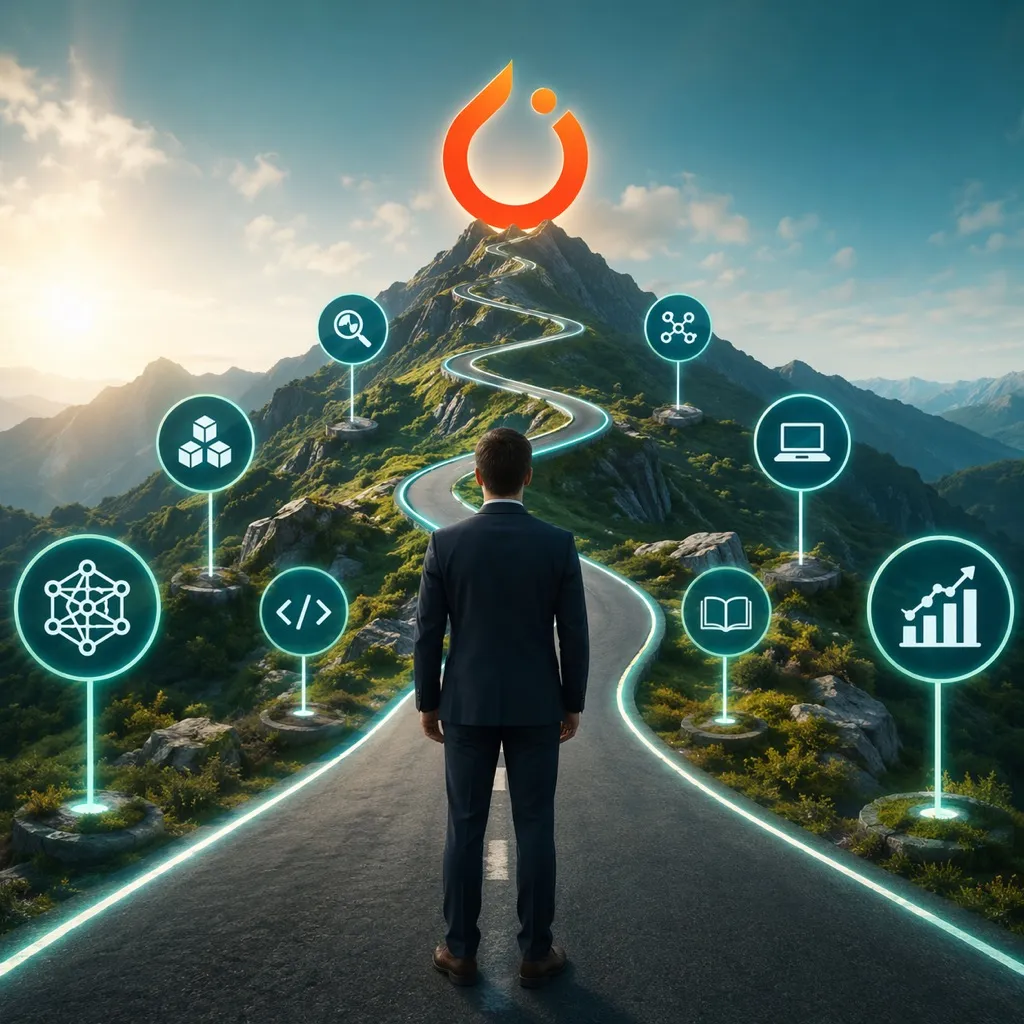
The Two Skills That Anchor Every High-Paid AI Engineering Role in 2026
If you are a working software engineer watching the AI labor market from the outside and trying to decide what to learn first, the 2026 data points to an unusually clear answer: deep PyTorch fluency and practical LLM fine-tuning experience. Every other high-value specialization — MLOps, RAG architectures, agent engineering, AI evaluations — sits on top of those two foundations. Start there and every adjacent skill compounds. Skip them and the rest stays theoretical.
The wage data tells the story. According to multiple 2026 compensation benchmarks, engineers skilled specifically in LLM fine-tuning earn $195,000–$250,000, or roughly 25-40% above the national software engineering median. PyTorch carries a 38% skill premium on top of that. Engineers who combine both PyTorch and TensorFlow earn 15-20% more than those who know only one. And across the industry, AI-skilled workers now command a 56% wage premium over their non-AI-skilled peers, according to PwC’s 2025 Global AI Jobs Barometer.
The good news is that the learning path is more accessible than it has ever been. The bad news is that the employer bar has also risen — “I watched a LangChain tutorial” is no longer enough.
Why Fine-Tuning Moved from Research Curio to Production Skill
Eighteen months ago, fine-tuning a large language model was a research-heavy exercise that required multi-GPU clusters, deep systems knowledge, and patient iteration. In 2026, it has moved decisively into production. Three developments did it.
The first is parameter-efficient fine-tuning (PEFT). Techniques like LoRA (Low-Rank Adaptation) inject small trainable matrices into a model’s attention layers, leaving the original weights frozen. Instead of updating billions of parameters, you train a fraction of a percent — typically 0.1%-1% — while retaining most of the adaptation benefit. The practical impact is enormous: fine-tuning runs that used to take days on eight GPUs now finish in hours on one.
The second is QLoRA, which combines LoRA with 4-bit quantization. The result is that 65B+ parameter models can be fine-tuned on a single consumer GPU such as an RTX 4090, or a single A100 in the cloud. What used to require a research lab’s infrastructure can now happen on a laptop in a coffee shop.
The third is tooling consolidation. Hugging Face’s TRL v1.0, released in April 2026, unified the post-training stack — Supervised Fine-Tuning (SFT), reward modeling, Direct Preference Optimization (DPO), and GRPO workflows — into a single library with native LoRA and QLoRA support. Combined with Unsloth kernels, training can run up to 2x faster with 70% less memory than earlier implementations. The friction between “reading a paper” and “shipping a production fine-tune” has effectively collapsed.
The 2026 Skill Roadmap: Sequencing Matters
The most common mistake engineers make pivoting into AI is trying to learn everything in parallel. Competency layers exist because later skills make no sense without earlier ones. Industry roadmaps consistently suggest a phased approach:
Months 0-3: PyTorch fundamentals. Get comfortable writing and debugging models from scratch. Build a CNN on CIFAR-10, a transformer on a small text dataset, a fine-tuned BERT for classification. The goal is not to produce something impressive — it is to internalize the training loop, backpropagation, and the mental model of how weights move.
Months 3-6: Fine-tuning with the modern stack. Once PyTorch feels natural, move to Hugging Face Transformers, PEFT, and TRL. Fine-tune a small open-weights model (Gemma, Llama 3.2, Mistral) using LoRA on a domain-specific dataset. Work through supervised fine-tuning and then Direct Preference Optimization. Practice deciding — with clear criteria — when to fine-tune versus when to use prompting, RAG, or few-shot examples instead.
Months 6-9: Deployment and MLOps. Learn how to serve fine-tuned models efficiently (vLLM, TGI, llama.cpp). Understand quantization for inference, batch scheduling, and observability. Build at least one end-to-end pipeline that goes from labeled data to an API-accessible fine-tuned model.
Months 9-12: Specialization. Choose one direction — RAG architectures, agent engineering, evaluations, or domain-specific applied AI — and go deep. By this point, you have the substrate to specialize meaningfully rather than superficially.
Most experienced software engineers can complete this transition in 75 intensive days if they can dedicate full-time effort, or 6-12 months part-time. The industry consensus is that 12-18 months produces a job-ready applied AI engineer, and 2-3 years produces a true expert.
Advertisement
The “When to Fine-Tune” Decision Framework
One of the most valuable skills in 2026 is knowing when not to fine-tune. Prompting, RAG, and structured few-shot examples solve most enterprise problems without the operational overhead of a custom model. Fine-tuning becomes the right call when at least one of the following is true:
- You need consistent format or style at scale — for example, legal document generation that must adhere to a precise structure every time.
- The task is highly specialized with substantial training data — medical coding, scientific terminology extraction, or niche domain classification.
- Prompt length is a cost or latency constraint — when the system prompt has become a multi-thousand-token wall, a fine-tuned model is often cheaper and faster.
- Privacy or data residency demands an on-premise model — fine-tuning an open-weights model gives you deployment control that closed APIs do not.
Engineers who can articulate these trade-offs convincingly in interviews tend to get offers. Engineers who default to “let’s fine-tune it” for every problem tend not to.
The Portfolio Over the Certificate
A theme that runs through every serious AI hiring report in 2026 is that demonstrated work has displaced credentials. PwC’s AI Jobs Barometer found that formal degree requirements fell 7 percentage points for AI-augmented jobs and 9 points for AI-automated jobs over the previous five years. Hiring managers increasingly want to see artifacts: a published fine-tune on Hugging Face, a benchmark repo on GitHub, a blog post walking through an evaluation you built, a small RAG system deployed for real users.
Three concrete portfolio pieces that tend to convert interviews:
- A fine-tuned open-weights model published on Hugging Face with a proper model card, a reproducible training script, and benchmark results on a relevant evaluation set.
- A domain-specific RAG system deployed as an API with observability and evaluation metrics, not just a demo notebook.
- A public write-up — blog post, paper, or talk — that explains a non-trivial decision you made (why this architecture, why this dataset, why this evaluation).
None of those require paid tooling. All of them require real work.
What This Means for the Pivot
The 2026 market rewards engineers who can go from a business requirement to a working fine-tuned model without waiting for a research team to do it for them. The tool stack — PyTorch, Hugging Face Transformers, PEFT, TRL, vLLM — is mature, open, and free to learn. The compensation premium is documented and growing. The bottleneck is not access to learning materials. It is the willingness to put in sequential, sustained effort over 6-12 months instead of chasing the next tutorial.
For software engineers considering the move, the sequencing is straightforward: PyTorch first, fine-tuning second, deployment third, specialization last. Follow that order, ship real artifacts, and the 40-45% wage premium stops being a statistic and starts being a salary number.
Frequently Asked Questions
Should I learn TensorFlow or PyTorch first?
PyTorch. It has won the applied research and production LLM space, and the 2026 tool stack (Hugging Face Transformers, PEFT, TRL, vLLM) is PyTorch-native. Engineers who combine both earn 15-20% more than those who know only one, but PyTorch alone is the faster route to employability.
When should I fine-tune instead of using prompting or RAG?
Fine-tune when you need consistent format/style at scale, when a task is highly specialized with substantial training data (medical coding, niche classification), when prompt length becomes a cost or latency constraint, or when privacy/data residency demands an on-premise model. For most enterprise problems, prompting plus RAG is the right default.
What portfolio artifacts actually convert interviews?
Three that work: (1) a fine-tuned open-weights model published on Hugging Face with a proper model card, reproducible training script, and benchmark results; (2) a domain-specific RAG system deployed as an API with observability and evaluation metrics; and (3) a public write-up explaining a non-trivial technical decision. All three require real work; none require paid tooling.
Sources & Further Reading
- AI linked to fourfold productivity growth and 56% wage premium — PwC Global AI Jobs Barometer
- Top 10 Most In-Demand AI Engineering Skills and Salary Ranges in 2026 — Second Talent
- 15 High-Demand AI Skills Employers Are Paying 43% More For in 2026 — Curominds
- Hugging Face Releases TRL v1.0: A Unified Post-Training Stack — MarkTechPost
- Hugging Face PEFT — GitHub
- AI Engineer Roadmap 2026: 6-Month Plan to Master GenAI, LLMs & Deep Learning — Scaler
- Software Engineer to AI Engineer Roadmap 2026 — Codebasics
- Efficient Fine-Tuning with LoRA — Databricks