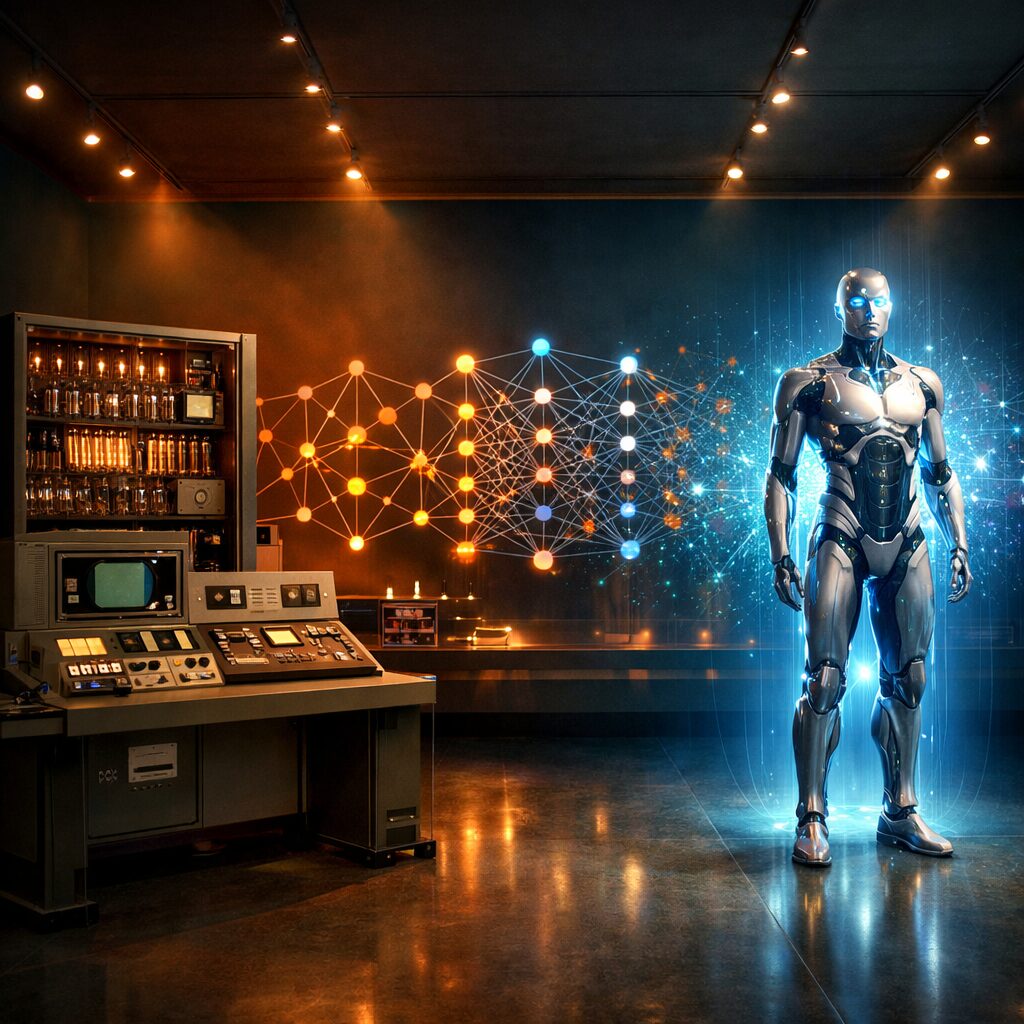
En bref : The AI models powering today’s revolution did not appear from nowhere. They are the product of seven decades of breakthroughs, dead ends, funding winters, and paradigm shifts. From Frank Rosenblatt’s Perceptron in 1958 to the autonomous AI agents of 2025, each era built on — and often rejected — the ideas of the previous one. Understanding this evolution explains why AI works the way it does today, what its real limitations are, and where it is heading next.
The Long Road to Overnight Success
When ChatGPT launched in November 2022 and reached 100 million users in two months, it felt like an overnight revolution. It was not. The technology behind it was the product of 65 years of research, three major AI winters, at least four paradigm shifts, and the slow accumulation of insights that only became transformative when hardware caught up with theory.
This is not just a history lesson. The evolution of AI models reveals structural patterns that predict where the technology is going. Every major advance emerged not from a single breakthrough but from the convergence of old ideas, new compute, and fresh data. Understanding these convergences helps separate genuine advances from hype.
Era 1: The Perceptron and Early Neural Networks (1958-1969)
The story begins in 1958 at the Cornell Aeronautical Laboratory, where Frank Rosenblatt introduced the Perceptron concept — a system that could learn to classify visual patterns. The physical Mark I Perceptron machine was built and demonstrated in 1960. It was the first implemented neural network, and the press coverage was extravagant. The New York Times reported it as the embryo of an electronic computer that would one day “be able to walk, talk, see, write, reproduce itself and be conscious of its existence.”
The Perceptron was a single layer of artificial neurons that could learn linear decision boundaries. It worked for simple tasks but could not solve problems requiring non-linear separation — famously, it could not learn the XOR function (a basic logical operation). In 1969, Marvin Minsky and Seymour Papert published “Perceptrons,” a mathematical proof of these limitations. The book was widely interpreted as a death sentence for neural networks.
Funding dried up. Researchers moved to other approaches. The first AI winter began.
Era 2: Backpropagation and the Second Wave (1986-1995)
The Perceptron’s limitation was its single layer. Multi-layer networks could theoretically solve any computational problem, but nobody knew how to train them. The error signal could not propagate backward through multiple layers.
In 1986, David Rumelhart, Geoffrey Hinton, and Ronald Williams published a paper demonstrating that backpropagation — computing gradients of the error function with respect to each weight by applying the chain rule layer by layer — could train multi-layer neural networks effectively. The technique had actually been invented multiple times before, but this paper provided clear experimental validation.
Multi-layer networks could now learn complex patterns: handwriting recognition, speech processing, simple image classification. Yann LeCun’s convolutional neural networks (CNNs) in the late 1980s demonstrated impressive handwritten digit recognition, eventually deployed by banks for check processing.
But the excitement outpaced the results. Neural networks required large datasets and significant compute that 1990s hardware could not provide. Simpler statistical methods — support vector machines, random forests, gradient boosting — often outperformed neural networks on practical problems while being faster to train and easier to understand. The second AI winter arrived, more gradual than the first but equally devastating for neural network research.
Era 3: Deep Learning Breaks Through (2012-2017)
The third wave arrived with a crash — specifically, with AlexNet’s dominant victory in the 2012 ImageNet competition. Alex Krizhevsky, Ilya Sutskever, and Geoffrey Hinton trained a deep convolutional neural network on GPUs and slashed the top-5 image classification error rate from 26.2% to 15.3%, a margin so large it stunned the computer vision community.
The ingredients that made this possible were not new individually. CNNs had existed since the 1980s. Large datasets (ImageNet, with 14 million labeled images) had been painstakingly assembled. GPUs had been available for years. But their convergence at sufficient scale produced capabilities that previous experiments could not approach.
The deep learning era had several defining characteristics:
Depth: Networks grew from 8 layers (AlexNet) to 152 layers (ResNet in 2015) as researchers discovered that deeper networks, equipped with techniques like batch normalization and skip connections, could capture increasingly abstract representations.
Specialization: Different architectures for different tasks — CNNs for vision, RNNs and LSTMs for sequences (language, speech, time series), generative adversarial networks (GANs) for image generation. Each architecture was engineered for its domain.
Transfer learning: Models trained on large general datasets could be fine-tuned for specific tasks with small amounts of domain-specific data. This dramatically reduced the data requirements for deploying AI in specialized applications.
Between 2012 and 2017, deep learning achieved superhuman performance on image classification, speech recognition, and the game of Go (DeepMind’s AlphaGo, 2016). But natural language — the most complex and nuanced domain — remained stubbornly resistant to similar breakthroughs.
Advertisement
Era 4: The Transformer Revolution (2017-2022)
The transformer architecture changed everything. Published in June 2017 as “Attention Is All You Need,” the paper proposed an architecture built entirely on attention mechanisms — no recurrence, no convolution. It processed sequences in parallel, captured long-range dependencies directly, and scaled beautifully with compute.
The transformer era unfolded in rapid succession:
BERT (2018): Google’s bidirectional encoder model showed that pre-training on large text corpora, then fine-tuning for specific tasks, could achieve state-of-the-art results across virtually every NLP benchmark. The era of task-specific architectures was ending.
GPT-2 (2019): OpenAI demonstrated that a decoder-only transformer, trained to predict the next word, could generate remarkably coherent text. The model was initially withheld from public release due to concerns about misuse — the first major AI safety controversy of the transformer era.
GPT-3 (2020): Scaling GPT-2’s approach to 175 billion parameters produced something qualitatively new: a model that could perform tasks it was never explicitly trained on, simply by being shown a few examples in the prompt. This “few-shot learning” capability suggested that scale itself was a path to general intelligence.
DALL-E and Stable Diffusion (2021-2022): Transformers and diffusion models brought the same revolution to image generation, producing photorealistic images from text descriptions.
ChatGPT (November 2022): OpenAI took GPT-3.5 — a large language model — and made it conversational through fine-tuning and RLHF (reinforcement learning from human feedback). The technical advance was incremental. The impact was seismic. For the first time, the general public could interact with a state-of-the-art AI system through natural conversation.
Era 5: The Frontier Model Arms Race (2023-2024)
ChatGPT’s success triggered an industry-wide sprint. GPT-4 (March 2023) demonstrated multimodal capabilities — processing both text and images — and scored in the top percentiles on professional exams. Google responded with Gemini. Anthropic released Claude. Meta open-sourced LLaMA, democratizing access to frontier-class models.
This era was defined by three simultaneous trends:
Scale: Models grew to hundreds of billions and likely trillions of parameters, with training costs exceeding $100 million. The capital requirements concentrated frontier AI development among a handful of well-funded labs.
Efficiency: The countertrend to raw scale. Mixture-of-experts architectures activated only a fraction of parameters per input. Model distillation compressed large models into smaller, deployable versions. Quantization reduced numerical precision without meaningful quality loss. Multilingual efficiency showed that smaller models could perform well across dozens of languages.
Multimodality: The boundaries between text, image, audio, and video models blurred. Claude, GPT-4, and Gemini could all process multiple input types. Dedicated video generators like Sora and Veo produced cinematic-quality clips from text descriptions.
Era 6: The Agent Revolution (2024-2026)
The current era — still unfolding — is defined by AI systems that do not just generate text but take actions in the world. AI agents can browse the web, write and execute code, manage files, interact with APIs, and orchestrate multi-step workflows.
The technical foundation of agents is not a new architecture but a new use pattern. Language models are used not just to generate text but to plan sequences of actions, observe the results, and adapt. Tool use — the ability to call external functions like web search, calculators, or databases — extends the model’s capabilities beyond what is encoded in its weights.
Computer-use agents represent the furthest extension of this paradigm, operating graphical user interfaces the way humans do — clicking buttons, filling forms, navigating menus. These systems combine language understanding, visual perception, and action planning in a single loop.
The agent era raises new challenges. Unlike a chatbot that generates a text response, an agent that takes actions can cause real-world consequences — sending emails, modifying files, making purchases. The safety engineering required for agentic systems is fundamentally more complex than for conversational AI.
The Pattern Behind the Progress
Looking across seven decades, several patterns emerge:
Old ideas, new compute. Neural networks were “invented” in the 1950s. Backpropagation was formalized in the 1980s. Attention mechanisms existed before transformers. In each case, the theoretical idea predated its practical impact by decades, waiting for hardware capable of realizing it at sufficient scale.
Simplicity wins at scale. The most successful architectures have been surprisingly simple. The transformer is essentially attention plus feed-forward networks. GPT is a transformer trained on next-token prediction. The complexity comes from scale, not from architectural intricacy.
Generality beats specialization. The trend has been consistently toward more general architectures. CNNs for vision, RNNs for language, and GANs for generation have all been subsumed by transformers. Each era’s specialized tools are replaced by the next era’s general-purpose model.
Capabilities emerge at scale. The most consequential capabilities — few-shot learning, chain-of-thought reasoning, code generation — were not explicitly designed. They emerged when models reached sufficient scale, suggesting that the relationship between model size and capability is not purely quantitative.
What Comes Next
Sovereign AI models are proliferating as nations seek linguistic and cultural independence in AI. Test-time compute is shifting intelligence from training to inference. Multi-agent systems are creating collaborative AI architectures that exceed individual model capabilities.
But perhaps the most important development is the democratization of AI. Open-source models from Meta, Mistral, and others have put frontier-class capabilities in the hands of anyone with a GPU. The history of AI has been a history of concentration — expensive machines, scarce expertise, exclusive institutions. The current era is breaking that pattern, and the consequences will be felt for decades.
Frequently Asked Questions
What does “The Evolution of AI Models” mean?
The Evolution of AI Models: From Perceptrons to Agents covers the essential aspects of this topic, examining current trends, key players, and practical implications for professionals and organizations in 2026.
Why does the evolution of ai models matter?
This topic matters because it directly impacts how organizations plan their technology strategy, allocate resources, and position themselves in a rapidly evolving landscape. The article provides actionable analysis to help decision-makers navigate these changes.
How does era 1: the perceptron and early neural networks (1958-1969) work?
The article examines this through the lens of era 1: the perceptron and early neural networks (1958-1969), providing detailed analysis of the mechanisms, trade-offs, and practical implications for stakeholders.
Sources & Further Reading
- Attention Is All You Need — Vaswani et al., Google Research (2017)
- ImageNet Classification with Deep Convolutional Neural Networks (AlexNet) — Krizhevsky et al. (2012)
- Stanford AI Index Report 2025: Historical Trends — Stanford HAI
- On the Opportunities and Risks of Foundation Models — Bommasani et al., Stanford CRFM (2021)
- A Brief History of Artificial Intelligence — Michael Wooldridge, Wired
🔗 Related Intelligence

AI Development Workflows: How Teams Integrate AI Into Every Stage of Software

The Agentic AI Stack: How Autonomous AI Systems Are Built

From Quarterly Bets to Weekly Experiments: How AI Agents Compress Product Iteration

From Agents to AI Operating Systems: The Next Layer of Computing