Introduction
The cloud was invented as a centralizing force. Rather than running software on many scattered computers, cloud computing concentrated computing power in large, efficient data centers and delivered it over the internet. The model was transformative — but it has a fundamental limitation: latency. Sending data to a data center and waiting for a response takes time, and for a growing class of applications — autonomous vehicles, industrial robotics, augmented reality, real-time gaming, remote surgery — time is everything.
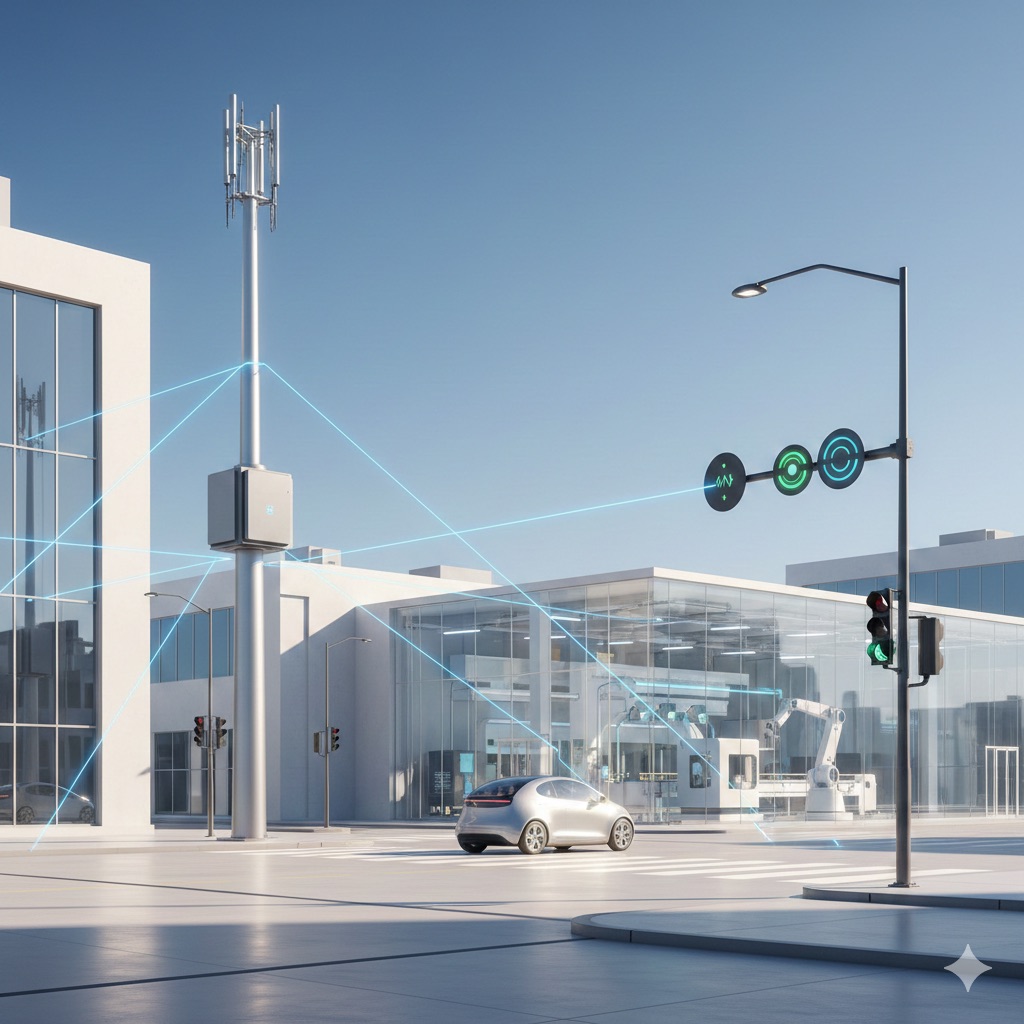
Edge computing inverts cloud’s centralizing logic. Instead of sending data to a distant data center, edge computing processes it near where it is generated — at the “edge” of the network. A 5G base station with an edge computing node processes data from connected devices in milliseconds rather than the hundreds of milliseconds required for a round trip to a cloud data center. Combine this with the massive bandwidth and device density of 5G networks, and a new class of real-time, intelligence-at-the-edge applications becomes possible.
The edge computing market is growing rapidly. The number of edge data centers is expected to grow from 250 in 2022 to approximately 1,200 by 2026. The Middle East edge data center market alone is projected at $1.5 billion by 2030. Globally, edge infrastructure spending is on a trajectory toward $200+ billion annually by 2028.
Why Latency Matters More Than You Think
The technical term for delay in data transmission is latency. Current 4G LTE networks have typical latencies of 20–100 milliseconds. Cloud data center round trips add another 50–200 milliseconds depending on distance. For streaming video or loading a webpage, this is acceptable.
For an autonomous vehicle making a split-second braking decision, it is not. For a surgeon performing remote surgery through a robotic arm, it is not. For an augmented reality overlay that must stay precisely aligned with the physical world as a person moves their head, it is not. For a factory robot that must respond to sensor inputs in real time, it is not.
5G networks, in their ultra-reliable low latency communication (URLLC) mode, can achieve end-to-end latencies below 1 millisecond. But this requires that the processing occur at the edge — at or near the base station — rather than at a distant data center. Edge computing is the architecture that makes 5G’s latency promise actually deliverable for applications that need it.
The latency spectrum matters:
- <1ms: Required for the most demanding real-time control applications (industrial automation, autonomous vehicles in safety-critical situations)
- 1–10ms: Augmented/mixed reality, remote robotic surgery, gaming, real-time collaboration
- 10–50ms: High-quality video conferencing, real-time analytics, most IoT monitoring
- >100ms: Traditional cloud applications — web services, mobile apps, most enterprise software
Edge computing is specifically about enabling the first two categories — the applications that genuinely require single-digit millisecond response times and where cloud-only architectures fail.
5G as Edge Infrastructure
5G and edge computing are deeply interrelated — 5G was architected with Multi-access Edge Computing (MEC) as a core capability from its inception.
5G MEC allows application servers to be deployed at or near 5G base stations, processing data from connected devices with minimal latency. The MEC architecture creates a new computing tier between devices and the central cloud — a tier that enables latency-sensitive applications while maintaining backhaul to the cloud for less time-critical functions.
Mobile operators — AT&T, Verizon, T-Mobile in the US; Vodafone, Deutsche Telekom, Orange in Europe; NTT, SoftBank, SK Telecom in Asia — are deploying edge computing nodes as part of their 5G network buildout. The telecom infrastructure becomes, in effect, a distributed computing platform.
The commercial models are evolving: operators are offering edge-as-a-service, allowing enterprises to run their applications on telecom-operated edge nodes — benefiting from both the low latency of proximity and the managed infrastructure of a service model. AWS Wavelength, Azure Edge Zones, and Google Distributed Cloud are all built on partnerships with telecom operators to deliver edge computing at scale.
Autonomous Vehicles: The Killer App for Edge
Of all the applications driving edge computing investment, autonomous vehicles represent the most demanding and most consequential.
A Level 4 autonomous vehicle (fully autonomous in defined conditions without human intervention) generates approximately 4–5 terabytes of sensor data per day — from cameras, lidar, radar, and ultrasonic sensors. Real-time processing of this data to make driving decisions cannot tolerate significant latency. Some decisions (emergency braking in response to an obstacle) must be made in under 100 milliseconds.
Current autonomous vehicle architectures process most computation on-board — powerful computers in the vehicle handle real-time sensor fusion and decision-making. But the next generation of connected autonomous vehicles is being designed to leverage vehicle-to-infrastructure (V2I) communication and edge computing for collaborative intelligence:
- Vehicles share sensor data with roadside edge nodes, which aggregate information from multiple vehicles to provide each with a more complete picture of the environment than any single vehicle’s sensors can produce
- Edge nodes process infrastructure sensor data (traffic cameras, pavement sensors, weather monitors) and provide real-time environmental updates to vehicles
- Cooperative collision avoidance uses edge processing to coordinate vehicle movements at intersections without traffic signals
The geographic distribution of edge computing nodes for autonomous vehicles roughly corresponds to road networks — creating an enormous infrastructure buildout challenge and opportunity.
Advertisement
Smart Manufacturing: Industry 4.0 Goes Real-Time
Manufacturing has been one of the earliest and most economically significant adopters of industrial edge computing.
Predictive maintenance: Vibration, temperature, acoustic, and current sensors on industrial equipment generate continuous data streams. Edge nodes processing this data locally can detect anomalies that predict bearing failures, impeller wear, or thermal events hours or days before failure — enabling planned maintenance that avoids unplanned downtime. The economic value is enormous: in automotive manufacturing, an unplanned line stoppage can cost $1–2 million per hour.
Quality control: Computer vision systems on production lines can inspect every unit at production speed — detecting defects that human inspectors miss. Edge computing enables the real-time processing required to check defects and stop the line before defective units pass downstream.
Digital twins: Real-time digital twins — software models synchronized with physical systems through continuous sensor data — require edge processing to maintain synchronization with sufficient resolution to be useful. Digital twins of manufacturing processes enable simulation, optimization, and predictive analysis that improve yield and reduce waste.
Collaborative robotics (cobots): Robots working alongside humans in manufacturing environments must respond instantly to human movement to avoid injury. Edge processing of visual and proximity sensor data enables the real-time safety monitoring that makes human-robot collaboration safe.
Siemens, ABB, Rockwell Automation, and Honeywell are the dominant players in industrial edge computing — integrating OT (operational technology) edge hardware with cloud platforms to create hybrid OT/IT architectures that are the backbone of Industry 4.0.
Smart Cities: Urban Infrastructure Goes Intelligent
Smart city applications — traffic management, public safety, environmental monitoring, energy management — represent the largest geographic deployment of edge computing nodes globally.
Intelligent traffic management: Traffic cameras with edge processing can analyze vehicle density, speed, and movement in real time to optimize signal timing across a traffic network. Cities implementing AI-optimized traffic management (using edge nodes at intersections rather than central data processing) report average commute time reductions of 10–25%.
Public safety: Video analytics at the edge can detect incidents (accidents, unusual crowd behavior, security threats) in real time and alert emergency services faster than human monitoring permits. The deployment of such systems raises significant civil liberties concerns — the surveillance infrastructure for public safety is identical to surveillance infrastructure for tracking individuals — creating ongoing policy debates about the appropriate scope of smart city deployment.
Smart lighting: Street lighting that adjusts intensity based on pedestrian and vehicle presence — using edge sensors and processing at each light fixture — reduces municipal energy consumption by 40–60% compared to fixed-schedule lighting. The infrastructure (networked light fixtures with processing capability) is also a foundation for other smart city applications.
Environmental monitoring: Distributed sensor networks measuring air quality, noise levels, water quality, and energy consumption generate distributed data that edge processing can aggregate into real-time city-wide environmental dashboards.
Retail Edge: The Connected Store
The retail sector is deploying edge computing at significant scale, driven by competitive pressure to optimize every dimension of the shopping experience.
Frictionless checkout: Amazon’s Just Walk Out technology — allowing customers to take items and leave without checking out, with billing handled automatically — uses computer vision and sensor fusion processed at edge nodes in the store. Competitors including Standard AI, AiFi, and Trigo are deploying similar systems. The processing requirement — tracking every customer and every product in real time across an entire store — requires edge computing that cannot tolerate the latency of cloud-round-trip processing.
Inventory management: Computer vision systems (cameras, RFID readers, weight sensors on shelves) provide real-time inventory visibility, alerting staff when items need restocking and identifying shrinkage (theft or checkout errors). Edge processing at the store allows this intelligence without sending continuous video feeds to central servers.
Personalization: In-store sensors tracking customer movement patterns (with appropriate privacy governance) can optimize store layout, product placement, and real-time offers.
The Security Challenges of the Edge
Edge computing creates security challenges that centralized cloud architectures don’t face.
Physical access: A cloud data center has multiple layers of physical security. An edge computing node at a 5G base station, a traffic intersection, or a factory floor is physically accessible to a much wider range of potential attackers. Physical security of edge nodes — tamper detection, secure boot, hardware security modules — is a significant engineering challenge.
Scale and patch management: Managing security patches across thousands or tens of thousands of distributed edge nodes is operationally demanding. Edge nodes that can’t be patched remotely and require on-site visits for updates create security technical debt at scale.
Network segmentation: Edge nodes that are connected to both operational technology (manufacturing equipment, vehicles, sensors) and information technology (cloud connections, corporate networks) are at the intersection of two historically separate security domains. The convergence creates risks if OT security weaknesses provide pathways to IT systems.
Supply chain risk: Edge hardware comes from a global supply chain. The potential for hardware-level security compromises (supply chain implants) in widely-deployed edge nodes is a genuine concern, particularly for infrastructure in sensitive locations.
Conclusion
Edge computing is not the end of cloud — it is cloud’s distributed expression. The most sophisticated architectures of 2026 combine central cloud (for analytics, model training, data aggregation, long-term storage) with edge computing (for real-time processing, latency-sensitive applications, and local autonomy). The two are complementary, not competing.
The applications that edge computing enables — autonomous vehicles, smart manufacturing, intelligent cities, immersive AR/VR, remote surgery — are among the most economically and socially significant technology applications of the coming decade. The infrastructure buildout required to support them is one of the largest investment themes in technology.
The edge computing opportunity is enormous and the infrastructure race is underway. The organizations that build the expertise, the partnerships, and the architectures now will be positioned to capture the value as the use cases mature.
Advertisement
🧭 Decision Radar (Algeria Lens)
| Dimension | Assessment |
|---|---|
| Relevance for Algeria | Medium-High — Algeria’s 5G rollout plans and industrial modernization ambitions make edge computing increasingly relevant, particularly for smart city pilots in Algiers and industrial zones. |
| Infrastructure Ready? | No — Algeria’s 5G deployment is in early stages. Edge computing infrastructure (MEC nodes, micro data centers) does not exist at scale. Algérie Télécom and Djezzy are potential deployment partners. |
| Skills Available? | No — Edge computing, IoT architecture, and 5G MEC expertise are scarce. University programs and vendor certifications need development. |
| Action Timeline | 12-24 months — Monitor 5G rollout progress; begin edge computing pilot planning for industrial zones and smart city projects. |
| Key Stakeholders | Telecom operators (Algérie Télécom, Djezzy, Ooredoo), industrial zone managers, smart city planners, Ministry of Digital Transformation |
| Decision Type | Educational — Build awareness and expertise now for deployment readiness when 5G infrastructure matures |
Quick Take: Edge computing requires 5G infrastructure that Algeria is still building. The immediate priority is educational: understanding edge architectures, identifying high-value use cases in Algerian industry (oil & gas, manufacturing, smart cities), and building technical expertise so organizations are ready to deploy when connectivity infrastructure supports it.
Sources & Further Reading
- Middle East Edge Data Center Industry Report 2025–2030 — GlobeNewsWire
- Edge Computing and 5G: Catalysts for Cloud Innovation in 2025 — VertiSystem
- Cloud Computing Trends to Watch in 2026 — CloudKeeper
- 5 Cloud Trends to Watch for in 2026 — TechTarget
- 49 Cloud Computing Statistics You Need to Know in 2026 — Finout






Advertisement