A Market Growing at Speed — On a Broken Foundation
Algeria’s e-commerce market has been on an extraordinary trajectory. According to Statista, the sector generated approximately US$799 million in revenue in 2024, with projections indicating growth to over US$2 billion by 2029. The Algerian Group of Digital Actors (GAAN) reported in September 2024 that the market had already surpassed US$1.5 billion, with payment cards in circulation exceeding 18 million. The number of e-commerce users is forecast to increase by 2.3 million (+32.72%) between 2024 and 2029, reaching 9.35 million users.
UNCTAD’s E-commerce and Digital Economy Year in Review 2024 estimated Algeria’s local business e-commerce sales at $1.9 billion in 2023, representing 0.8% of GDP. Registered e-commerce businesses have grown at an average annual rate of 92% since 2020, while online payment transactions for goods and services tripled between 2020 and 2024. Law 18-05, enacted in May 2018, provided the legal framework for electronic commerce, requiring online retailers to register with the National Trade Register Center (CNRC) and host their websites in Algeria.
But beneath these headline growth numbers lies a fundamental structural problem. The overwhelming majority of Algeria’s e-commerce transactions are settled not through digital payments but through cash handed to a delivery driver at the customer’s door. Cash on Delivery is not a payment method in Algeria — it is the payment method, accounting for roughly 95% of online purchases.
Personal credit cards remain extremely limited in Algeria, with very few merchants accepting international credit cards. Most commercial exchanges take place on informal platforms such as social networks and messaging applications, with payment made in cash upon delivery. While SATIM’s CIB and Algerie Poste’s Edahabia cards exist — totalling 3.5 million CIB cards and 10.1 million Edahabia cards as of 2022 — their use for online purchases remains marginal compared to overall transaction volumes.
The result is an e-commerce ecosystem that has achieved digital discovery and digital ordering — but still relies on a physical, analog payment mechanism that introduces friction, risk, and cost at the most critical point in the customer journey.
The RTS Epidemic: E-Commerce’s Biggest Poison
If COD is the foundation on which Algerian e-commerce is built, then Return-to-Sender (RTS) is the crack running through that foundation.
RTS occurs when a customer either refuses a delivered package or is unavailable to receive it — the delivery driver returns to the address, finds no one, or the customer simply declines to pay. The package goes back to the merchant. And the merchant pays for it — twice.
As Algerian logistics platform Colisify describes it, the Return-to-Sender phenomenon is the “biggest poison” of Algerian e-commerce. When a customer refuses a product or ghosts the delivery driver, the merchant pays double shipping costs — the outbound delivery fee and the return shipping fee — entirely out of pocket. The product returns to inventory (often in unsaleable condition after handling and transit), the sale evaporates, and the merchant absorbs a pure loss.
The economics are brutal. Consider a typical transaction: a merchant sells a product for 3,000 dinars with a 30% margin (900 dinars profit). Shipping costs 400 dinars each way. If the customer accepts delivery, the merchant nets 500 dinars. If the customer refuses, the merchant loses 800 dinars in shipping alone — nearly the entire margin from a successful sale. A single RTS wipes out the profit from the next successful delivery. At scale, an RTS rate above 15-20% can push an e-commerce operation into negative territory.
The problem is amplified by Algeria’s geography. Delivery to remote wilayas in the south or mountainous interior involves significantly higher shipping costs and longer transit times. An RTS on a shipment to Tamanrasset or Bechar does not merely double the shipping cost — it can represent a total loss equivalent to several successful urban deliveries.
Why Customers Refuse: The Psychology of COD
Understanding why RTS rates are so high in Algeria requires understanding the psychology of cash-on-delivery purchasing.
COD eliminates the financial commitment at the point of ordering. A customer browsing an Instagram store at midnight can place an order with zero financial consequence — no card number entered, no money deducted, no skin in the game. By the time the delivery driver arrives 48 to 72 hours later, the impulse that drove the purchase may have evaporated entirely.
Several behavioral patterns drive high RTS rates:
Impulse ordering without commitment. The absence of upfront payment means customers treat orders as tentative rather than binding. Social media marketing — particularly on Facebook and Instagram, which dominate Algeria’s informal e-commerce landscape — is designed to trigger impulse purchases. Without a payment barrier, the conversion funnel captures orders that were never serious purchase intentions.
Multiple-order hedging. Customers frequently order the same product from multiple sellers, planning to accept whichever arrives first and refuse the rest. In a market with inconsistent delivery times, this is rational behavior from the customer’s perspective — and devastating for the merchants who lose the race.
Address and contact issues. Algeria’s addressing system remains imprecise in many areas. Delivery drivers navigate by landmarks and phone calls rather than standardized addresses. If a customer’s phone is off, they are at work, or they simply do not answer, the package becomes undeliverable.
Product expectation mismatches. Without the ability to inspect goods before purchase — particularly for fashion, electronics, and cosmetics — customers use delivery as an inspection point. If the product does not match the photos or description (a common issue in Algeria’s largely unregulated social commerce ecosystem), the customer refuses at the door.
Financial timing. A customer who ordered on payday may face delivery during a tight financial period. With no prepayment, the decision to refuse is friction-free.
The cumulative effect is that a substantial percentage of COD orders are placed with no firm intention to complete the purchase. Globally, COD return rates are significantly higher than prepaid order return rates — and in Algeria, where the broader infrastructure for returns, refunds, and customer service is less mature, the gap is even wider.
The Delivery Ecosystem: Building Infrastructure Under Pressure
Algeria’s logistics sector has responded to e-commerce growth with remarkable entrepreneurial energy. A generation of delivery startups has emerged to serve the market, each attempting to solve the last-mile challenge in a country with complex geography, uneven infrastructure, and extreme COD dependence.
Yalidine Express, founded in 2013, has grown into one of Algeria’s leading courier services, delivering to more than 1,469 municipalities across 56 wilayas. The company offers same-day delivery in northern cities, real-time tracking, and COD collection up to 150,000 dinars. Its extensive branch network and regional offices provide the operational backbone for a significant share of Algeria’s e-commerce deliveries.
Maystro Delivery, founded in 2019, has carved out a position serving thousands of registered e-commerce stores, with over 500 employees and operations spanning Algeria and Tunisia. Beyond simple delivery, Maystro offers warehousing, pick-up, packaging, cash collection, and call center support — reflecting the reality that Algerian e-commerce merchants need far more than just shipping.
ZR Express operates across 54 wilayas with 45 offices, providing delivery coverage that reaches communities across much of the country.
The logistics sector has seen steady growth, with new delivery companies launching regularly to meet rising e-commerce demand. The super-app Yassir, backed by approximately $150 million in its 2022 Series B (bringing total funding to roughly $200 million), operates across 45 cities and increasingly integrates delivery into its ride-hailing and food delivery platform.
But the delivery companies are caught in the same COD trap as the merchants they serve. Their business model depends on successful deliveries — when a package is refused, the delivery company incurs the cost of the return trip and the operational overhead of the failed attempt. Some companies have introduced penalties or reduced COD limits to mitigate RTS exposure, but these measures risk pushing merchants to competitors who offer more lenient terms.
Consumer Expectations: The 24-48 Hour Squeeze
While COD creates financial fragility, consumer expectations are simultaneously compressing delivery timelines in ways that strain the logistics infrastructure.
Algerian e-commerce consumers increasingly expect delivery within 24 to 48 hours, benchmarked against Yalidine’s same-day service in the capital and the broader global trend toward instant gratification. Real-time tracking has become a baseline expectation rather than a premium feature — consumers want to know where their package is at every moment.
This creates a punishing operational dynamic for delivery companies. Faster delivery requires more distribution points, more delivery personnel, and more sophisticated routing — all of which increase costs. But the COD model means that revenue only materializes when the customer accepts and pays. A failed delivery at same-day speed is more expensive than a failed delivery at D+3 speed, because the faster service requires more resource-intensive logistics.
The expectation gap is particularly acute outside major cities. While Algiers, Oran, and Constantine have delivery infrastructure that can support same-day or next-day service, wilayas in the Hauts Plateaux, the south, and rural areas face structural challenges — longer distances, fewer distribution points, and higher per-delivery costs. Customers in these areas increasingly expect urban-level service, but the economics do not support it under a COD model with elevated RTS rates.
Advertisement
The Social Commerce Factor: Facebook and Instagram as Storefronts
A critical dimension of Algeria’s COD problem is the dominance of social commerce — buying and selling through Facebook pages, Instagram accounts, and WhatsApp groups rather than through dedicated e-commerce platforms.
Algeria had 25.6 million social media user identities as of January 2025, and for many merchants, a Facebook page is their entire digital storefront. There is no shopping cart, no checkout flow, no integrated payment system. A customer sees a product in their feed, sends a direct message, provides a delivery address, and waits for the package to arrive. The transaction is sealed with a handshake through a screen, not a payment.
This informal commerce model amplifies every pathology of COD. There is no verified inventory system — the product shown may differ from what is shipped. There is no structured return policy. There is no dispute resolution mechanism beyond blocking someone on social media. And there is no way to collect prepayment, because the platforms used for selling have no integrated payment processing for the Algerian market.
The scale of social commerce in Algeria is difficult to quantify precisely because it operates largely outside the formal e-commerce framework established by Law 18-05. Many social sellers do not register with the CNRC, do not issue invoices, and do not collect or remit taxes. They operate in a gray zone that the e-commerce law was designed to regulate but has struggled to reach.
For the consumer, the lack of formal structure means that COD is not just a preference — it is a rational protection mechanism against an unregulated marketplace. For the merchant, the same lack of structure means they bear all the risk of the transaction, including the shipping costs of products that never sell.
The Trust Deficit: Why Algerians Will Not Prepay
The obvious solution to the COD problem is electronic prepayment. If customers pay before the delivery driver arrives, RTS rates collapse, merchant margins stabilize, and the entire ecosystem becomes economically sustainable.
But Algerians have deep-seated reasons for their reluctance to prepay online.
Research on Algerian consumer behavior consistently identifies distrust of electronic payment security as a primary barrier to online payment adoption. This is not irrational paranoia — it reflects the reality of an ecosystem where consumer protections are nascent, dispute resolution is unreliable, and the recourse options for a prepaid transaction gone wrong are limited.
The AfricaNenda State of Inclusive Instant Payment Systems report classifies Algeria as an “emerging” country in digital payment adoption, noting that while access barriers are relatively low (high internet and smartphone penetration), the predominant barriers relate to “early usage factors such as lack of need and lack of awareness about digital payments.” Most digital payment users in their Algerian sample used them fewer than three times per month.
The informal nature of much of Algeria’s e-commerce amplifies the trust problem. A significant share of online selling happens through Facebook pages, Instagram accounts, and WhatsApp groups — platforms with no integrated payment processing, no buyer protection, and no formal dispute resolution. A customer who prepays through a bank transfer to a Facebook seller and receives a defective product has essentially no recourse. COD, for all its inefficiencies, provides the customer with a final inspection point and the power to refuse.
A 2023 report revealed that only 3% of businesses were equipped to process digital payments, primarily due to high setup costs and inadequate infrastructure — further limiting opportunities for consumers who might be willing to pay digitally.
Breaking the Cycle: What It Would Take
The COD bottleneck is not a single problem with a single solution. It is a systemic challenge that requires coordinated action across multiple dimensions.
Regulatory framework for buyer protection. Algeria’s e-commerce law (18-05) provides a foundation, but consumers need visible, accessible dispute resolution mechanisms for online purchases. A consumer who knows they can recover their money if a product is defective is a consumer more willing to prepay.
Partial prepayment models. Some Algerian merchants have experimented with requiring a partial deposit (typically 500-1,000 dinars) at the time of ordering, with the balance collected on delivery. This small commitment filters out the most casual impulse orders while preserving the COD safety net for consumers. The approach has shown promise in reducing RTS rates without eliminating the trust mechanism.
DZMobPay integration with e-commerce platforms. The rollout of Algeria’s interoperable mobile payment system — currently offered by seven banks and Algerie Poste, with plans to expand to 15 banks in 2026 — creates the infrastructure for seamless online payments. But infrastructure alone is insufficient — e-commerce platforms must integrate DZMobPay as a payment option, and consumers must be incentivized to use it through discounts, faster shipping, or priority service. As of early November 2025, DZMobPay had 79,130 users and 11,873 merchants — a start, but still modest relative to Algeria’s e-commerce scale.
Merchant credibility signals. Platform-level verification (verified seller badges, transaction history, customer reviews) can build the trust that currently resides in the COD mechanism. The challenge is extending these features beyond formal platforms to the informal social commerce ecosystem where much of Algeria’s online selling occurs.
Data-driven RTS management. Delivery companies are increasingly using data analytics to predict and prevent RTS. Colisify, for example, recommends mandatory phone confirmation within 4 hours of order placement, address verification with visual landmarks, and blacklist systems that flag phone numbers associated with previous refusals. Customer scoring based on order history can reduce failed deliveries without eliminating COD as a payment option.
The Regional Comparison: How Others Navigated COD
Algeria’s COD challenge is not unique. Across the MENA region and beyond, e-commerce markets have grappled with the same structural dependency on cash payments — and the solutions that worked elsewhere offer lessons.
Egypt faces a similar COD dominance problem, with 51-60% of online shoppers choosing COD. The Central Bank of Egypt has responded with fintech-friendly regulation, including the launch of InstaPay (Egypt’s instant payment network) and the full rollout of SoftPos technology in February 2026, which turns smartphones into payment terminals — eliminating costly POS hardware for merchants.
The UAE has significantly reduced COD usage — down 75% since the pandemic — through a combination of near-universal banking penetration, digital payment incentives, and consumer habituation to card-based commerce. COD still represents roughly 30% of e-commerce volume, but the trend is firmly toward digital.
Turkey offers perhaps the most relevant parallel for Algeria. Like Algeria, Turkey has a large, young population with high smartphone penetration and a growing e-commerce sector. Turkey’s transition from COD toward digital payments was driven by fintech innovation — companies like iyzico and Papara offered merchants easy-to-integrate payment solutions that worked with Turkey’s banking infrastructure. Credit and debit cards now account for roughly 60% of Turkish e-commerce transactions.
For Algeria, the common lesson from all these markets is clear: COD recedes only when digital payment alternatives are simultaneously easier for consumers and more profitable for merchants than cash. Policy push and infrastructure pull must work together.
The Path Forward: COD as Bridge, Not Destination
The tension at the heart of Algeria’s e-commerce sector is that COD is simultaneously essential and unsustainable. Essential because it enables commerce in a market where digital payment trust is low and financial inclusion is incomplete. Unsustainable because the RTS costs it generates threaten the economic viability of the merchants and delivery companies that depend on it.
The resolution will not come from eliminating COD — that would collapse the market. It will come from gradually shifting the balance of transactions from COD to prepaid, driven by better payment infrastructure, stronger consumer protections, and the slow accumulation of positive digital payment experiences.
Algeria’s push toward cashless transactions — with the 939 billion dinar e-payment milestone in 2025 (a 46% increase over 2024), the Finance Act prohibiting cash for real estate, luxury goods, and insurance, the DZMobPay expansion, and the Bank of Algeria’s 2028 cashless target — creates the macro conditions for this shift. But the micro conditions — individual consumer trust, individual merchant adoption, individual successful prepaid transactions — are what will ultimately determine the pace of change.
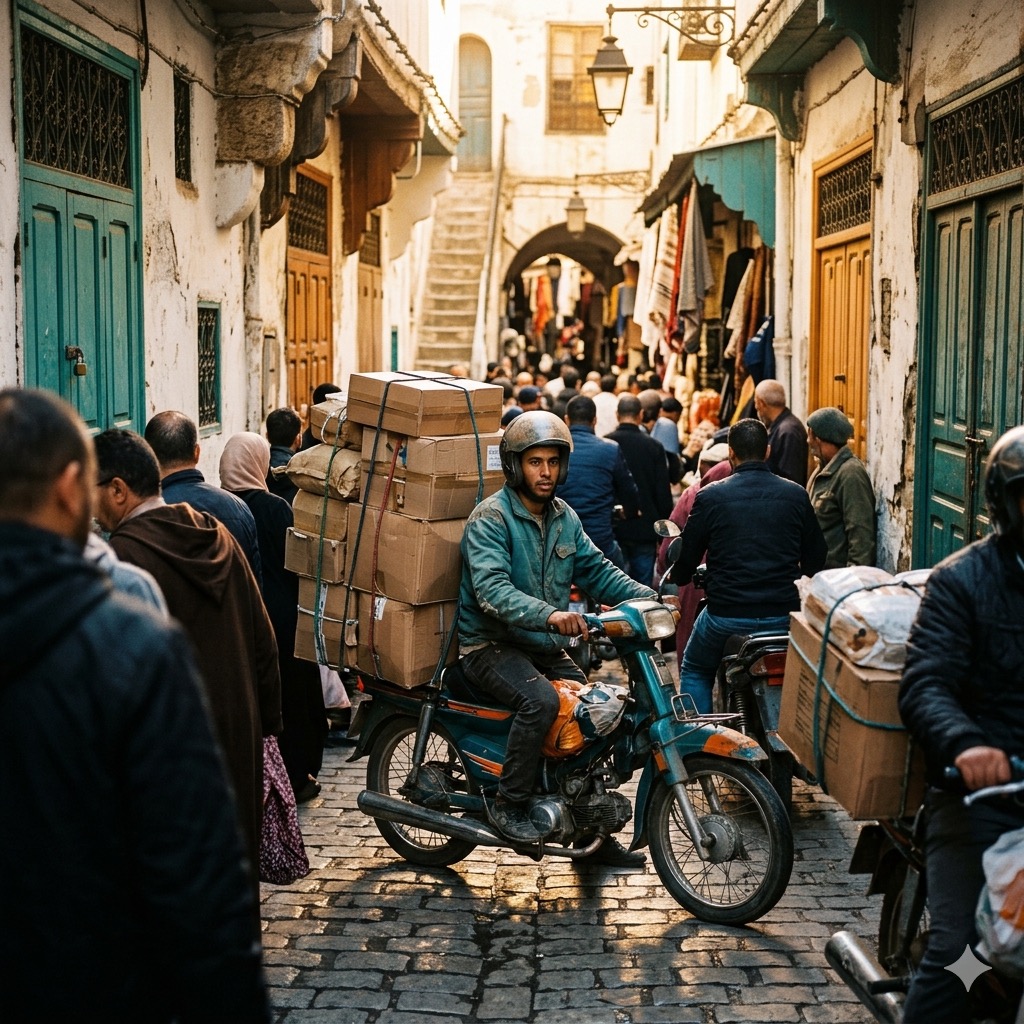
For now, the delivery driver still knocks on the door, package in one hand, cash register in the other. And sometimes, no one answers. That is the cost Algeria’s e-commerce ecosystem pays for growth built on a foundation of cash.
Frequently Asked Questions
Why does Cash on Delivery dominate e-commerce in Algeria?
COD accounts for roughly 95% of online purchases in Algeria because digital payment trust remains low, consumer protection mechanisms are underdeveloped, and much of the e-commerce activity happens through informal social media channels that lack integrated payment processing. For consumers buying from unverified Facebook or Instagram sellers, COD provides a critical inspection point and the power to refuse a product that does not match expectations.
What is the Return-to-Sender (RTS) problem and how does it affect merchants?
RTS occurs when a customer refuses delivery or is unavailable to receive a package. The merchant absorbs double shipping costs — outbound and return — plus the loss of the sale. A single RTS at typical Algerian shipping rates (around 400 dinars each way) can wipe out the profit from the next successful delivery. RTS rates above 15-20% can push an e-commerce operation into negative territory.
How is Algeria working to reduce COD dependency?
Algeria is expanding the DZMobPay interoperable mobile payment system from seven banks to 15 in 2026, with SoftPos technology planned for late 2026 that will turn smartphones into payment terminals. The Finance Act 2025 has already banned cash for real estate, luxury goods, and insurance transactions. The Bank of Algeria has set an ambitious target of cashless transactions by 2028, though only 3% of businesses were equipped to process digital payments as of 2023.
Sources & Further Reading
- Managing Returns (RTS) in COD E-commerce: Saving Profitability — Colisify Blog
- Algeria eCommerce Country Commercial Guide — U.S. International Trade Administration
- E-commerce in Algeria 2026: Laws, Taxes, and the Commercial Register — Ecommaps
- E-commerce Market in Algeria Surpasses $1.5 Billion — AL24 News
- eCommerce Market Forecast: Algeria — Statista
- The Best E-Commerce Delivery Companies in Algeria — Kiostore
- Yassir: The Algerian Superapp — Empower Africa
- State of Inclusive Instant Payment Systems: Algeria Consumer Research — AfricaNenda
- Algeria to Become Cashless Society by 2028 — Diplomatic Courier
- Paiement mobile: l’interoperabilite elargie a 15 banques en 2026 — Algerie Eco
- E-payments: 939 Billion Dinars in 2025 — Algerie Eco
- CBE Greenlights Full Rollout of Soft POS — Enterprise AM
🔗 Related Intelligence

Gifty Algeria: Building Digital Payment Rails in a Cash-First Economy

Algeria’s War on Cash: 939 Billion Dinars in E-Payments and the SoftPos Revolution Coming by 2028

The Dinar Wall: How Non-Convertibility Is Slowing Algeria’s Digital Economy

Financial Exclusion in Algeria: Why 65% Unbanked Blocks the Digital Economy