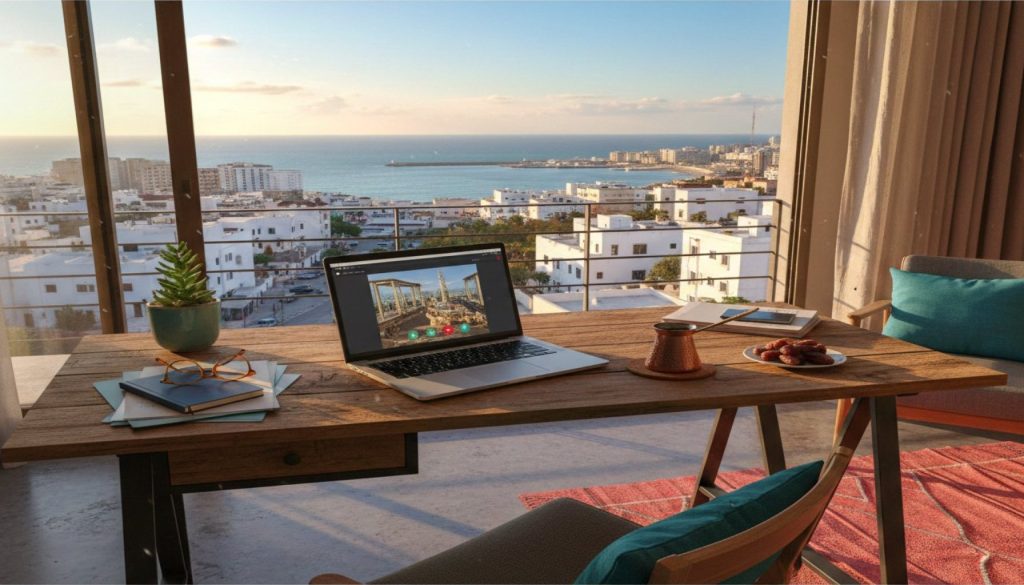
The Reality on the Ground
Remote work in Algeria is widespread and entirely unregulated. Thousands of Algerian tech professionals — developers, designers, data analysts, content creators, and IT support staff — work from home for both Algerian employers and international clients. The COVID-19 pandemic accelerated this trend dramatically: companies that had never considered remote work were forced to implement it overnight, and many never fully returned to office-based models. Algerian tech companies like Yassir and Emploitic, along with numerous smaller startups, have embraced flexible and distributed work arrangements.
Yet Algeria’s labor code — Law 90-11 of April 21, 1990, and its subsequent amendments including Law 22-16 of 2022 — contains zero provisions for telework. The law was written for an industrial economy where work meant physical presence at a defined workplace. The employment relationship is defined in terms that implicitly assume a physical location — a labor relation exists “by virtue of working for an employer” at a specified site. Working hours provisions set a standard workweek without contemplating the blurred boundaries of home-based work. The entire regulatory framework — from workplace safety inspections to employer obligations — is designed around the premise that employees work at employer-controlled premises.
This legal vacuum creates real problems. When an employee working from home in Tlemcen suffers a back injury from a poorly configured workstation, is it a workplace accident? When an employer in Algiers monitors an employee’s screen activity at their home in Oran, what are the privacy boundaries? When a remote worker’s internet connection fails for three days, what are the attendance implications? The law provides no answers.
—
What Other Countries Have Done
France has built its telework framework through successive legislative layers. The 2005 ANI (Accord National Interprofessionnel) first defined telework at the national level, transposing a 2002 European framework agreement. The Warsmann Law of 2012 codified these provisions into the Labor Code (Articles L. 1222-9 to L. 1222-11). Then the El Khomri Law of 2016 introduced the “droit a la deconnexion” (right to disconnect), effective January 1, 2017 — companies with 50+ employees must negotiate policies defining hours during which employees cannot be expected to respond to professional communications. Finally, the Macron Ordinances of September 2017 simplified telework implementation, eliminating the need for a formal contract amendment. Employers must cover telework-related expenses (internet, electricity, equipment), and the employee’s home workspace is subject to the same safety obligations as the office.
Portugal went further with Law 83/2021, effective January 1, 2022. Employers face fines for contacting employees outside working hours except in emergencies. They must compensate for increased household expenses (electricity, internet, equipment depreciation). Parents with children under three have the right to telework when the role permits it, and single parents or households where only one parent has access to telework can exercise this right for children up to age eight — though microenterprises are excluded from these provisions. Portugal also addressed the isolation dimension head-on: employers must meet face-to-face with remote workers at least once every two months and ensure they have equal access to career advancement opportunities.
Colombia has developed a multi-layered approach through separate laws: telework (Law 1221 of 2008), work-from-home (Law 2088 of 2021), and remote work (Law 2121 of 2021), each with distinct regulatory requirements. Law 2121 specifically governs fully remote employment relationships conducted entirely through digital means from start to finish. Spain’s Royal Decree-Law 28/2020 requires a formal written telework agreement for employees working remotely at least 30% of the time, covering equipment provision, expense compensation, working hours, and the right to digital disconnection. The common thread across these frameworks is clear: remote work requires explicit regulation covering equipment, expenses, working hours, privacy, and the right to disconnect.
—
Advertisement
The Cross-Border Employment Problem
Algeria’s legal gap is most acute for the growing number of workers employed by foreign companies or working as contractors for international clients. A developer in Constantine working for a French startup faces a jurisdictional labyrinth. Which country’s labor law applies? If the French employer offers no social security coverage and the Algerian worker is not registered with CNAS (Caisse Nationale des Assurances Sociales des Travailleurs Salaries), the worker has no social protection at all — no health insurance through employment, no work injury coverage, no retirement contributions.
The taxation dimension is equally murky. Income earned from foreign employers or clients should theoretically be declared under Algerian tax law, but the mechanisms for doing so are unclear for remote employment relationships. Many workers operate in a gray zone — technically employed or contracting internationally, practically invisible to Algerian labor and tax authorities. This is not evasion by intent but a consequence of regulatory frameworks that do not contemplate cross-border remote employment.
The Algerian diaspora adds another layer. Many Algerian professionals living abroad work remotely for Algerian companies. Their employment status, social security obligations, and tax treatment are governed by bilateral agreements (where they exist) that predate the remote work era. The France-Algeria bilateral social security convention, for instance, was designed to coordinate protections for workers physically relocating between countries, not for remote work across borders.
—
What an Algerian Telework Framework Should Include
A practical Algerian remote work law should address six core areas. First, a clear definition of telework — distinguishing between regular telework (primarily home-based), occasional telework (a few days per week), and mobile work (location-independent). The law should specify that telework is voluntary for both parties and that an employee cannot be penalized for refusing to work remotely, nor can they demand remote work as an absolute right unless specific conditions apply (disability accommodations, for instance).
Second, employer obligations for home office equipment and expenses. At minimum, the employer should provide or reimburse: a computer, a monitor, internet connectivity costs, and a proportional contribution to electricity expenses. The French model — where employers cover “professional use” expenses — is practical and avoids the complexity of calculating exact household cost increases. A fixed monthly telework allowance (perhaps 5,000-8,000 DZD) would be simpler to administer than itemized reimbursement.
Third, working hours and the right to disconnect. Algeria’s current standard workweek of 40 hours — reduced from the original 44 hours set in Law 90-11 through subsequent amendments — should apply equally to teleworkers, with explicit provisions that employers cannot require responses outside defined working hours. This is especially important in Algeria’s context, where the cultural expectation of availability — particularly from authority figures — can blur work-life boundaries even more than in European settings.
Fourth, workplace safety at home. The law should require employers to provide ergonomic guidance and hold employers liable for work-related injuries sustained during telework hours, while defining reasonable boundaries (an injury during a lunch break errand would not qualify). Fifth, data protection and monitoring limits — employers may track work output but not conduct invasive surveillance of home environments. Sixth, equal treatment guarantees — teleworkers must have equal access to training, promotion, and career development as office-based colleagues.
—
Advertisement
🧭 Decision Radar
| Dimension | Assessment |
| Relevance for Algeria | Very High — thousands of workers operate in a legal vacuum, and the trend is accelerating |
| Action Timeline | Immediate — 12-18 months for legislative drafting and passage |
| Key Stakeholders | Ministry of Labor, UGTA, CAPC (formerly FCE), CNAS, Ministry of Finance, tech industry associations |
| Decision Type | Strategic — legislative reform requiring amendment to the labor code or a dedicated telework decree |
| Priority Level | Critical |
Quick Take: Algeria’s labor code is silent on remote work despite thousands of workers teleworking daily. The legal gaps create risks for both employers and employees — from workplace injury liability to social security coverage. France, Portugal, Spain, and Colombia provide tested models. Algeria needs a dedicated telework law addressing equipment, expenses, working hours, disconnect rights, and cross-border employment.
Sources & Further Reading
- Algeria Labor Code — Law 90-11 of April 21, 1990 — WIPO Lex
- The Complete Guide to Algeria’s New Labor Law — JOBSdz
- France: Right to Disconnect Takes Effect — Library of Congress
- Telework and the French Right to Disconnect — Library of Congress
- Article L1222-9 of the French Labour Code — French Business Law
- Portugal: Parliament Approves Law to Amend Telework Regime — Library of Congress
- Portugal: New Rules on Remote Work Effective January 2022 — L&E Global
- Colombia Remote Work Law 2121 vs Telework — CMS Law
- Spain Royal Decree-Law 28/2020 on Remote Work — Hogan Lovells
- Algeria Remote Working Policy — Rivermate
- ILO Working from Home Report: From Invisibility to Decent Work
- CNAS Algeria — Social Security Framework






Advertisement