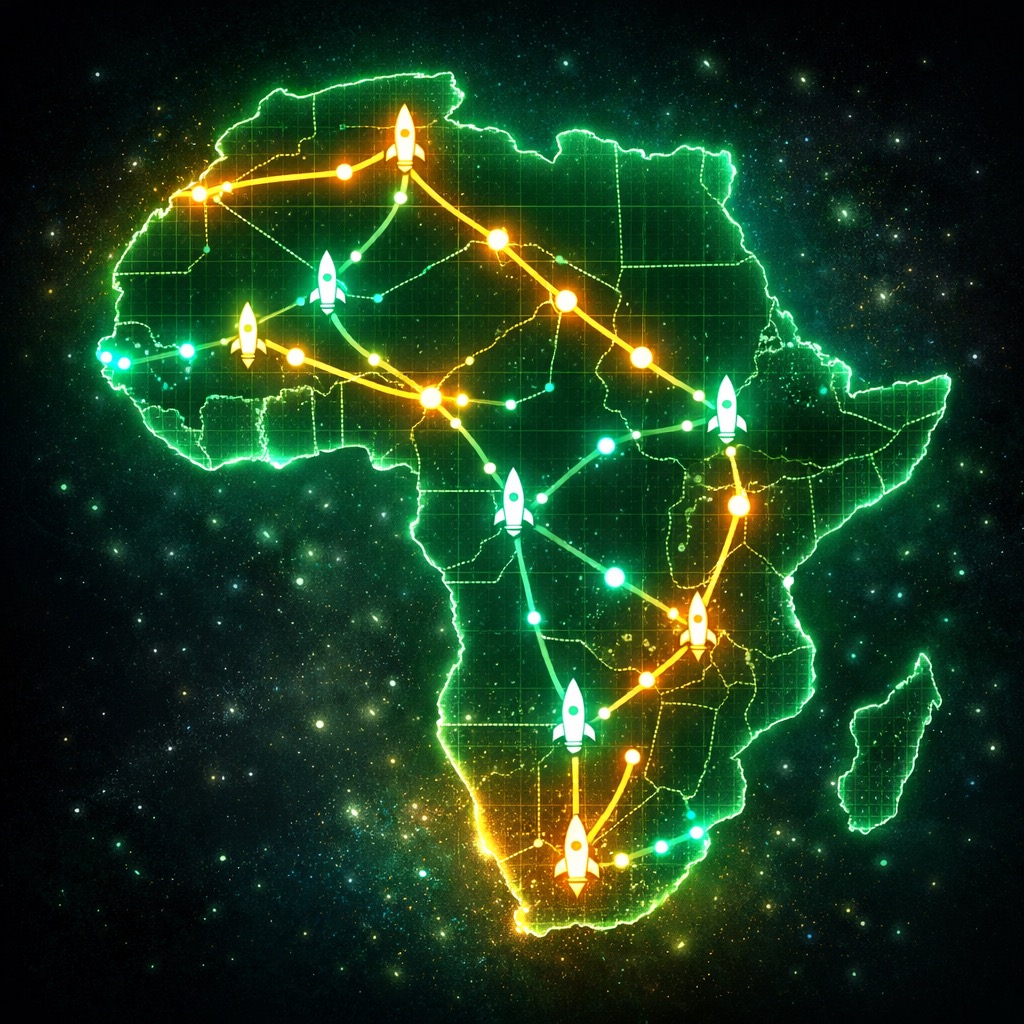
Algeria’s Continental Bet
For decades, Algeria’s economic strategy pointed north — toward European export markets, French-language business networks, and Mediterranean trade corridors. That orientation is shifting. Through a combination of high-profile continental events, new institutional commitments, and the structural opening created by the African Continental Free Trade Area (AfCFTA), Algeria is repositioning its startup ecosystem to look south and west across Africa.
The signal moment came in September 2025, when Algiers hosted the Intra-African Trade Fair (IATF 2025). Organized by the African Export-Import Bank (Afreximbank) in partnership with the African Union Commission and the AfCFTA Secretariat, the event attracted fourteen heads of state, 41 ministers, and tens of thousands of business participants. By the time it closed, participants had signed $48.3 billion in trade and investment deals — with $11.4 billion earmarked for Algeria itself.
Three months later, in December 2025, Algiers hosted the fourth African Startup Conference under the theme “Raising African Champions.” The back-to-back hosting of these two continental events was not coincidental. Algeria is building a narrative — and more importantly, institutional infrastructure — around becoming Africa’s northern gateway for trade and technology.
The African Startup Fund
The most concrete outcome from IATF 2025, from a startup perspective, was President Tebboune’s announcement of a new investment fund dedicated to African startups. The fund, to be managed by the Algerian Agency for International Cooperation, is designed to direct resources toward projects that foster technological innovation, generate employment, and promote African economic integration.
This positions Algeria differently from its North African neighbors. Morocco has pursued a strategy of attracting multinational corporations and building industrial infrastructure. Tunisia has cultivated a boutique startup scene connected to European markets. Algeria is betting on a Pan-African startup investment role — using its oil revenues, geographic position, and political capital within the African Union to become a node in the continent’s startup financing architecture.
The partnership with the African Development Bank (AfDB), confirmed at IATF 2025, adds institutional weight. The AfDB and Algeria agreed to strengthen cooperation on supporting startups and SMEs across Africa, with specific commitments to joint programs at the African Startup Conference.
What AfCFTA Actually Changes for Algerian Startups
The AfCFTA, which Algeria has ratified, creates a single market of 1.4 billion people with a combined GDP exceeding $3.4 trillion. For Algerian startups, this framework addresses several historical constraints.
Market access. Algeria’s domestic market of 46 million people is significant by African standards but limited for technology companies that need scale. The AfCFTA’s progressive elimination of tariffs on 90% of goods — and its protocols on services, investment, and digital trade — creates theoretical access to the entire continent.
Payment infrastructure. The Pan African Payment and Settlement System (PAPSS), a cross-border payment platform developed alongside the AfCFTA, enables faster capital deployment and transaction settlement across multiple African markets. For Algerian startups accustomed to a banking system that barely supports domestic digital payments, PAPSS offers a workaround for cross-border commerce.
Regulatory harmonization. The AfCFTA’s protocols on investment and competition policy, while still being negotiated, aim to reduce the regulatory fragmentation that makes operating across African borders expensive and unpredictable.
However, theory and practice diverge significantly. Intra-African trade remains at approximately 15-16% of total African trade, according to the Afreximbank African Trade Report — far below intra-European (60%+) or intra-Asian (50%+) levels. Algeria’s own trade with sub-Saharan Africa is minimal, dominated by hydrocarbons, with non-oil exports to African markets representing a small fraction of total trade.
Advertisement
Sectors Where Algerian Startups Have an Edge
Not all sectors are equally suited for cross-border expansion. Algerian startups have identifiable advantages in several areas.
Logistics and last-mile delivery. Companies like TemTem and Yassir have built operational expertise in managing delivery networks across Algeria’s geographically challenging terrain — from dense coastal cities to dispersed interior populations. This operational knowledge transfers to other large African countries with similar logistics challenges (Nigeria, DRC, Ethiopia).
Fintech and payments. Algeria’s underdeveloped banking infrastructure has paradoxically created a generation of fintech entrepreneurs solving real payment problems. The Fintech Times reports that Algeria’s fintech ecosystem is “building momentum” in 2026, with solutions for mobile payments, diaspora remittances, and merchant services that could serve neighboring markets.
EdTech and Arabic-language platforms. Algeria’s trilingual environment (Arabic, French, Tamazight) positions its EdTech startups to serve both Francophone West Africa and Arabic-speaking North and East Africa — a rare dual-market advantage.
Agriculture and food technology. Algeria is one of Africa’s largest agricultural producers. Startups digitizing supply chains, improving yields through AI, and connecting farmers to markets have natural expansion paths into neighboring countries with similar crops and climate conditions.
The Competition for Africa’s Startup Capital
Algeria is not the only country positioning for a Pan-African startup role. Kenya, Nigeria, South Africa, and Egypt have deeper venture capital ecosystems, more mature startup infrastructure, and stronger track records of producing scaled technology companies. Rwanda has positioned itself as a regulatory innovator. Morocco’s Casablanca Finance City targets financial services.
The data from 2025 shows the competitive landscape clearly. African startups raised approximately $4.1 billion in total funding, a 25% year-over-year increase. But this capital concentrated heavily in the Big Four markets (Nigeria, Kenya, South Africa, Egypt), with North Africa outside Egypt receiving a small fraction.
Algeria’s differentiator is its combination of oil-funded institutional resources, geographic position bridging North and sub-Saharan Africa, large domestic market, and growing technical talent pipeline (250,000 graduates per year, 110,000+ in technical fields). Whether this translates into actual cross-border startup success depends on execution far more than positioning.
From Declarations to Deals
The gap between Algeria’s continental ambitions and its current startup reality is wide. The country’s startup ecosystem ranks 111th globally, and most activity remains concentrated in Algiers, Oran, and Constantine. Foreign exchange controls, bureaucratic complexity, and banking limitations continue to constrain even domestic operations.
Bridging this gap requires three things. First, the African startup fund announced by President Tebboune must receive meaningful capitalization and begin making investments — announcements without disbursements erode credibility. Second, foreign exchange reforms must allow Algerian startups to transact internationally without prohibitive friction. Third, the government must support bilateral startup mobility agreements with key African markets — Nigeria, Kenya, Senegal, Ethiopia — that allow Algerian companies to establish presences without starting from regulatory zero in each country.
The IATF 2025 results suggest appetite exists. The $48.3 billion in deals signed included commitments across technology, manufacturing, agriculture, and services. Algeria’s startup ecosystem now has a window to convert political momentum into commercial traction across the continent.
Frequently Asked Questions
What concrete benefits does AfCFTA provide to Algerian startups today?
The AfCFTA provides theoretical market access to 1.4 billion consumers and the PAPSS cross-border payment platform for settling transactions across African markets. However, practical benefits remain limited for most Algerian startups because intra-African trade is only 15-16% of total African trade, Algeria’s FX controls restrict international transactions, and the AfCFTA’s digital trade and services protocols are still being negotiated. The framework creates a long-term market opening, but startups need bilateral agreements and regulatory reform to exploit it in the near term.
Which Algerian startups are best positioned for African expansion?
Logistics companies like TemTem and Yassir have the most transferable operational expertise — managing delivery networks across challenging geography is a skill that applies directly to Nigeria, DRC, and Ethiopia. Fintech startups solving payment friction have natural demand in markets with similar banking constraints. EdTech companies with Arabic and French content can address both Francophone West Africa and Arabic-speaking North and East Africa, a unique dual-market position that no other country in Africa matches.
How does Algeria’s African startup positioning compare to Morocco’s?
Morocco has pursued a corporate attraction strategy, building Casablanca Finance City as a continental financial hub and attracting multinational headquarters. Algeria is betting on startup investment and political infrastructure — using AU influence, oil-funded capital, and geographic position to become a different kind of hub. Morocco has deeper venture capital, more international investor connections, and a longer track record. Algeria has larger institutional resources, a bigger domestic market (46 million vs. 37 million), and stronger political relationships across the AU. The approaches are complementary rather than directly competitive.
Sources & Further Reading
- IATF2025 Ends on High Note with Record $48.3 Billion in Deals — Afreximbank
- IATF 2025: African Development Bank and Algeria Strengthen Partnership — AfDB
- How AfCFTA Could Help Build Africa’s Venture Capital Infrastructure — World Economic Forum
- AfCFTA Unlocks New Markets for African Startups — The Next Africa
- Algeria Launches Startup Fund to Drive Innovation and Trade — Maghrebi.org
🔗 Related Intelligence

ASC 2025 Algiers: How Algeria’s $1B Fund and 9-Point Declaration Reshape African Startups

Algeria’s Stock Exchange: Now Open to Startups at Zero Cost
Algeria on the Global Stage: How Startups Are Winning at GITEX and VivaTech

From Sahara to Shelf: Startups Building Algeria’s Agri-Export Tech Stack