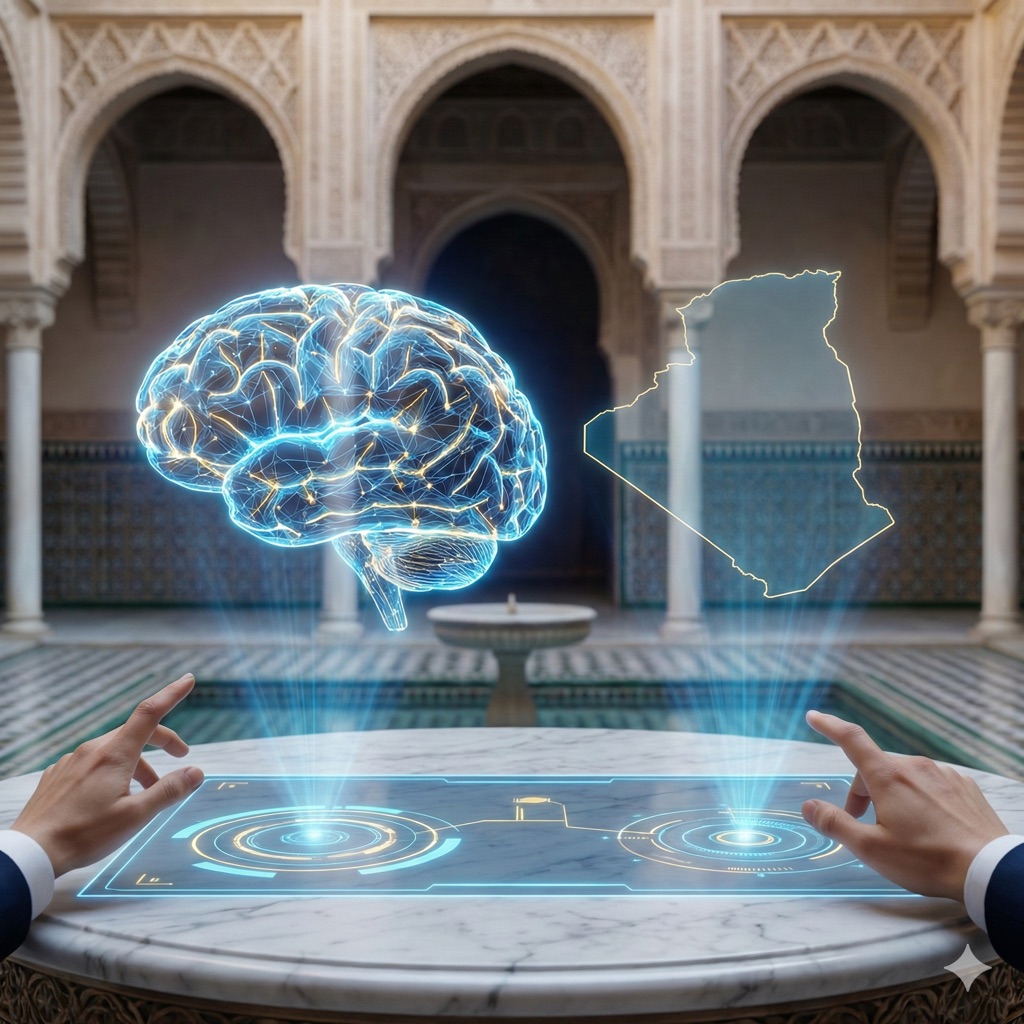
Algeria has officially entered the global artificial intelligence race. In December 2024, the country’s AI Council adopted a National Artificial Intelligence Strategy — a comprehensive framework targeting six pillars: scientific research, startup support, digital infrastructure, skills development, international partnerships, and ethical AI governance. The government set a bold headline target: AI must account for 7% of Algeria’s GDP by 2027.
For tech companies and entrepreneurs operating in or watching Algeria, the strategy is not just political rhetoric. It is backed by real money, real institutions, and real deadlines.
The $11 Million Bet on AI Startups
In early 2025, Algérie Télécom announced a 1.5 billion dinar (approximately $11 million USD) investment fund specifically targeting AI, cybersecurity, and robotics startups. This is the largest state-backed tech fund in Algeria’s history, channeled through the national telecom operator’s venture arm. Simultaneously, the government launched “Scale Centers” — accelerator hubs in major cities designed to train young Algerians in AI, cloud computing, and cybersecurity. The ambition: to help grow Algeria’s estimated 50–60 active AI-enabled startups into a roster of 20,000 startups by the end of the decade.
The contrast with peer economies in North Africa is striking. Morocco announced a similar national AI strategy in 2021 but without equivalent state-backed funding. Tunisia’s startup ecosystem, while more mature, lacks the depth of Algeria’s university research pipeline.
A University Ecosystem Ready to Scale
Algeria’s most underrated asset in the AI race is its academic infrastructure. As of 2025, 57,702 students are enrolled across 74 AI master’s programs in 52 universities — the largest computer science student base on the African continent. Institutions like the University of Science and Technology Houari Boumediene (USTHB) in Algiers have produced generations of mathematicians and computer scientists who form the backbone of any serious AI industry.
The challenge, however, is converting academic output into commercial output. Research by the Algerian Journal of Science and Technology reveals that most universities are not yet ready to adopt AI policies due to lack of updated curricula, hardware resources, and trained faculty. The gap between producing engineers and deploying products remains the central bottleneck.
Advertisement
Six Strategic Pillars Explained
The National AI Strategy organizes action around six areas:
- Scientific Research: Funding for AI research labs, publication quotas, and international collaboration agreements with institutions such as INRIA (France) and MIT (USA).
- Startup Environment: Simplified incorporation, tax incentives for AI startups, and access to the national fund.
- Human Capital: Scale Centers, AI integration into university curricula, and a national upskilling program targeting 100,000 professionals.
- Sectoral AI Application: Smart agriculture (leveraging the sector’s 12.4% GDP contribution), optimized oil and gas extraction (via Sonatrach partnerships), and AI-powered public services.
- AI for Export: Development of Arabic-language AI tools and services designed for regional markets — a genuine competitive advantage.
- Governance and Ethics: A proposed national AI ethics charter and regulatory sandbox framework.
The Arabic AI Opportunity
One dimension of Algeria’s strategy that deserves special attention is the Arabic language AI market. The global Arabic-speaking population exceeds 400 million, yet Arabic NLP (Natural Language Processing) tools remain dramatically underdeveloped relative to English equivalents. Algerian researchers and startups are beginning to fill this gap.
Nojoom.ai, described as Algeria’s first 100% national generative AI platform, has built “Thuraya” — an AI-powered Arabic search engine — and “Suhail,” a document analysis tool. Meanwhile, the Hadretna project, a collaboration between Algerian-French startup Fentech and AI scientist Professor Merouane Debbah, has pre-trained an LLM on 2 billion tokens of Algerian Arabic (Darija) and Tamazight data. This positions Algeria to become the global center for North African Arabic language AI tools — a market with virtually no competition.
Risks and Honest Assessments
No strategy document survives contact with implementation without friction. Algeria’s AI roadmap faces three structural risks:
- Brain drain: Highly trained Algerian engineers continue to emigrate to France, Canada, and the Gulf. Without competitive salaries and working environments, the talent pipeline will leak faster than it fills.
- Bureaucratic friction: Foreign tech companies report that licensing, import regulations for hardware (especially GPUs), and currency controls remain significant barriers to market entry.
- Connectivity gaps: AI deployment at scale requires reliable, high-speed internet. Algeria’s 5G rollout only began in late 2025, and rural connectivity remains poor.
Despite these challenges, the trajectory is clear. The government has aligned political will, financial resources, and institutional architecture behind a coherent AI strategy for the first time in the country’s history.
For any company building in Arabic NLP, smart agriculture, or public sector AI — Algeria is a market you cannot afford to ignore in 2026.
Advertisement
Decision Radar
| Dimension | Assessment |
|---|---|
| Relevance for Algeria | Critical — this is the national AI roadmap with direct funding, institutional mandates, and hard deadlines |
| Action Timeline | Immediate — the $11M fund is open, Scale Centers are enrolling, and procurement is active |
| Key Stakeholders | Tech startup founders, AI researchers, university administrators, public sector IT directors, international vendors targeting Algeria |
| Decision Type | Strategic |
| Priority Level | Critical |
Quick Take: Algeria’s AI strategy is backed by real money and real institutions. Tech companies should apply for the Algérie Télécom fund now, explore Scale Center partnerships, and position for Arabic NLP and public sector AI procurement before the market gets crowded.
Sources
- Why Algeria Is Positioned to Become North Africa’s AI Leader — New Lines Institute
- Algeria Unveils AI Strategy to Boost Digital Transformation — Ecofin Agency
- Algeria Launches $11 Million AI Investment Fund — Startup Researcher
- National AI Strategy — Digital Policy Alert
- North African AI Large Language Model — Middle East AI News
- AI in Algeria Deep Dive — TechaHub





Advertisement