How Baridi Pay Works
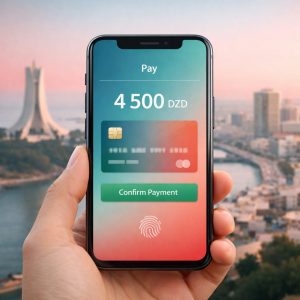
Algerie Poste officially launched Baridi Pay on June 14, 2025, introducing QR code-based mobile payments to Algeria’s predominantly cash-driven retail economy. The payment flow is deliberately simple: a merchant displays their unique QR code at their point of sale, the customer opens the BaridiMob app, scans the code, confirms the amount, and the payment transfers instantly from the customer’s CCP account to the merchant’s commercial CCP account. Both parties receive confirmation via SMS.
This simplicity is deliberate. Algeria’s previous digital payment attempts stumbled on complexity — card readers required merchant investment, internet connectivity was unreliable in many areas, and user experience could not compete with the convenience of cash. Baridi Pay reduces the merchant’s technology requirement to a single printed QR code and the customer’s requirement to a smartphone with BaridiMob.
For merchants, onboarding requires a commercial CCP account, an operational mobile phone number, a trade register (RC), and a tax identification card. No card reader or special equipment is needed. These requirements are manageable for formal businesses but exclude Algeria’s substantial informal economy.
Strategic Rollout Through Pharmacies
Algerie Poste chose to launch Baridi Pay in pharmacies and small neighborhood shops before expanding to other sectors. This phased approach is strategic. Pharmacies handle frequent, relatively small transactions where cash management is a genuine burden. Neighborhood shops (epiceries) are the most common retail touchpoint for Algerian consumers — the environment where payment habits are formed.
The rollout builds on the CCP Business platform launched previously for merchant account management. Baridi Pay adds the consumer-facing payment layer on that foundation, extending BaridiMob’s utility from a personal finance tool — balance checks, CCP transfers, bill payments, mobile recharges — to a comprehensive payment platform. A planned upgrade will enable CCP-to-bank-account transfers through BaridiMob in 2026, further expanding the ecosystem.
Advertisement
The Scale Advantage
Baridi Pay’s competitive advantage is its pre-existing user base. Algerie Poste operates 27.5 million CCP accounts across its 4,000+ offices nationwide. These account holders do not need to create new accounts or adopt an unfamiliar platform. Algeria’s 37.8 million internet users and high smartphone penetration, particularly among the under-35 demographic that represents the majority of the population, provide the demand-side infrastructure.
The daily transaction limit has been progressively increased to accommodate the vast majority of retail purchases. For larger transactions, traditional banking channels remain available.
Policy Tailwinds: Cashless by 2028
The regulatory environment is actively pushing toward digitization. In October 2025, the Bank of Algeria announced an ambitious target of transitioning Algeria to a cashless society by 2028. The Finance Act 2025 introduced measures to discourage large cash transactions, including banning cash payments for real estate transactions. Article 141 provides corporate income tax reductions for banks and Algerie Poste corresponding to commissions on electronic payment transactions — a direct financial incentive for facilitating digital payments.
Algeria has also issued its first fintech regulation for Payment Service Providers, creating a regulatory framework for companies building payment infrastructure. This combination of policy push and regulatory clarity creates the most favorable environment for digital payment adoption that Algeria has seen.
The Cash Economy Barrier
Despite policy support, structural barriers persist. Many small merchants prefer cash for anonymity, tax avoidance, and zero digital literacy requirements. Baridi Pay’s formal onboarding requirements limit adoption to the formal sector. Internet reliability in rural and semi-urban areas can disrupt real-time transactions — a failed payment erodes consumer trust faster than successful transactions build it.
Payment fragmentation is another challenge. Multiple systems — CCP Business, Baridi Pay, WimPay, Gifty — create confusion rather than critical mass. Unlike Kenya’s M-Pesa, which dominated through a single platform, Algeria’s landscape is scattered across several competing systems.
Comparing to successful international models reveals both strengths and gaps. Like M-Pesa, Baridi Pay leverages an existing distribution network (4,000+ offices) and pre-existing account base. Unlike M-Pesa, it lacks merchant cash-in/cash-out through agents. Like India’s UPI, it uses QR codes within a single system. Unlike UPI, it does not yet support interbank transactions — customers with commercial bank accounts cannot use Baridi Pay without a CCP account.
The challenge is not technology but behavior. Converting millions of daily cash transactions into digital payments requires consistent reliability, merchant incentives, and a consumer experience that is genuinely more convenient than carrying cash.
Frequently Asked Questions
What is Baridi Pay and how does it work?
Baridi Pay is a QR code-based mobile payment service within the BaridiMob app by Algerie Poste, launched June 14, 2025. Customers scan a merchant’s QR code, confirm the payment amount, and funds transfer instantly from the customer’s CCP account to the merchant’s commercial CCP account. No card or cash is needed, and both parties receive SMS confirmation.
What does a merchant need to accept Baridi Pay?
Merchants need a commercial CCP account, an operational mobile phone number, a trade register (RC), and a tax identification card. Once approved, the merchant receives a unique QR code to display at their point of sale. No card reader or special equipment is required, making adoption essentially free for formal businesses.
Can Baridi Pay realistically replace cash in Algeria by 2028?
The Bank of Algeria has set a 2028 cashless society target, and Baridi Pay has the technical capability and user base (27.5 million CCP accounts) to drive adoption. However, replacing cash depends on merchant adoption rates, network reliability, and overcoming the informal economy’s preference for cash. The Finance Act 2025 tax incentives and real estate cash ban signal regulatory commitment, but behavior change at the merchant level remains the critical bottleneck.
Sources & Further Reading
- Algerie Poste Launches Baridi Pay Mobile Payment Service — DzairTube
- Service Paiement Mobile BaridPay — Algerie Poste Official
- Algeria to Become Cashless Society by 2028 — Diplomatic Courier
- Algeria Enacts 2025 Finance Law — EY Tax Alert
- Algeria Opens for Fintech: New PSP Rules — LaunchBase Africa
- BaridiPay QR Code Payment in Algeria — BaridiMob.com
🔗 Related Intelligence

Wimpay-BNA: Algeria’s First Contactless Mobile Payment App Reaches 137K Users
From 95% COD to Digital Trust: How Algerian Platforms Are Shifting Payments

Mobile Payments: BaridiMob Has 5M Users — Why Isn’t Everyone Using It?

Gifty Algeria: Building Digital Payment Rails in a Cash-First Economy