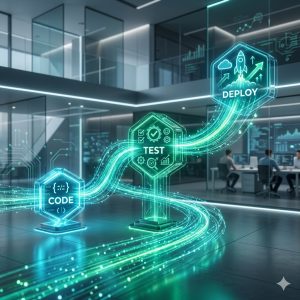
Software development is being rewritten — by software. In the span of two years, AI has moved from generating autocomplete suggestions to planning architectures, writing tests, reviewing pull requests, and deploying production code. The shift is not incremental. It is structural. And it is changing what it means to be a software developer.
This hub brings together ALGERIATECH’s coverage of how artificial intelligence is transforming the practice of building software — from the tools developers use daily to the philosophical questions about what code itself becomes when machines can produce it faster than humans can read it.
The Big Picture
The transformation of software development through AI is not a single story. It is a collection of interconnected shifts happening simultaneously: new tools, new workflows, new career skills, and new questions about the nature of code itself. Our pillar guide covers the full landscape.
- How Artificial Intelligence Is Transforming Software Development — The comprehensive guide to AI’s impact on software engineering, from code generation to testing to deployment. How the developer role is evolving and what comes next. (Pillar)
Advertisement
Tools and Techniques
AI coding tools have fragmented into specialized categories, each with different strengths. Understanding the landscape is essential for any team making tooling decisions.
- AI Coding Assistants: The Tools Reshaping Development — A comparative analysis of GitHub Copilot, Cursor, Claude Code, Windsurf, and the assistants that now write a quarter of all new code at major tech companies.
- Vibe Coding: The New Way Developers Build Software — Andrej Karpathy coined the term. Collins Dictionary made it Word of the Year. Vibe coding — building software through natural language conversation with AI — is reshaping how developers think about the act of programming.
- AI Development Workflows: How Teams Integrate AI — Beyond individual tools, enterprise teams are restructuring their entire CI/CD pipelines, code review processes, and development workflows around AI capabilities. The teams that treat AI as an add-on see modest gains. The teams that rebuild see transformations.
The Deeper Questions
AI-generated code raises questions that go beyond productivity metrics. What happens to technical debt when code can be regenerated from specifications? What does code review mean when the author is a neural network?
- Disposable Software: When AI Makes Code Temporary — When a module can be regenerated in minutes rather than refactored over weeks, the calculus of software maintenance changes fundamentally. An examination of what happens when code becomes cheap and specifications become the durable artifact.
From the Archive
These published articles provide additional context on the tools and trends shaping AI-powered software development.
- Cursor vs Windsurf: The AI IDE Landscape — How the new wave of AI-native IDEs compares to traditional editors enhanced with AI plugins.
- Claude Code Mastery: 7 Levels of AI-Assisted Development — A practical framework for progressing from basic AI code completion to fully autonomous agent-directed development.
This hub is part of ALGERIATECH’s AI coverage, exploring how artificial intelligence is reshaping technology, business, and society.
🔗 Related Intelligence

AI in Software Development: How AI Is Transforming the Industry

AI Coding: How Artificial Intelligence Is Rewriting Software Development
Artificial Intelligence
The AI Revolution Explained: Agents, Infrastructure, and the Future of Software