En bref : Training GPT-4 reportedly cost $78 to $100 million or more in compute alone. Google’s Gemini Ultra likely exceeded that figure. The next generation of frontier models — trained on clusters of 100,000 or more GPUs — may cross the $1 billion threshold. AI compute scaling follows mathematical laws that make each generation exponentially more expensive, concentrating frontier AI development among fewer than ten organizations worldwide. This article explains the scaling laws, the economics, and why the cost curve is forcing the industry to rethink how models are built.
In 2020, OpenAI spent an estimated $4 to $5 million training GPT-3, according to Stanford HAI analysis — a 175-billion-parameter model that took roughly 3,640 petaflop-days of compute. Four years later, GPT-4’s training cost was estimated at $78 to $100 million — Sam Altman himself described it as “more than $100 million.” By 2025, credible estimates placed the compute budget for frontier models from Anthropic, Google, and OpenAI in the $300 million to $500 million range per training run. The AI infrastructure race is not just about building data centers. It is about whether the exponential cost of training ever bends downward.
The mathematics behind this escalation are not speculative. They are governed by scaling laws — empirical relationships between model size, data volume, compute budget, and performance — that have held remarkably stable across five orders of magnitude. Understanding these laws is understanding why AI compute scaling has become the central economic constraint of the entire field.
Scaling Laws Explained
In January 2020, researchers at OpenAI — Jared Kaplan, Sam McCandlish, and colleagues — published a paper that changed how the industry thinks about model development. They demonstrated that language model performance improves predictably as a power law function of three variables: the number of parameters (N), the size of the training dataset (D), and the amount of compute (C) used for training.
The critical finding was that performance gains were smooth and predictable. Double the compute, and you get a roughly fixed improvement in loss. There were no discontinuities, no plateaus — just a relentless, quantifiable relationship between resources and capability. This meant that model performance could be forecast with surprising accuracy before a single GPU was allocated.
In 2022, DeepMind’s Chinchilla paper refined these laws. Kaplan’s original work had suggested that scaling model parameters was more efficient than scaling data. Chinchilla showed the opposite: the optimal strategy was to scale both parameters and data roughly equally. A model with 70 billion parameters trained on 1.4 trillion tokens outperformed a 280-billion-parameter model trained on fewer tokens at the same compute budget.
The practical implication was enormous. The industry had been building models that were too large and training them on too little data. Chinchilla did not change the fundamental cost trajectory — it corrected the recipe. But the bill kept growing.
The Cost Curve
The compute required to train state-of-the-art AI models has been doubling approximately every six months since 2010, according to analysis by Epoch AI. That is a far steeper curve than Moore’s Law, which describes a doubling in transistor density roughly every two years.
To appreciate the scale: GPT-3 in 2020 required approximately 3.14 x 10^23 floating-point operations. GPT-4 in 2023 required an estimated 2.15 x 10^25 — nearly 70 times more. Each generation pushes into territory where even hyperscale GPU clusters strain under the load.
Hardware improvements partially offset this growth. NVIDIA’s H100 GPU delivers roughly three times the AI training throughput of its predecessor, the A100. The B200 doubles that again. But these gains arrive on a roughly two-year cadence, while compute demand doubles every six months. The gap is structural, and it is widening.
The cost is not just GPUs. A single frontier training run requires massive data preparation pipelines (petabytes of curated text, code, and multimodal data), distributed storage systems, high-bandwidth networking to synchronize gradients across thousands of GPUs, and engineering teams that can debug failures in clusters where any one of 100,000 components might fail on any given day.
Anatomy of a Training Run
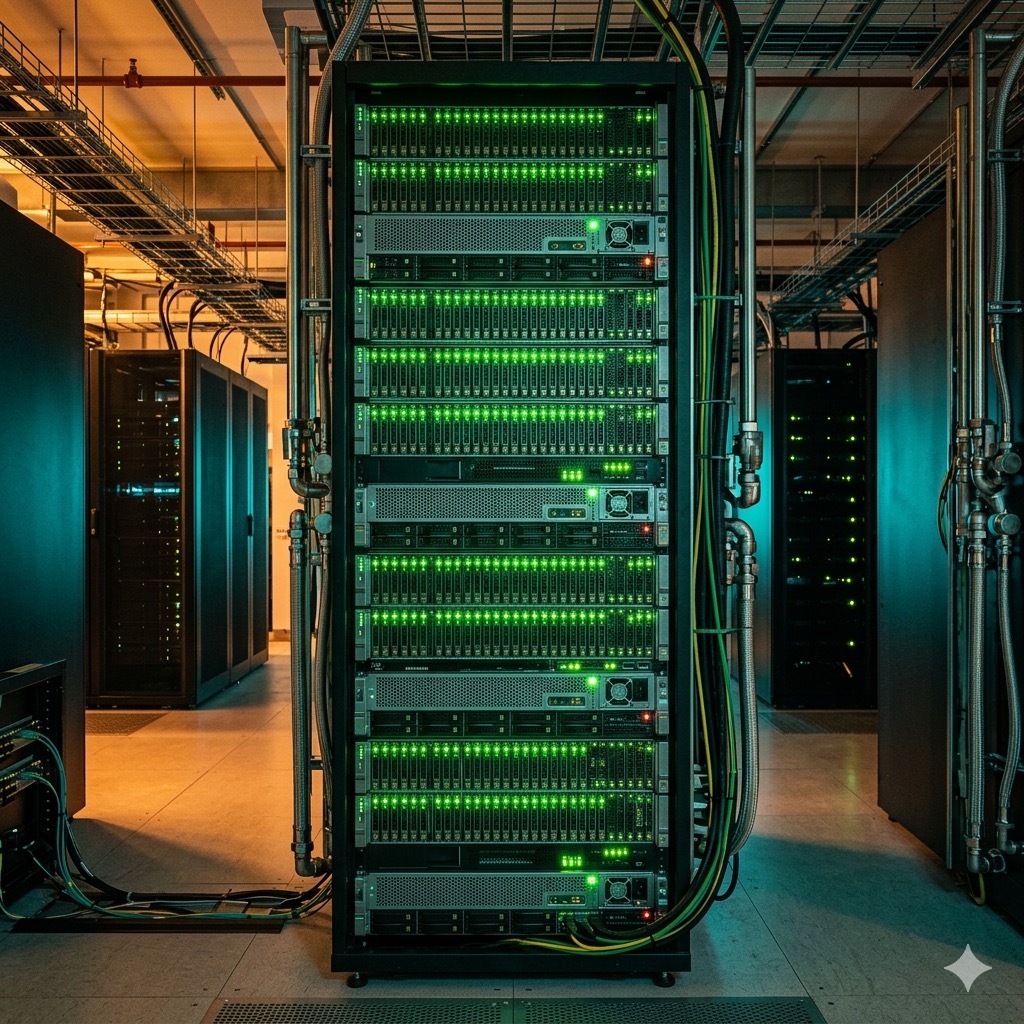
Consider what a $200 million training run actually looks like. A hypothetical frontier model in 2026 might train on a cluster of 32,000 NVIDIA B200 GPUs, connected via NVLink within nodes and InfiniBand between them, housed in a purpose-built AI data center drawing 150 megawatts.
The training run might last three to four months. During that period, the cluster runs 24 hours a day, seven days a week. Checkpoints — full snapshots of model weights — are saved every few hours to distributed storage, consuming petabytes of disk space. If a hardware failure corrupts a checkpoint, the run rolls back hours or days of work.
GPU utilization — the percentage of time each GPU is actually performing useful computation — is a critical efficiency metric. State-of-the-art training frameworks achieve 38 to 55 percent Model FLOPs Utilization (MFU), meaning that roughly half of the GPU’s theoretical compute capacity is consumed by communication overhead, memory transfers, and pipeline bubbles. Improving MFU by even a few percentage points can save tens of millions of dollars on a frontier training run.
Data pipelines are equally critical. Training data must be deduplicated, filtered for quality, tokenized, and shuffled — often multiple times. The Chinchilla scaling laws dictate that a 1-trillion-parameter model should ideally train on roughly 20 trillion tokens. Assembling, cleaning, and staging that volume of data is an engineering challenge that rivals the training itself.
Advertisement
Who Can Afford This?
The economics of AI compute scaling have created a natural oligopoly. As of early 2026, fewer than ten organizations in the world can credibly afford to train frontier foundation models: OpenAI (backed by Microsoft), Google DeepMind, Anthropic (backed by Amazon and Google), Meta, xAI (backed by Elon Musk’s capital), Mistral (backed by European investors), and a handful of Chinese labs including ByteDance and Alibaba.
This concentration is not primarily about talent — though frontier AI researchers are scarce — but about capital. A single training run that costs $500 million requires not just the cash but also the cloud infrastructure to execute it. Securing 30,000 GPUs for four months means either owning the hardware or negotiating enormous reserved-capacity contracts with GPU cloud providers.
The result is a widening gap between frontier labs and everyone else. Universities, startups, and government research institutions that could contribute to fundamental AI research in 2020 can no longer afford to train competitive models. The compute barrier to frontier research has risen by roughly three orders of magnitude in five years.
Efficiency Innovations
The industry is not passively accepting the cost curve. Several architectural and methodological innovations are pushing back against exponential scaling.
Mixture-of-experts (MoE) architectures activate only a fraction of a model’s total parameters for any given input, dramatically reducing the compute required per token while maintaining the capacity of a much larger model. Mixtral 8x7B, for example, uses 12.9 billion active parameters out of a total 46.7 billion, achieving performance competitive with models several times its effective size.
Knowledge distillation — training smaller “student” models to replicate the behavior of larger “teacher” models — offers another path. A distilled model might achieve 90 percent of its teacher’s performance at 10 percent of the parameter count. This does not reduce the cost of training the teacher, but it dramatically reduces the cost of deploying AI at scale.
Synthetic data generation, where existing models produce training data for future models, is quietly reshaping the data side of the equation. This approach raises quality-control challenges — models can amplify their own biases through recursive self-training — but it partially decouples training scale from the finite supply of high-quality human-generated text.
Curriculum learning, where models are first trained on simpler data and gradually exposed to harder examples, can improve training efficiency by 20 to 30 percent in some settings, reducing total compute without sacrificing final performance.
The Inference Pivot
There is an irony at the heart of AI compute scaling: the most expensive part of a model’s lifecycle is shifting from training to inference.
Training a frontier model is a one-time (or few-time) cost, amortized across every user and every query the model ever serves. Inference — the cost of actually running the trained model to generate responses — is a per-query cost that scales linearly with usage.
OpenAI reportedly serves hundreds of millions of queries per day across ChatGPT and its API. At even fractions of a cent per query, the annual inference bill dwarfs training costs. Google’s integration of Gemini into Search — handling billions of daily queries — makes inference the dominant compute expense by a wide margin.
This pivot is driving demand for a different hardware profile. Training optimizes for raw throughput and GPU-to-GPU bandwidth. Inference scaling optimizes for latency, cost per token, and energy efficiency. Custom silicon — Google’s TPUs, Amazon’s Trainium and Inferentia, Microsoft’s Maia — is increasingly designed for inference economics rather than training peak performance.
The AI revolution was built on the insight that scaling compute predictably improves AI capability. The question now is whether the industry can keep climbing a cost curve that doubles every six months — or whether efficiency innovations and architectural breakthroughs will bend it into something sustainable.
Frequently Asked Questions
What is ai compute scaling?
AI Compute Scaling: Why Training AI Costs Billions covers the essential aspects of this topic, examining current trends, key players, and practical implications for professionals and organizations in 2026.
Why does ai compute scaling matter?
This topic matters because it directly impacts how organizations plan their technology strategy, allocate resources, and position themselves in a rapidly evolving landscape. The article provides actionable analysis to help decision-makers navigate these changes.
How does the cost curve work?
The article examines this through the lens of the cost curve, providing detailed analysis of the mechanisms, trade-offs, and practical implications for stakeholders.
Sources & Further Reading
- Kaplan et al. — Scaling Laws for Neural Language Models (OpenAI, 2020)
- Hoffmann et al. — Training Compute-Optimal Large Language Models (Chinchilla, DeepMind 2022)
- Epoch AI — The Training Compute of Notable AI Models Has Been Doubling Roughly Every Six Months
- Stanford HAI — AI Index Report 2025
- Fortune — Why the Cost of Training AI Could Soon Become Too Much to Bear
- SemiAnalysis — GPT-4 Architecture, Infrastructure, Training Dataset, Costs
🔗 Related Intelligence

AI Compute Scaling: Why the Shift from Training to Inference Changes Everything
AI Training vs AI Inference: The Two Economies of Artificial Intelligence

Test-Time Compute: The Scaling Law That Does Not Need More Training Data

AI Dev Workflows: How Engineering Teams Actually Ship Software with AI in 2026