
🧭 Decision Radar
Relevance for Algeria
Medium
▾
Infrastructure Ready?
Partial
▾
Skills Available?
Partial
▾
Action Timeline
Monitor only
▾
Recommended readers: Algerian agricultural cooperatives, agronomic researchers, residue-processing project teams
Decision Type
Educational
▾
Quick Take: An Algerian evaluation should define the intended residue and the records required, then test local suitability. Financing and digital tracking should not be treated as proof of crop benefits or carbon permanence.
Funding the move toward repeatable deployment
Cotierra raised USD 3 million to move its decentralised biochar technology toward repeatable commercial scale. The important word for a prospective customer is “toward”. This is financing for an intended industrial transition, rather than proof that every requirement for a repeatable commercial installation has already been met. The announcement should prompt questions about delivery and evaluation, rather than stand in for the answers.
According to Comunicaffe International, the financing brings cumulative funding to approximately USD 4.75 million. Keeping the new financing separate from the cumulative amount avoids overstating the round. The approximation should also remain visible: the reported total is not an exact figure to be silently converted into a more precise claim. Neither amount provides a measured outcome for a particular customer or crop.
The same reporting identifies PINC and Carbon Removal Partners as co-leaders of the financing. This identifies who backed the transaction. It does not supply an agronomic result, a reactor acceptance report or a guarantee about carbon outcomes. A buyer should keep financing evidence in its appropriate place while building a separate record of the technical and operational evidence required for the intended installation.
There is no need to assign the round a financing-stage label that the supplied claims do not provide. The useful story is already concrete: the company has raised capital for commercialisation, and potential users need to establish what commercial readiness would mean in their own circumstances. That evaluation should address the physical equipment and the accompanying information system together, without allowing either to obscure the other’s requirements.
Coffee experience and a broader intended market
Vestbee reports that Cotierra initially deployed its technology in coffee supply chains. That is the starting application described in the supplied reporting. It should not be rewritten as proof that the same process has already been validated across all agricultural residues. A prospective customer working with another input should ask what has actually been tested with that input and what remains part of a proposed trial.
Cotierra plans to expand into cocoa, cotton and citrus supply chains. Those are expansion plans, not a list of completed deployments. For an evaluator, the distinction suggests a clear question: is the proposed application part of the company’s existing experience or part of the expansion programme? A supplier’s response should be documented at the level of the proposed use, rather than inferred from a list of intended markets.
The financing supports industrialisation of Cotierra’s reactor technology and digital platform. This links the manufacturing and information components of the commercialisation effort. An assessment should therefore examine what is being supplied in both categories. Ask what the reactor proposal includes, what the digital service includes and how responsibility is allocated when a record is incomplete or an operating question arises. These are suggested contracting questions, not assertions about undisclosed product features.
A reactor and a record are different kinds of evidence
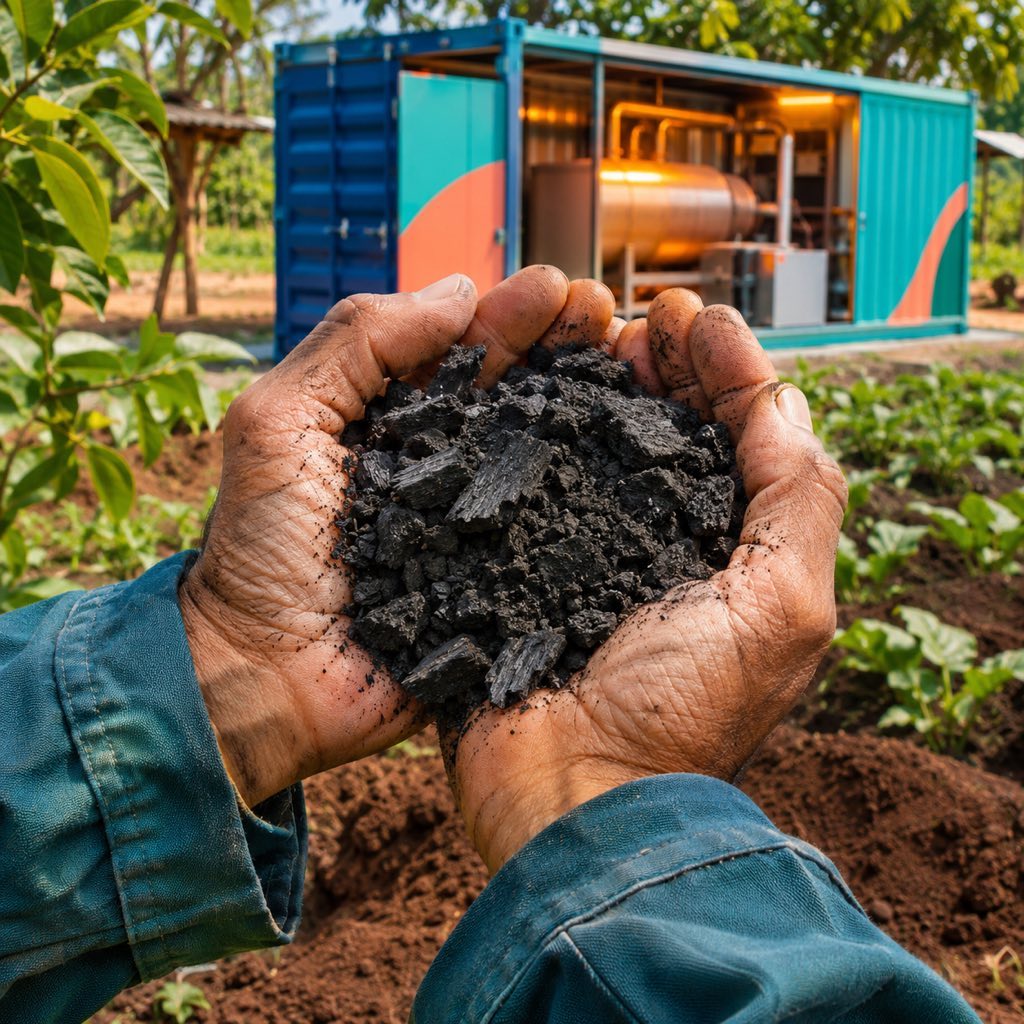
On its website, Cotierra describes a reactor that converts coffee residues into biochar. That company description explains the stated process. It does not establish a measured yield gain, suitability for a particular Algerian soil or a quantified carbon-removal result. A reader should resist turning an explanation of what equipment does into a claim about every outcome that might be associated with its use.
Cotierra also says it uses IoT and a digital application to track biochar production and application. Tracking is therefore part of the company’s stated approach. For a prospective user, the next questions concern the content, accessibility and interpretation of those records. What would be recorded for the proposed deployment? How would the user check completeness? What evidence would be required to support a separate claim about the resulting agricultural or carbon outcome?
The central analytical distinction is between a record of an activity and proof of an effect. A proposed evaluation should define both, then identify which evidence could answer each question. Digital records could be useful within that assessment, but their existence should not be treated as the conclusion. Any assertion about soil benefits or permanence would require supporting evidence beyond the company descriptions supplied here.
Advertisement
How Algerian evaluators should frame a pilot
1. Define the local application before discussing scale
Start with a written description of the intended residue, the proposed operating context and the decision the pilot is meant to support. Ask the supplier to distinguish experience with that input from plans to evaluate it. Do not assume that a stated expansion market proves suitability for a specific local project. A pilot proposal should explain what would be tested, who would observe the process and what result would justify a next step. If that definition is missing, discussions about wider deployment should remain provisional. This is a recommended evaluation method, not evidence that an Algerian project is already underway.
2. Specify what the digital record must demonstrate
Before accepting a monitoring proposal, identify the records the evaluation team needs and the person responsible for reviewing them. Ask how production and application entries would be linked to the activities they describe. Separate the question of whether an activity was recorded from the question of whether a claimed benefit occurred. The team should also ask what it would receive if it needed to inspect the underlying information. The purpose is to define a usable evidence package for the proposed project, rather than presume that the presence of an application supplies all the information needed for a decision.
3. Keep agronomic and carbon conclusions conditional
Agree in advance which conclusions the pilot could reasonably support. For an Algerian proposal, seek local agronomic evidence before asserting soil benefits or crop suitability. Ask separately what evidence would be required for any carbon claim, and avoid assigning a removal volume or a permanence conclusion without it. A commercial evaluation can proceed as a bounded test while those questions remain open. Documenting those limits makes the eventual decision easier to assess: the team can say what was demonstrated, what was not measured and what additional work would be needed before considering a broader commitment.
Commercial repeatability is the question to watch
Cotierra’s financing points toward an industrialisation agenda that encompasses reactors and digital tracking. For a potential customer, the meaningful test is whether a proposed deployment can be specified, delivered and evaluated on terms the customer understands. The funding story creates a reason to investigate that question. It does not establish the answer for every residue, crop or operating environment.
The Algerian connection is consequently a conditional evaluation opportunity. Teams interested in distributed residue processing could examine the approach, provided they keep local suitability, agricultural outcomes and carbon claims as separate evidence requirements. The strongest next step would be a clearly bounded proposal whose success criteria are stated before operation. Until that evidence exists, neither financing nor a digital platform should be converted into an assertion of local deployment, proven soil improvement or independently demonstrated carbon permanence.
Frequently Asked Questions
What is the financing intended to support?
It supports industrialisation of the reactor technology and digital platform. The stated objective is a move toward repeatable commercial deployment.
Are the planned expansion crops already validated everywhere?
The supplied reporting describes planned expansion beyond the initial coffee application. It does not establish suitability for every crop, residue or local operating environment.
Does digital tracking prove a soil or carbon benefit?
The company describes tracking biochar production and application. That description does not independently prove soil benefits, a quantified removal volume or carbon permanence.
Sources & Further Reading
- Financing amount, cumulative funding and investors — Comunicaffe International
- Commercialisation plans and supply-chain expansion — Vestbee
- Company descriptions of reactor and digital tracking — Cotierra
- Paulig’s venture arm PINC co-leads €2.6 million investment in Cotierra to strengthen coffee supply chain resilience — Paulig Group