🧭 Decision Radar
Relevance for Algeria
Low
▾
Infrastructure Ready?
No
▾
Skills Available?
No
▾
Action Timeline
24+ months
▾
Algerian logistics and freight operators, Sonatrach (industrial operations), Ministry of Industry, local manufacturing associations
Decision Type
Educational
▾
Quick Take: Algerian logistics and manufacturing operators should treat 2026’s whole-body reasoning gains as a multi-year-out trend to monitor rather than a near-term purchase — the more immediate opportunity locally remains conventional warehouse automation (conveyors, basic AGVs, WMS software) that delivers ROI without requiring humanoid robotics infrastructure.
From Showcase to Industrial Proving Ground
For years, humanoid and general-purpose robots were judged almost entirely on demo videos — a single robot folding a shirt or walking a stage under tightly controlled conditions. That benchmark has shifted in 2026. Robots are now being measured on whether they can sustain repeatable, unscripted work inside live operations, and logistics and warehousing have become the first sector willing to put that claim to the test.
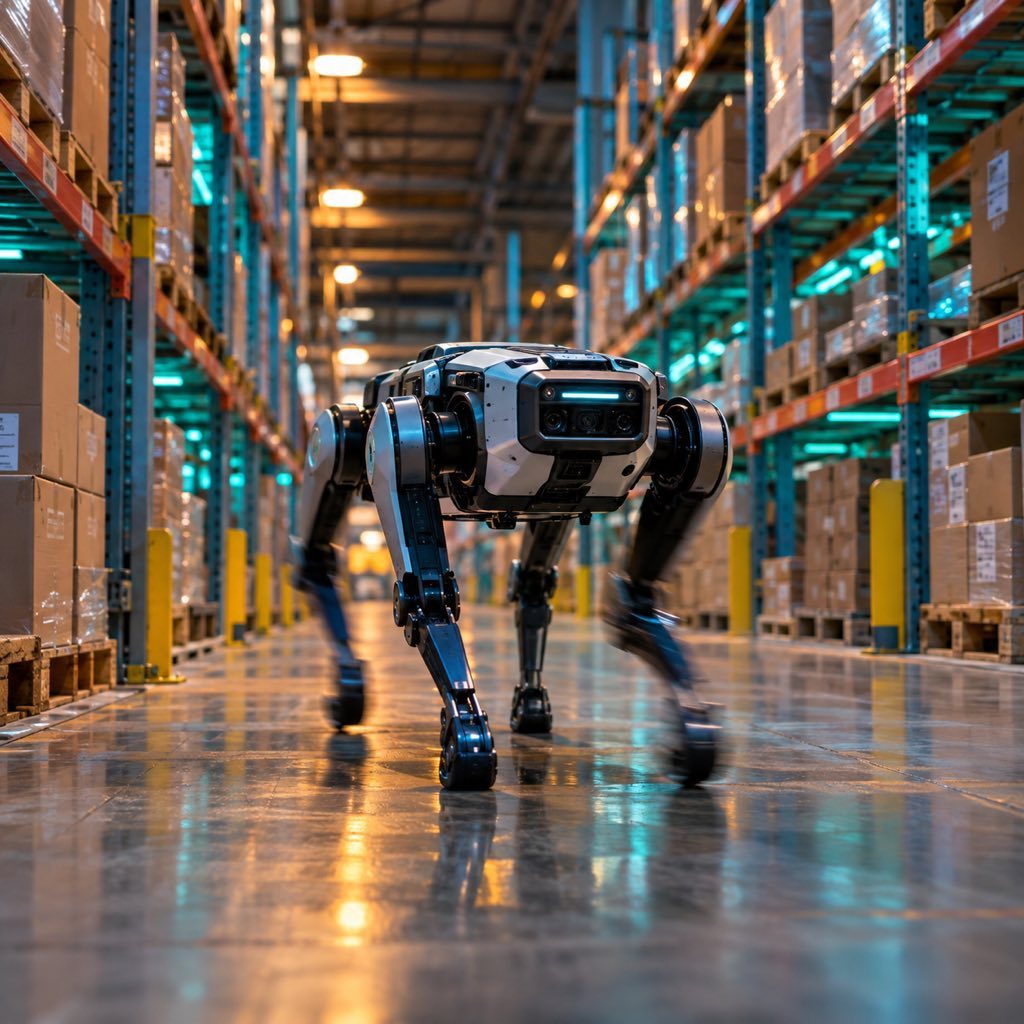
Agility Robotics’ Digit robot has moved more than 100,000 totes inside a commercial GXO Logistics warehouse — not a pilot demo, but ongoing operational work measured over time. Separately, Figure’s Figure 03 humanoid has autonomously executed a full pick-pack sequence — scanning, grasping, flipping, and depositing packages — processing approximately 249,600 parcels across roughly 200 hours of operation. Both figures point to the same underlying shift: robots are increasingly able to reason about their whole body’s movement and coordinate multi-step physical tasks well enough to run for extended periods without human intervention between each action.
Why Whole-Body Reasoning Is the Missing Piece
Earlier generations of warehouse robots were largely single-purpose — automated guided vehicles that follow fixed paths, or robotic arms bolted to one station performing one repetitive motion. What has changed in 2026 is the emergence of systems that can interpret a visual scene, plan a sequence of actions across an entire body (legs, torso, arms, and grip simultaneously), and adapt that plan in real time as objects, obstacles, or task requirements shift. That whole-body coordination is what allows a single humanoid platform to walk, bend, grasp an irregular object, and place it correctly — the kind of generalized physical competence that fixed-purpose robots were never designed to have.
Crucially, the software coordination layer sitting above the hardware has become the harder and more valuable engineering problem than building a better robot body. A humanoid chassis with strong actuators is now a comparatively solved problem across multiple vendors; the differentiator is whether the AI system controlling it can plan, adapt, and recover from unexpected situations without a human resetting the task.
Advertisement
The Scale Numbers Behind the Shift
The throughput data reinforces that this is now an operations story, not a research story. Amazon has surpassed one million robots in operation across its fulfillment network, and DHL Supply Chain has crossed more than 500 million robot-enabled picks using Locus Robotics’ autonomous mobile robots. Even so, adoption remains far from universal: Interact Analysis forecasts that only around 26% of warehouse sites will have meaningful automation by 2027, while Gartner predicts half of newly constructed warehouses in developed markets will be robot-centric by 2030 — a forecast about future builds rather than a retrofit of existing facilities.
1. Expect warehouses and logistics to remain the proving ground before farms and care settings catch up
Because warehouses offer structured environments, high repetition, and clear ROI metrics (totes moved, parcels processed per hour), they remain the sector best suited to validate whole-body reasoning at commercial scale before the same robots are trusted in less structured settings like farms or care facilities.
2. Treat the coordination software, not the robot chassis, as the competitive differentiator
Buyers evaluating humanoid or general-purpose robotics vendors should weight software-layer capability — task planning, real-time adaptation, failure recovery — more heavily than raw hardware specifications, since multiple vendors have converged on broadly comparable physical platforms.
3. Watch integration bottlenecks, not just picking speed, as the real constraint on ROI
Faster in-warehouse picking only improves delivery outcomes if those events reach downstream cut-off times for transport and customer fulfillment — meaning the biggest remaining barrier for many operators is systems integration, not robot capability itself.
What This Means for the Physical AI Timeline
The gap between language AI and physical AI has narrowed measurably in 2026, but the throughput numbers also show the limits of where things stand: even the best-performing deployments are measured in hundreds of thousands of parcels or totes, not the billions of transactions that fully mature logistics automation would eventually require. The realistic read is that 2026 marks the year physical AI moved from research demo to sustained commercial pilot — a meaningful and necessary step, but still a step before the farm, care-setting, and manufacturing-floor deployments that current whole-body reasoning gains are meant to eventually unlock.
Frequently Asked Questions
What does “whole-body reasoning” mean for robots?
It refers to a robot’s ability to interpret a visual scene, plan a coordinated sequence of movements across its entire body (legs, torso, arms, grip), and adapt that plan in real time — rather than executing one fixed, pre-programmed motion at a single station.
What evidence shows robots moving from demos to real deployment in 2026?
Agility Robotics’ Digit has moved more than 100,000 totes inside a commercial GXO Logistics warehouse, and Figure’s Figure 03 has autonomously processed approximately 249,600 parcels across roughly 200 operating hours — both measured over sustained operational periods rather than single demonstration runs.
How widespread is warehouse robotics adoption expected to be?
Interact Analysis forecasts only around 26% of warehouse sites will have meaningful automation by 2027, while Gartner projects half of newly constructed warehouses in developed markets will be robot-centric by 2030 — indicating steady but still partial adoption over the coming years.
Sources & Further Reading
🔗 Related Intelligence

Humanoid Robotics Gold Rush: $14 Billion and the Race to Automate Warehouses

Robotics Foundation Models: The Real Breakthrough Is Software, Not Hardware
The Humanoid Robot Race: How AI Is Powering the Next Generation of Physical Automation

Neuro-Symbolic AI: The 100x Energy Breakthrough Reshaping Robotics in 2026