The Policy That Flipped the Chip War
For three years the story of US-China chip policy was one of escalating American restriction. In January 2026 that logic inverted. On 13 January 2026, the Bureau of Industry and Security (BIS) revised its license-review policy, moving exports of Nvidia’s H200 and comparable chips to China and Macau from a “presumption of denial” to case-by-case review. A day later, on 14 January, the White House added a 25% Section 232 tariff on advanced AI chips meeting the same performance thresholds. The rule set precise technical limits — total processing performance below 21,000 and DRAM bandwidth below 6,500 gigabytes per second — and capped shipments to China and Macau at no more than 50% of what an exporter ships to US customers.
The conditions were stringent. Exporters must certify that banned end-users cannot access the chips “even remotely or after the sale,” and third-party laboratory testing on US soil is required before shipment. One nuance is worth flagging up front: the widely repeated “25% payment to the US” conflates two different things. The 25% import tariff is real and in force; the notion of a 25% revenue share paid to the government traces to political announcements rather than the regulatory text, which does not impose a direct payment-to-government licensing condition. Treat the tariff as fact and the “revenue share” as framing.
Nvidia Loaded the Trucks — Then Beijing Said No
Nvidia moved fast. Drawing on existing inventory, the company reportedly prepared to ship roughly 80,000 to 82,000 H200 GPUs to China before the Lunar New Year — the largest legal China shipment since 2022. That “82,000” figure rests on a single Reuters report and appears interchangeably as “80,000,” so it is best read as a reported estimate rather than a firm audited number.
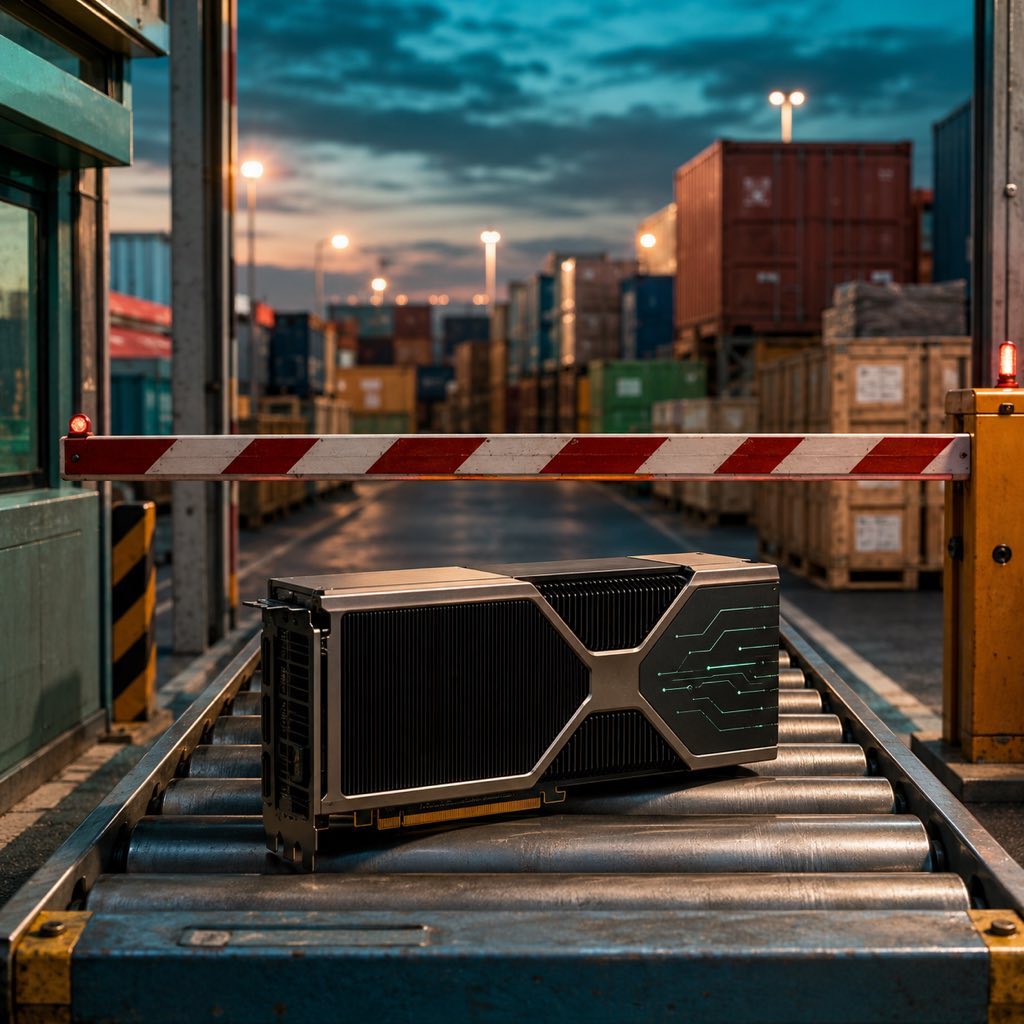
The shipments did not go through. In mid-January 2026, reporting carried by Yahoo Finance said Chinese customs agents had been told the H200 chips were “not permitted”, and the Financial Times reported that Nvidia’s suppliers halted H200 component output around 17 January. Crucially, this was not a published, gazetted ban — authorities gave no public reasons and no indication whether the directive was permanent, temporary, or a bargaining chip. In parallel, Beijing summoned domestic technology firms and pressed them not to buy the H200 “unless necessary,” steering them toward domestic alternatives such as Huawei’s Ascend line. The bottleneck had flipped: the constraint was no longer a US export ban but Chinese demand suppression and industrial-policy gatekeeping.
A Trickle by August
By late summer the picture had softened only marginally. On 18 August 2026, wire reporting carried by Yahoo Finance said ByteDance and Tencent had each received about 10,000 H200s — the first meaningful deliveries, but roughly 13% of the per-firm license cap. Beijing reportedly wanted most licensed chips kept in Hong Kong, where they can legally be handled, rather than moved to the mainland — a deliberate move to protect domestic chipmakers. Notably, other major buyers such as Alibaba and JD.com did not appear in the August deliveries.
Here the sources genuinely disagree, and honesty requires naming it. The August wire reporting described firms cleared to purchase large per-company volumes — up to 100,000 units each in one account, while other reporting on the same licensing framework has cited a lower per-firm ceiling, against which the widely quoted “roughly 13%” delivered is calculated. The figures cannot be fully reconciled from the public record, so the safe reading is that the per-company caps are large but their exact ceiling is contested — and, more importantly, that actual deliveries have run far below whichever ceiling applies.
Advertisement
The Balance Sheet Tells the Real Story
Nvidia’s own financials are the least ambiguous evidence of how little is actually flowing. When the earlier H20 line was blocked, Nvidia took a $4.5 billion charge in the first quarter of fiscal 2026 on stranded inventory and could not ship $2.5 billion of H20 revenue. Chief executive Jensen Huang described China as an “effectively closed” market worth roughly $50 billion, with Nvidia’s China GPU share falling from about 95% toward 50%.
The most recent numbers confirm the freeze persists. In its second-quarter fiscal 2027 results, reported on 26 August 2026, Nvidia posted record revenue of $96.2 billion — but Hopper shipments to China amounted to less than 1% of data-center revenue, and the company assumes zero China data-center compute revenue in its guidance. Whatever the policy permits on paper, the H200-to-China channel remains economically negligible eight months after Washington opened it.
The National-Security Countercurrent
The reversal did not go unchallenged in Washington. On 28 January 2026, the House Select Committee on the Chinese Communist Party wrote to Commerce warning that H200 access could aid the People’s Liberation Army and Chinese models such as DeepSeek, calling the no-military-use certification effectively unenforceable given China’s military-civil fusion strategy. A proposed AI Overwatch Act, which would give Congress a review window over advanced-chip licenses, advanced in committee but remained pending — not law — as of August 2026. Enforcement pressure is real too: US prosecutors alleged that roughly $160 million of export-controlled Nvidia GPUs were smuggled to China, part of a broader illicit trade estimated in the hundreds of millions to over $1 billion.
The unresolved tension is structural. Washington wants to sell enough to keep Chinese AI dependent on American hardware while withholding the true frontier; Beijing wants access without dependence, and is willing to throttle its own firms’ purchases to build domestic substitutes. Neither side has fully won, which is why the H200 sits in limbo — legal, tariffed, and largely unbought.
What It Means for the Global Chip Order
The H200 episode marks a maturation of the chip war from blunt prohibition to a contest of managed interdependence. The lesson for everyone downstream is that export policy is now bidirectional: a US license is necessary but no longer sufficient, because the importing state can veto with an unwritten customs instruction. That makes AI-hardware supply chains more political and less predictable, and it accelerates the bifurcation of the global compute stack into an American-aligned tier and a Chinese domestic tier built around Huawei Ascend. For any country buying AI infrastructure, the takeaway is that access now depends on which side of that divide your suppliers and cloud providers sit — and that the terms can change with a policy memo on either side of the Pacific.
Frequently Asked Questions
Did the US ban or allow Nvidia H200 exports to China?
Washington allowed them. On 13 January 2026 the Commerce Department’s BIS moved H200 licensing for China from a “presumption of denial” to case-by-case review, and a 25% tariff was added on 14 January. The constraint that then stalled shipments came from China, not the US — an informal customs directive and pressure on domestic firms not to buy.
How many H200 chips has China actually received?
Very few relative to what was cleared. Nvidia reportedly prepared to ship around 80,000–82,000 units in early 2026, but Chinese customs blocked entry. By 18 August 2026, ByteDance and Tencent had each received only about 10,000 H200s — roughly 13% of their per-firm license cap — with most licensed chips reportedly kept in Hong Kong.
Why would China block chips its own companies want?
Beijing is pursuing self-sufficiency. By discouraging H200 purchases and steering demand toward domestic alternatives like Huawei’s Ascend, Chinese authorities protect and grow their own chipmakers, even at the cost of short-term performance. The move reflects a strategic choice of independence over dependence on US hardware.
Sources & Further Reading
- Department of Commerce Revises License Review Policy for Semiconductors Exported to China — BIS
- BIS Revises Export Review Policy for Advanced AI Chips Destined for China and Macau — Morgan Lewis
- Nvidia prepares shipment of H200 AI GPUs to China as chip war lines blur — Tom’s Hardware
- Nvidia suppliers halt H200 output as China customs block bites — Reuters/FT via Yahoo Finance
- Nvidia H200 chips reach China in small shipments — Reuters via Yahoo Finance
- NVIDIA Announces Financial Results for Second Quarter Fiscal 2027 — NVIDIA Newsroom
- NVIDIA Q1 FY26 results (H20 charge disclosure) — SEC / NVIDIA
- House Select Committee on the CCP letter to Commerce on H200, DeepSeek and PLA use — U.S. House
- $160 million in export-controlled Nvidia GPUs allegedly smuggled to China — CNBC
🔗 Related Intelligence
The Chip Wall Backfires: US Export Controls Lock Nvidia Out of China

China’s 2026 Cybersecurity Law: AI Governance Clauses and Global Compliance Stakes
The MATCH Act: How New Chip Export Controls Could Reshape the Global AI Supply Chain

China’s Algorithm Pricing Ban: 29 Rules That Reshape E-Commerce