The Same Network Path Failed Twice in Weeks
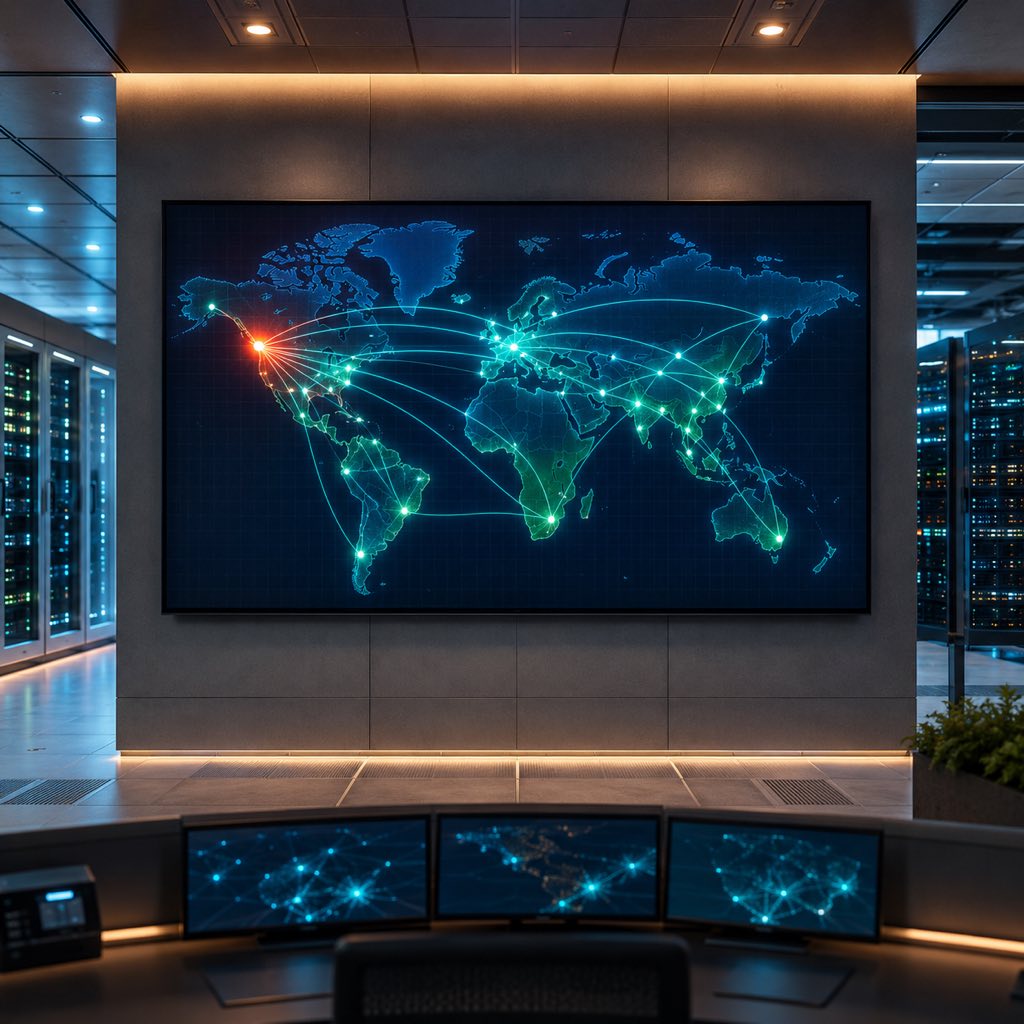
On July 24, 2026, AWS’s us-west-2 region — one of its largest, based in Oregon — lost connectivity to the outside world through a specific physical route. According to a detailed incident writeup, networking hardware that carries routing between the region and the Seattle Metro failed at 10:55 UTC. AWS engineers were engaged by 11:01 UTC, connectivity began returning at 11:15 UTC, and full routing convergence was not complete until 11:59 UTC — with a secondary Direct Connect disruption lingering until 12:12 UTC, a total incident window of roughly 77 minutes.
Ten AWS services were affected during that window, per the incident report: Direct Connect, Global Accelerator, Internet Connectivity, IoT Core, Site-to-Site VPN, API Gateway, EC2, ECS, Elastic Load Balancing, and VPC. Critically, compute running inside the region kept functioning — the failure was specifically at the ingress/egress boundary, meaning traffic already inside us-west-2 was fine, but anything trying to cross the region’s edge was not.
Weeks later, the same failure signature recurred. AWS again attributed the disruption to an internet connectivity and networking hardware problem on the network path connecting its US-WEST-2 region to the Seattle Metro area, which briefly also affected the neighboring US-WEST-1 region. The recurrence of an identical root-cause description — the same regional network path — is the detail that turned an isolated incident into a pattern worth scrutinizing.
Real Products Went Dark
The July 24 outage was not an abstract infrastructure event. According to a report on the disruption, Sony’s PlayStation Network went offline for users during the incident window, a visible, consumer-facing casualty of a backend networking failure most of those users would never otherwise know existed.
That is the general shape of modern cloud concentration risk: a single hardware fault in one metro-area network path can silently take down services with no obvious connection to each other or to Oregon, simply because they all happen to route traffic through the same regional edge.
A Pattern, Not a One-Off
Incident trackers documented the July 24 us-west-2 failure as the third major infrastructure failure in nine days across the industry, following a July 16 AWS CloudFront outage and a July 23 Azure West US outage — with two of the three tied specifically to region-boundary networking rather than compute or storage failures. The same incident report counted nine confirmed downstream incidents across seven other providers whose services depend on the affected AWS infrastructure, plus three more possible cascading incidents.
The pattern continued into August. Coverage of the recurrence characterized it as part of a fourth notable AWS reliability incident within roughly four months of 2026, following earlier incidents including a data center thermal event in May and a separate network disruption in June, with the August recurrence lasting roughly 80 minutes from first customer reports to AWS’s resolution notice.
Advertisement
Why This Keeps Making Regulators Nervous
AWS remains the largest cloud infrastructure provider by a wide margin. According to Synergy Research Group data cited by The Register, AWS held 28% of the worldwide cloud infrastructure market in the second quarter of 2026, ahead of Microsoft Azure’s 20% and Google Cloud’s 15% — with the three combined accounting for 67% of all cloud revenue that quarter, up from 63% a year earlier.
That scale is exactly why a single Oregon network link matters far beyond Oregon. Coverage of the August recurrence noted that consumer financial infrastructure — from Apple Pay to Coinbase to CME Direct — has been touched by an AWS incident at some point in 2026, and warned that concentration-risk concerns simmering in Washington and Brussels since 2025 could resurface now that a fourth incident within a matter of months has occurred on the same infrastructure family. When a market this concentrated experiences repeat failures with an identical stated root cause, the question shifts from “was this bad luck” to “is this an architectural weakness AWS has not yet fixed.”
What This Means for Engineering Teams Relying on a Single Cloud Region
1. Map your true blast radius before the next incident, not during it
Most teams know which services run “in AWS us-west-2.” Fewer teams know which of those services depend specifically on cross-region or internet-egress traffic versus traffic that stays entirely inside the region. Given that the July 24 incident left in-region compute running normally while only boundary-crossing traffic failed, teams should audit their architecture specifically for internet-facing load balancers, API Gateway endpoints, Direct Connect links, and Site-to-Site VPN tunnels — the exact service list AWS confirmed was affected — since those are the components most exposed to this specific failure mode recurring.
2. Treat “networking hardware between the region and its metro” as a named risk in your resilience plan
A vague “AWS could have an outage” risk entry is not actionable. A specific entry — “the network path between us-west-2 and Seattle Metro has failed at least twice in recent months with the same stated cause” — forces a concrete decision: accept the risk, add a secondary region for internet-facing traffic, or add a secondary cloud provider for the specific services most exposed. Generic multi-region AWS deployments that still route all external traffic through the same physical metro link do not actually solve this problem.
3. Build and test a genuine cross-region failover for internet-facing traffic specifically
Because the failure mode is boundary-crossing traffic rather than compute, a failover strategy that only handles “the whole region is down” will not trigger correctly when the actual failure is “the region is up internally but cannot reach the internet.” Failover automation should specifically test for external reachability, not just instance health checks, and should be validated against a simulated egress failure, not just a simulated regional outage.
4. Reassess multi-cloud as a resilience decision, not just a cost or lock-in decision
The recurring root cause across incidents — physical networking hardware on a specific metro path — is the kind of failure that a second AWS region cannot fully protect against if both regions share upstream network infrastructure or peering points. For services where even an hour of external unreachability is unacceptable (payments, real-time gaming infrastructure, safety-critical systems), evaluate whether a second cloud provider for that specific workload is now justified given AWS’s documented 2026 incident frequency, rather than treating multi-cloud purely as a negotiating lever for pricing.
The Structural Lesson
None of AWS’s 2026 incidents individually looks catastrophic — durations measured in tens of minutes to just over an hour, with in-region compute unaffected each time. What makes the pattern significant is the combination of recurrence, an identical stated root cause, and AWS’s outsized 28% share of a market that is itself increasingly concentrated among three providers controlling 67% of global cloud revenue. A single fragile network link between one region and one metro area is a local engineering problem when it happens once. When the same link fails again with the same explanation weeks later, and consumer financial and entertainment infrastructure spanning Apple Pay to PlayStation Network gets caught in the blast radius each time, it becomes a systemic question about how much of the internet’s plumbing runs through points AWS itself has not yet hardened.
Frequently Asked Questions
What caused AWS’s repeated us-west-2 outages in 2026?
AWS attributed both the July 24, 2026 incident and a later recurrence to networking hardware problems on the specific network path connecting its us-west-2 region in Oregon to the Seattle Metro area, according to incident reporting. The failure affected traffic crossing the region’s boundary — internet connectivity, Direct Connect, and VPN — while compute running inside the region continued operating normally.
What real-world services were affected?
During the July 24, 2026 incident, ten AWS services were disrupted including EC2, Elastic Load Balancing, API Gateway, and VPC, and Sony’s PlayStation Network went offline for users as a visible downstream consequence. Broader 2026 AWS incidents were reported to have touched consumer financial services including Apple Pay, Coinbase, and CME Direct at various points.
How dominant is AWS in the cloud market, and why does that matter for outages?
AWS held 28% of the global cloud infrastructure market in the second quarter of 2026, ahead of Microsoft Azure’s 20% and Google Cloud’s 15%, with the three providers together controlling 67% of cloud revenue, according to Synergy Research Group data reported by The Register. That concentration means a single AWS network failure has an outsized ripple effect across unrelated industries and services compared to an outage at a smaller provider.
Sources & Further Reading
- The July 24, 2026 AWS us-west-2 Outage: Network Routing and a Long Recovery Tail — IncidentHub
- AWS Outage Hits US-West-2: 4th Incident in 4 Months [2026] — Tech Insider
- The PSN is back online after AWS outage — TheSixthAxis
- Enterprise cloud infrastructure uptake shows no sign of slowing — The Register
🔗 Related Intelligence

Egress Costs Reimagined: AWS Interconnect GA and the End of Cloud Lock-In Economics

AWS and Google Cloud Just Made Multicloud Real: What the Interconnect Deal Changes

Multi-Cloud Gets Real: AWS, Google, and Soon Azure Unite on One Interconnect Standard

The Railway Outage: When One Cloud Provider Kills Your Entire Stack