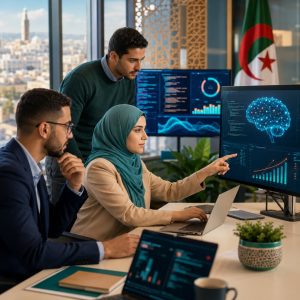
The Global Premium That Is Reaching Algeria
The salary premium for AI-certified professionals is no longer a Silicon Valley phenomenon. Skillupgradehub’s analysis of over 10,000 job postings found that certified AI professionals earn between 23% and 47% more than uncertified peers in equivalent roles in 2026 — a range that reflects both certification type and seniority, with the highest premiums concentrated in fine-tuning, MLOps, and RAG system expertise.
The global number matters for Algeria because it sets the expectation floor. Algerian private-sector employers — particularly the multinationals with Algerian offices (Huawei, Oracle, SAP, regional banking and telecom players) — do not operate in isolation from global compensation benchmarks. An Algerian software engineer at a multinational who holds an AWS Certified Machine Learning Specialty credential is visible to the same recruiting ecosystem that places engineers in Paris or Dubai. That visibility creates upward pressure on local compensation that is independent of domestic supply-and-demand dynamics.
Algeria’s labour market in 2026 is characterised by 8-12% per annum salary growth in technology, banking, and financial services, driven by expanding demand and currency dynamics. Against that backdrop, AI certification functions as a multiplier: it accelerates the salary trajectory that the broader market is already moving in. The question for Algerian professionals is not whether the global premium will reach them — it is already present in multinational hiring — but how quickly it propagates into purely domestic private-sector firms.
The Certification Landscape: What Employers in Algeria Actually Recognize
1. Huawei certifications: the home-court advantage in Algeria’s tech market
Huawei’s HCIA-AI (Huawei Certified ICT Associate in AI) and HCIP-AI (Professional level) credentials have a specific advantage in the Algerian market that international certifications do not: direct employer recognition from the country’s dominant enterprise technology partner. Algeria’s September 2026 Ministry-Huawei joint diploma program for cloud, cybersecurity, and AI training creates a formal channel between credential and employment that does not exist for AWS or Google credentials — because Huawei is a direct employer and enterprise partner in Algeria in ways that AWS and Google currently are not.
For Algerian candidates targeting roles at Sonatrach’s digital transformation units, Djezzy, Ooredoo, Algeria Telecom, or any of the large industrial firms that have signed Huawei enterprise partnerships, the Huawei AI certification stack is the highest-ROI credential available. It signals fluency in the specific technology ecosystem that those employers are actually using.
The practical path: HCIA-AI at the associate level requires approximately 60-80 hours of preparation and costs less than 15,000 DZD for exam fees through authorized training centres. The Algeria National AI Training Programme launched in April 2026 explicitly prepares candidates for this certification pathway through its 12-week Ministry programme.
2. AWS and Google credentials: the signal for multinational and remote roles
AWS Certified Machine Learning Specialty correlates with approximately a 20% salary premium globally; Google Professional ML Engineer with approximately a 25% premium. For Algerian professionals targeting multinational employers with Algerian offices, or remote roles with European or North American companies, these credentials are the recognized market signal.
The practical gap for Algerian candidates has historically been exam accessibility — AWS and Google Professional exams require online proctoring infrastructure that was unreliable in Algeria until 2024. By mid-2026, both AWS and Google have expanded their online proctoring availability to Algeria through Pearson VUE, removing the access barrier. Candidates with strong English and mathematics foundations can prepare for the AWS ML Specialty in approximately 3-4 months of part-time study; the Google ML Engineer in 4-6 months.
For candidates without a machine learning background, the entry-level credentials — AWS AI Practitioner and Google Cloud AI Fundamentals — serve as market-recognizable entry signals for business-facing AI roles (product management, AI project coordination, enterprise sales engineering) without requiring deep technical depth.
3. Microsoft Azure AI credentials: the highest demand in Algeria’s banking sector
Algeria’s banking sector — BNA, BEA, CPA, Société Générale Algérie, BNP Paribas El Djazaïr — is the private-sector segment where AI credential demand is growing fastest. The sector’s digital transformation programs run overwhelmingly on Microsoft infrastructure (Azure, Power BI, Microsoft 365 Copilot), making Microsoft’s AI credentials — specifically Azure AI Fundamentals (AI-900) and Azure AI Engineer Associate (AI-102) — the most directly applicable certifications for banking sector roles.
The 2026 Compensation Trends from Ravio found that AI and ML hiring grew 88% year-over-year globally, with financial services as the second-fastest-growing sector. In Algeria, the banking sector’s AI ambitions are constrained by talent: the combination of French language fluency, banking regulatory knowledge, and Azure AI skills is sufficiently rare that employers are willing to pay significant premiums to candidates who bring all three.
AI-900 (Azure AI Fundamentals) is a 3-4 week preparation credential accessible to non-technical banking professionals. AI-102 (Azure AI Engineer Associate) requires approximately 2-3 months of preparation for candidates with a software development background and is the credential that commands the highest premium in Algerian banking sector hiring.
Advertisement
What This Means for Algerian Professionals
The certification landscape described above is not uniform — the right credential depends on the employer target. The decision matrix is simple:
- Targeting Sonatrach, Djezzy, Ooredoo, industrial conglomerates: Huawei HCIA-AI or HCIP-AI
- Targeting multinational offices or remote international roles: AWS ML Specialty or Google Professional ML Engineer
- Targeting banking, financial services: Microsoft Azure AI Fundamentals + Azure AI Engineer Associate
- Entry-level or career-changing from non-technical roles: AWS AI Practitioner or Azure AI Fundamentals as signal credentials
The 8-12% annual salary growth that characterises Algeria’s private technology sector is a tailwind for certified professionals regardless of which track they choose. Certification accelerates placement within that growth curve; without it, Algerian professionals are competing on experience alone in a market where credential differentiation is increasingly the first-pass filter.
The Government’s 500,000 ICT specialist target by 2027 creates structural demand at the lower end of the credential stack — basic digital literacy certifications will see widespread adoption. The salary premium opportunity is concentrated in the mid-to-upper tier: candidates who go beyond basic certification into specialist AI tracks command a wage outcome that is meaningfully differentiated from the commodity credential market.
The Regional Benchmark: What Comparable Markets Show
Across MENA, the salary premium pattern for AI-certified professionals follows a consistent curve: markets with strong multinational presence (Dubai, Riyadh, Casablanca) show higher absolute premiums earlier; markets with strong domestic tech sectors developing independently (Cairo, Tunis) show lower absolute premiums but faster percentage growth as domestic demand catches up. Algeria sits between these two archetypes: significant multinational presence in telecom and energy, growing domestic fintech and IT services sector.
The practical implication is that the certification premium in Algeria is currently concentrated in multinational and hybrid employers — but the domestic premium is growing. The 2025 baseline in Algerian IT services showed AI-certified professionals earning approximately 15-20% more than uncertified peers; by end-2026, that spread is projected to reach 25-30% as domestic employers face the same talent shortage pressures that multinationals have been navigating for two years.
Algerian professionals who certify in 2026 are entering at the inflection point — early enough to benefit from scarcity premium, late enough that the employer recognition infrastructure (known credentials, Pearson VUE exam access, Ministry-backed programs) is sufficiently developed to make the investment low-risk.
Frequently Asked Questions
Which AI certification has the highest ROI for Algerian professionals in 2026?
The answer depends on target employer. For roles at multinationals or remote international positions, AWS Certified Machine Learning Specialty (approximately 20% salary premium) and Google Professional ML Engineer (approximately 25% premium) have the highest global recognition. For roles at Algerian banking and financial services firms, Microsoft Azure AI Engineer Associate (AI-102) is the most directly applicable credential. For roles at Algerian industrial conglomerates and telecoms using Huawei infrastructure, Huawei HCIA-AI or HCIP-AI credentials have home-court recognition advantage. Entry-level candidates should start with AWS AI Practitioner or Azure AI Fundamentals (both achievable in 3-4 weeks) before advancing to specialist tracks.
Is the global 56% AI skills wage premium relevant in Algeria where salaries are lower in absolute terms?
Yes — because the mechanism is relative, not absolute. A 56% premium on an Algerian IT salary of 150,000 DZD/month is 84,000 DZD — the same relative uplift regardless of the base. More importantly, the premium in Algeria’s private sector is currently concentrated in multinational employers who use global compensation benchmarks adjusted for local purchasing power. As domestic firms adopt the same credential requirements, the premium will propagate through the broader market. Algerian professionals who certify early capture both the current multinational premium and the future domestic premium as the market converges.
How does Algeria’s 12-week Ministry AI training program relate to formal certification?
The April 2026 Ministry programme at the Centre of Excellence in the Digital Economy in Sidi Abdellah is explicitly designed to prepare candidates for AI certification pathways, culminating in a joint Ministry-Huawei diploma from September 2026. This means the programme functions as both training and credential: graduates who complete it emerge with the practical skills to pass entry-level Huawei AI certifications and with a government-recognized diploma that domestic employers in Algeria understand. The programme does not currently prepare candidates for AWS or Google certifications, which require additional self-study. It is best understood as a Huawei-track credential programme embedded in the vocational training system.
—
Sources & Further Reading
- AI Salary Premium 2026: The 56% Premium — Let’s Data Science
- AI Certification Salary Guide: 23-47% Premium for Certified Professionals — Dumpsgate
- Algeria Launches 12-Week AI Training Programme — TechAfrica News
- Algeria Launches National AI Training Program to Build Digital Skills — Ecofin Agency
- AI and ML Hiring Grew 88% Year-Over-Year — Highest Paying AI Jobs 2026
- Algeria Salary Guide 2026 — MaxisHR
🔗 Related Intelligence

AI Certifications for Algerian Developers: Azure, Google, and AWS Paths

Algeria Job Summit 2026: Which AI and Tech Skills Employers Are Hiring For

Algeria Private Sector AI Upskilling: How Companies Build Internal AI Talent in 2026

From ESI to Employment: The AI Fluency Roadmap Algerian Graduates Need in 2026