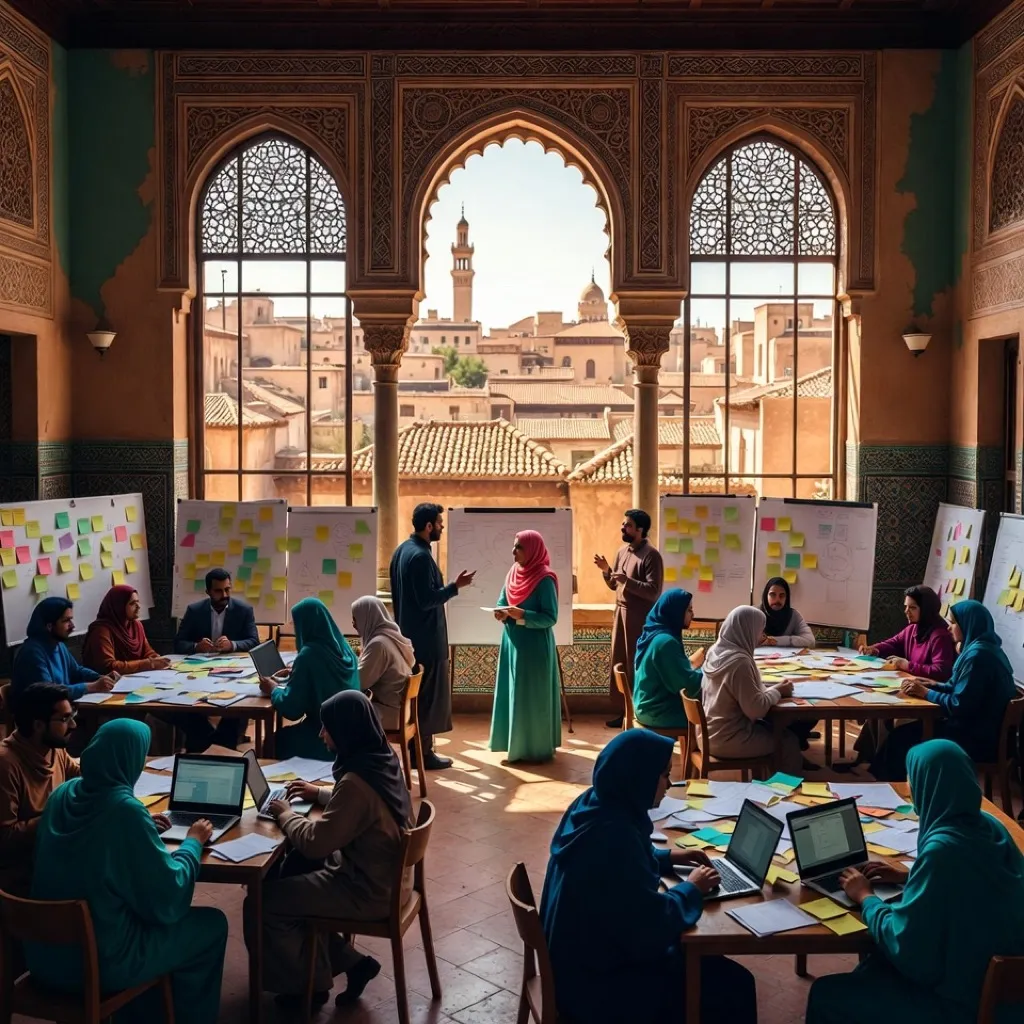
Three years ago, Algeria’s presence at global tech exhibitions was close to invisible. Today, a 50-startup delegation occupies the “largest African stand” at VivaTech Paris, an investment fund for African tech companies is being launched from Algiers, and the country is hosting 35,000-delegate trade fairs that generate billions in projected deals. The shift is real — and for Algerian founders, understanding how to leverage international exhibitions has become a core business skill.
Algeria’s Growing International Startup Footprint
Algeria’s startup ecosystem has reached over 9,000 labeled companies, with a government target of 20,000 by 2029. Behind that headline number is a quieter transformation: the ecosystem is becoming outward-looking. Government ministries now co-fund international booth space. State accelerator Algeria Venture (A-Venture) helps founders prepare investor-grade pitches in English and French. And Algerian startups are no longer arriving at global events as observers — they’re coming as exhibitors with products that attract genuine interest.
The turning point came roughly in 2023-2024, when the Ministry of Knowledge Economy, Startups and Micro-Enterprises began treating international exhibition participation as a strategic pillar rather than a discretionary expense. That policy shift opened the door to what Algerian founders are experiencing today.
VivaTech Paris: Algeria’s European Gateway
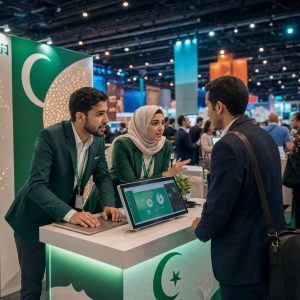
The clearest proof of Algeria’s new approach came at VivaTech Paris 2024, held May 22-25 at the Porte de Versailles exhibition center. For the first time, Algeria sent approximately 50 startups and entrepreneurs to the event — and for the first time, the country occupied a large dedicated national pavilion. Observers noted it was the largest African stand at that edition, a claim that would have seemed absurd just two years prior.
The delegation covered a remarkably wide range of sectors. BK Robotronic showcased Hoggar, a fully automated solar panel cleaning robot that navigates panel lines up to 100 meters autonomously and recharges itself without human intervention — a product with obvious commercial appeal in the solar-heavy Gulf and North African markets. BK Fire presented a firefighter robot for emergency response scenarios. Another startup showed an educational robotics kit targeting schools. Namlatic, described as Algeria’s first dedicated hotel booking platform, was already listing over 300 hotels across 43 Algerian cities at launch, with booking confirmation in approximately five minutes and support for both local (CIB/EDAHABIA) and international payment methods.
VivaTech matters for Algerian startups specifically because of its European dimension. The first three days of each edition are reserved for B2B professional networking — investor meetings, partnership discussions, corporate pilot conversations. For startups targeting European distribution, EU funding programs like Horizon Europe, or French-speaking African expansion, Paris is the right room to be in.
Minister Yacine Oualid attended and committed publicly to providing greater international visibility for Algerian digital sector actors. That political signal translated into practical support: booth subsidies, pitch coaching, and coordination of the delegation’s travel and logistics.
GITEX: Two Tracks to Know
GITEX operates as two distinct opportunities for Algerian startups. The first is GITEX Global (Dubai, October), the world’s largest annual tech and startup event, drawing over 200,000 visitors from 180 countries and 6,000+ exhibitors. The startup-focused “Expand North Star” track within GITEX Global is particularly valuable for founders seeking Gulf market access, regional investor introductions, or media coverage that reaches Arabic-speaking tech communities across the MENA region.
The second track — and arguably the more immediately practical one — is GITEX AFRICA (Marrakech, Morocco, held annually in May). The 2024 edition brought together 1,500+ exhibitors from 130+ countries, with Algeria among the African nations formally represented alongside Morocco, Nigeria, Egypt, Kenya, South Africa, Ghana, and Senegal. For Algerian startups, GITEX Africa offers proximity benefits: no long-haul flights, a common regulatory context, and French-language networking that feels natural.
Algeria Venture supports startups preparing for GITEX through its acceleration program’s market access component, including partnerships with the Google for Startups MENA network that help founders connect with the broader regional ecosystem.
Advertisement
Algiers as a Host: The IATF 2025 and African Startup Conference
Beyond attending international events, Algeria is now hosting them — and that matters strategically for the local ecosystem.
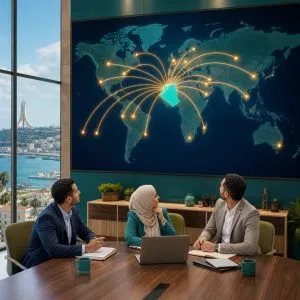
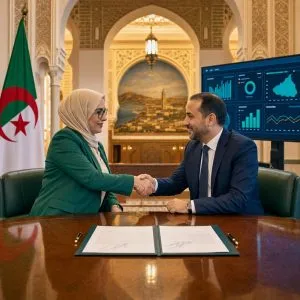
In September 2025, Algiers hosted the fourth edition of the Intra-African Trade Fair (IATF 2025), the most significant trade event on the African continent. Over 35,000 visitors from 140+ countries converged on the capital, with 2,000+ exhibitors and an estimated $44 billion in projected trade and investment deals. The African Development Bank and Algeria’s Ministry signed a joint partnership to boost startups and SMEs across the continent — a deal announced on the sidelines of an event Algiers was hosting for the first time.
Three months later, in December 2025, Algiers hosted the 4th African Startup Conference under the theme “Raising African Champions.” The scale was striking: 25,000+ participants, 35+ ministerial delegations from across the continent, 200+ exhibitors, 300+ international experts, and 150+ investors. The conference produced the “Algiers Declaration,” a commitment by African ministers to support continental startups in regional and international market expansion, improve funding access, and establish tax frameworks favorable to innovation.
President Tebboune announced the creation of a new investment fund for African startups at the conference’s margins. The fund’s structure was not yet finalized publicly, but the signal was clear: Algeria is positioning itself as the infrastructure hub for African startup ambition, not just a participant in someone else’s event.
What Actually Gets Done at These Events
International exhibitions are often portrayed as networking theater — expensive booths, business cards that never convert, and exhausted founders flying home with nothing to show. The Algerian startups who are extracting real value know what to aim for.
Investor meetings are the primary objective for early-stage startups. Pre-scheduling 8-12 investor meetings before the event — not hoping to meet investors on the floor — is the standard practice. A-Venture’s acceleration program includes investor pitch preparation specifically calibrated for international audiences.
Distribution partnerships are the goal for product-stage startups. Namlatic’s hotel platform, for example, is a product that benefits from European travel agency partnerships that can only be established in person.
Media coverage in regional tech publications (Wamda, Magnitt, Jeune Afrique Tech, Tech.eu for European audiences) often requires journalists to physically see a product or founder. VivaTech and GITEX are both heavy media environments.
Recruitment — specifically finding diaspora engineers willing to return or work remotely for Algerian companies — happens at these events more than founders expect.
How to Get There: Government Support and Realistic Costs
The Ministry of Knowledge Economy covers a portion of exhibition costs for delegations coordinated through A-Venture or official channels. The exact subsidy structure varies by event and year — founders should contact A-Venture directly well in advance (typically 3-4 months before the event) to confirm the application process for the current cycle.
Realistic costs for an exhibitor (not just an attendee) at VivaTech or GITEX Africa include floor space rental, booth design and materials, flights, hotel (Paris and Dubai are expensive markets), and staff time. A modest 6m² booth presence at VivaTech can run €8,000-15,000 all-in before subsidy. Government support can offset 30-50% of that for approved delegations, but founders should not plan on full reimbursement.
Practical Guide for First-Time Exhibitors
Six months before: Confirm whether your startup qualifies for the official national delegation (generally requires a valid startup label and alignment with the Ministry’s sectoral priorities for that event). Apply immediately.
Three months before: Finalize your English-language pitch deck and one-pager. If your product has a demo, ensure it works without internet connectivity — exhibition hall WiFi is never reliable. Identify the 10 investors, 5 potential partners, and 3 journalists you want to meet and begin outreach before the event.
At the event: Arrive a day early for setup. Your first 90 minutes each morning matter most — traffic to stands peaks early. Every conversation that has potential should end with a concrete next step booked before the person walks away.
Post-event: Follow up within 48 hours. The standard at these events is that most booths never follow up at all — being among the minority who do is a genuine differentiator.
Frequently Asked Questions
What is algeria on the global stage?
Algeria on the Global Stage: How Startups Are Winning at GITEX and VivaTech covers the essential aspects of this topic, examining current trends, key players, and practical implications for professionals and organizations in 2026.
Why is algeria on the global stage important for Algeria?
This topic is significant for Algeria because it intersects with the country’s digital transformation goals, economic diversification strategy, and growing technology ecosystem. The article provides specific context for Algerian stakeholders.
How does vivatech paris: algeria’s european gateway work?
The article examines this through the lens of vivatech paris: algeria’s european gateway, providing detailed analysis of the mechanisms, trade-offs, and practical implications for stakeholders.
Sources & Further Reading
- VivaTech Paris: Discover the Hoggar robot developed by an Algerian startup — TSA-Algerie
- Educational robot, firefighter robot: Algerian innovations at VivaTech Paris — TSA-Algerie
- The 4th African Startup Conference in Algiers held — The AZB
- IATF 2025: African Development Bank and Algeria strengthen partnership to boost startups and SMEs — AfDB
- Algeria startup ecosystem 2025: Reforms driving tech innovation and growth — Techpression
- Algeria Venture (A-Venture) Overview — Startup Algeria
- Algiers Declaration Adopted: 4th African Startup Conference ends on high note — Eurasia Media Network
- IATF2025 kicks off in Algiers as leaders call for acceleration in Intra-African trade — Afreximbank