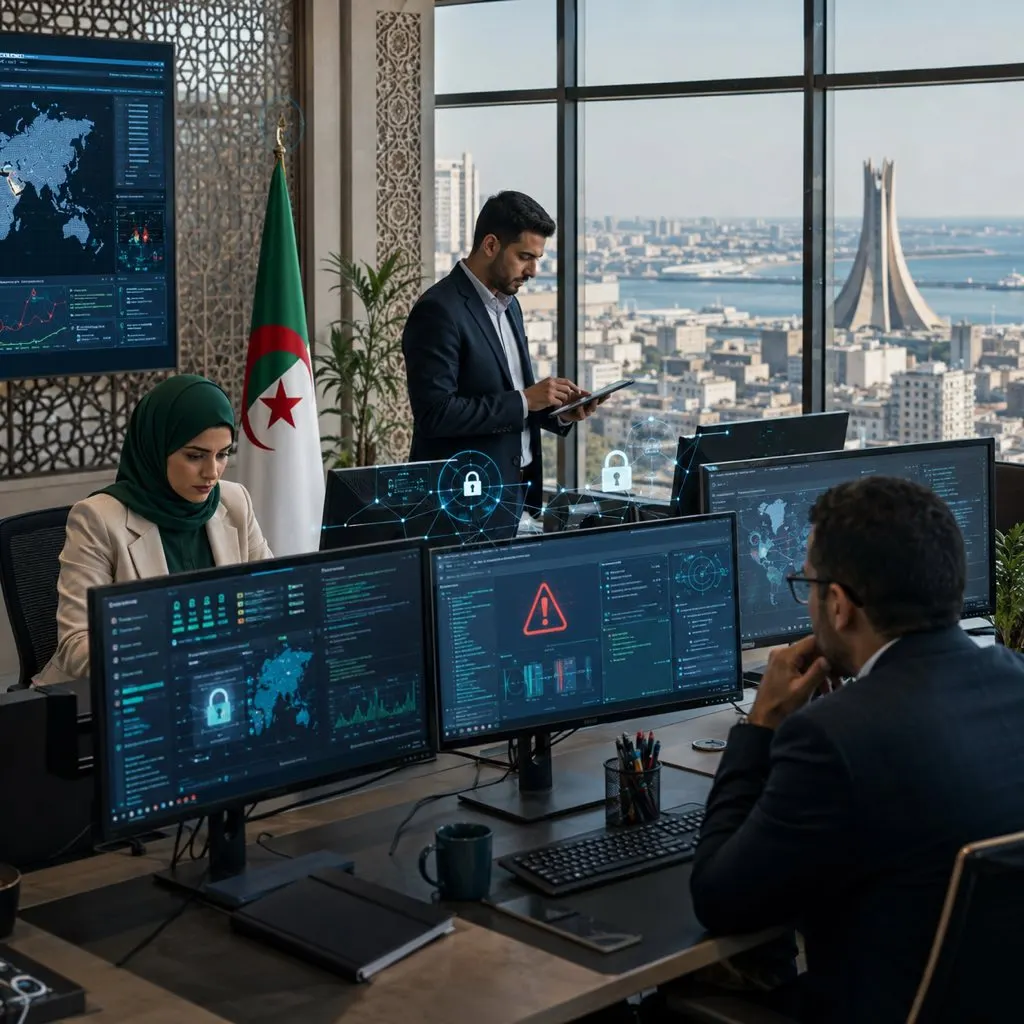
Why BEC Is the Top Risk for Algerian SMBs in 2026
North Africa’s security landscape changed measurably in the twelve months ending January 2026. Cyber incidents have become the ranked number-one business risk across African markets according to the Allianz Risk Barometer 2026, displacing natural catastrophes and macroeconomic volatility that dominated prior years. Within that threat portfolio, BEC — attacks in which a criminal impersonates a trusted business contact via email to redirect wire transfers or extract sensitive credentials — sits at the apex.
The mechanics are deceptively simple. An attacker registers a domain that closely resembles your supplier’s address (algeriasupply.com vs algeriasuppIy.com — a lowercase L replacing an uppercase I), spoofs a payment request citing a “bank account change,” and routes your transfer to a mule account in a jurisdiction without mutual legal assistance. The target is almost always the accounts-payable clerk, not the CTO. Small businesses lose an average of $4,500 per BEC incident globally, though enterprise-targeting campaigns now average $120,000 per incident according to Microsoft’s SMB ransomware research.
Algeria’s digital acceleration makes the exposure structural. E-commerce turnover is growing, cross-border B2B payments are increasing as Algerian SMBs integrate into the Mediterranean supply chain, and the shift to cloud-based communication platforms has expanded the attack surface for intercepted or spoofed correspondence. Meanwhile, AI-generated phishing has removed the linguistic tells — the grammatical errors and awkward phrasing — that previously allowed trained employees to flag suspicious emails. In 2026, BEC emails are written in fluent Arabic, French, and Darija, personalized with the target’s real name, position, and recent business context scraped from LinkedIn and public procurement databases.
Critically, Africa’s cybersecurity market is still in formation. Mordor Intelligence projects the market will grow from USD 0.77 billion in 2026 to USD 1.44 billion by 2031 — a 13.3% CAGR driven primarily by expanding threat volume, not voluntary investment. Algerian SMBs operating in the gap between legacy email systems and the emerging security market are the actors most at risk during this transition period.
The AI Phishing Escalation
The BEC threat has evolved structurally in 2025-2026 in ways that invalidate most pre-2024 training and detection protocols. Three shifts define the current environment.
First, GenAI has commoditized personalization. Phishing-as-a-Service platforms now offer subscriptions for as little as $200 per month that provide customized BEC email generation, real-time victim profiling, and automated follow-up sequencing. The barrier to launching a convincing, localized BEC campaign against an Algerian exporter or logistics firm has dropped to the price of a cloud subscription.
Second, AI enables multi-channel coordination. A BEC campaign in 2026 does not start with a fake email — it starts with a LinkedIn connection request from a fabricated procurement officer, followed by two weeks of plausible business conversation, then a spoofed invoice request that arrives looking like the natural conclusion of a real relationship. The FBI classifies this as “Business Email Compromise via social engineering pretext” — the email fraud is just the final step in a multi-platform manipulation campaign.
Third, QR code phishing (quishing) has emerged as a mobile-first BEC vector specifically targeting payment authorization workflows in SMBs. Attackers embed malicious QR codes in invoice PDFs or WhatsApp messages, routing victims to credential-harvesting pages that capture banking logins directly. Algerian SMBs that process payment authorizations via mobile WhatsApp messages — a common workflow for businesses without formal ERP systems — are particularly exposed to this vector.
Advertisement
What Algerian SMB Security Officers Should Do to Protect Their Business
1. Implement DMARC, DKIM, and SPF on Every Business Domain — Not Just Your Primary One
Email authentication protocols are the non-negotiable technical foundation of BEC defense. DMARC (Domain-based Message Authentication, Reporting, and Conformance) combined with DKIM (DomainKeys Identified Mail) and SPF (Sender Policy Framework) prevents attackers from spoofing your domain to impersonate your CEO or finance director in emails to your vendors and clients. Setup requires DNS access and roughly four hours of technical configuration — it is free and it cuts outbound impersonation attacks that target your supply chain. Critically, you must also configure DMARC on every secondary domain your business owns — typosquatted lookalike domains registered by attackers frequently pass DMARC checks on the primary domain because the secondary domain has no protection. DZ-CERT publishes a Tunisian-Arabic-language guide to DMARC configuration that applies directly to .dz-registered domains.
2. Enforce a Dual-Authorization Rule for All Wire Transfers and Payment Changes
The single most effective process control against BEC is removing the ability of any single employee to authorize a wire transfer in response to an email request. Establish a written, signed policy: any payment exceeding DZD 500,000 (approximately €3,300) requires verbal confirmation via a previously-known phone number — not a number provided in the email requesting the payment — before processing. Payment change requests for existing vendors (new bank account, new IBAN, new beneficiary) require a second authorization from a manager who was not part of the original email chain. This procedure eliminates the fundamental vulnerability that BEC exploits: a single trusted employee acting in good faith on a plausible email. The FBI reports that this dual-authorization control is the primary factor distinguishing BEC-resistant from BEC-victimized organizations.
3. Train Your Accounts-Payable Team Specifically on BEC Scenarios, Not Generic Phishing Awareness
Generic “phishing awareness” training that shows employees pictures of suspicious email headers has no measurable impact on BEC resistance because BEC emails are not suspicious-looking. Effective training is scenario-specific: run quarterly tabletop exercises in which the security officer or a trusted external firm sends a realistic BEC simulation — a fake vendor payment-change request, a spoofed CEO wire-transfer request — to the accounts-payable and procurement team. Measure the click-through rate and correction rate. The Verizon 2025 Data Breach Investigations Report found phishing responsible for over one-third of all confirmed breaches globally, making it the leading breach cause; organizations with quarterly simulations reduced susceptibility by 64% compared to annual-only training programs.
4. Register Business Domains with DZ-CERT and Monitor for Lookalike Registrations
DZ-CERT operates a threat-alerting service for registered Algerian businesses that includes notifications when domains closely resembling your business name are newly registered in .dz and international TLDs. Lookalike domain registration is the most common precursor action to a BEC campaign — attackers typically register the spoofed domain one to three weeks before launching the email campaign, giving defenders a detection window. Registration with DZ-CERT is free and takes under thirty minutes. Additionally, use free tools such as MXToolbox’s domain spoofing checker and DMARC Analyzer’s monitoring dashboard to audit your email authentication posture weekly. Detection before the first malicious email is sent is fundamentally more effective than training employees to detect it after.
5. Establish a “Verify Before You Pay” Response Playbook for Suspected BEC Attempts
When an employee suspects a BEC attempt — a payment request that feels slightly off, a vendor bank-change notification without prior notice — they need a predefined response path, not a judgment call under time pressure. The playbook should be a single printed card on every finance desk: (1) Do not reply to the suspicious email. (2) Call the purported sender on a phone number from your existing contacts — never from the email footer. (3) Report the attempt to the internal security officer and to DZ-CERT’s incident reporting portal within 24 hours. (4) If a payment was already made, immediately call your bank’s fraud line and initiate a recall — the FBI’s Internet Crime Complaint Center (IC3) reports that banks successfully recover funds in roughly 70% of BEC cases when notification occurs within 24 hours of transfer. Time is the critical variable in recovery.
The Structural Picture for Algerian SMBs
The BEC threat is not solvable at the level of individual awareness. It is a structural challenge created by the combination of free AI content generation, commoditized phishing infrastructure, and the absence of mandatory email authentication standards for private-sector email domains in Algeria. ANSSI’s cybersecurity strategy for 2025-2029 identifies social engineering as a priority threat, but the enforcement mechanisms under Decree 26-07 focus on public institutions, leaving private-sector SMBs to implement defenses voluntarily.
In that gap, the practical answer for Algerian SMBs is a layered, low-cost defense stack: DMARC + DKIM + SPF authentication (free), dual-authorization payment procedures (zero cost, policy change only), quarterly BEC simulation training (available via DZ-CERT’s partner program), and DZ-CERT lookalike-domain monitoring (free). None of these require a dedicated cybersecurity team or a significant technology budget. They require deliberate process design and the discipline to enforce procedures even when trusted colleagues are asking for exceptions.
Africa’s cybersecurity market is growing at 13.3% annually because the threat is growing faster than the defense ecosystem. Algerian SMBs that build these foundations now are not simply protecting their cash flow — they are building the operational resilience that will be required for qualification in public procurement processes under Decree 26-07’s enforcement cascade.
Frequently Asked Questions
What is the most common BEC attack targeting Algerian SMBs specifically?
Vendor impersonation and invoice fraud are the dominant variants for Algerian SMBs: an attacker spoofs a regular supplier’s email address and sends a “bank account change” notification before a scheduled payment. A secondary variant is CEO/management impersonation targeting accounts-payable clerks with urgent wire-transfer requests. Both exploit the trust relationships inherent in SMB operations where employees frequently communicate directly with senior management and key suppliers.
How does DMARC protect against BEC if the attacker uses a lookalike domain?
DMARC prevents attackers from using your exact domain to impersonate your outgoing emails. It does not prevent lookalike domain attacks (algeriasuppIy.com vs algeriasupply.com). The defense against lookalike domains is DZ-CERT registration for new domain monitoring alerts combined with employee training that uses the verbal callback procedure — calling the vendor on a known number — before processing any payment-change request received by email.
Can DZ-CERT help Algerian SMBs that have already been victimized by a BEC transfer?
Yes — DZ-CERT coordinates with INTERPOL’s Financial Crime unit and can initiate bank-freeze requests through Algerian banking authorities within hours of a confirmed BEC report. The success rate for fund recovery drops from approximately 70% (within 24 hours) to under 20% after 72 hours. Immediate reporting to DZ-CERT, your bank’s fraud line, and the local police cyber division (BSOJ) simultaneously is the correct response.
Sources & Further Reading
- Cyber Risks Top Concerns for African Businesses in 2026 — Ecofin Agency
- Africa Confronts Expanding Cyber Threats Amid Digital Acceleration — Security MEA
- Cyber Insights 2026: Social Engineering — SecurityWeek
- FBI IC3: Business Email Compromise — The $55 Billion Scam
- Africa’s Rising Cyber Risk — CyberCube Insights
- Global Cyber Attacks Rise in January 2026 — Intelligent CIO Africa
🔗 Related Intelligence

BEC 3.0 in Algeria: Defending Banks and Enterprises Against AI Voice Cloning Fraud
Phishing, Ransomware, and Social Engineering: The Top Cyber Threats Targeting Algerian

CTEM for Algerian Enterprises: Moving from Reactive Patching to Continuous Exposure Control

Decree 26-07 Compliance: A Practical Cybersecurity Guide for Algerian SMEs