The Quiet Emergence of Algeria’s Digital Export Sector
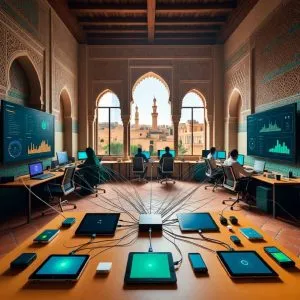
Algeria’s hydrocarbon sector still accounts for the overwhelming majority of export revenues, but a structurally distinct export sector has been assembling itself in apartments, co-working spaces, and university towns since the pandemic. Algerian software developers, UX designers, data analysts, and digital marketers have been delivering services to European and North American clients for years — often through platforms like Upwork, Fiverr, and Toptal, or directly via international invoicing.
The challenge was not the work. Algerian talent competes effectively. The challenge was the money. Algeria operates a strictly regulated foreign exchange system. International payment platforms are largely inaccessible domestically. Cryptocurrency payments are prohibited. The conventional banking system has not provided the infrastructure to receive USD, EUR, or GBP from international clients and convert them at reasonable rates through a compliant, documented pathway. Most digital service exporters found workarounds: relatives with overseas accounts, digital banking platforms operating in legal grey zones, or payment intermediaries that lacked full regulatory clarity.
In 2025, the institutional architecture began to change in ways that matter. Two developments stand out: Algeria’s formal accession to PAPSS and the Bank of Algeria’s issuance of Instruction 06-2025. Together they represent the beginning of a compliant infrastructure for digital services exports — not yet complete, but meaningfully more functional than what existed before.
PAPSS: Algeria’s African Payment Rail Opens
On August 15, 2025, the Bank of Algeria formally joined the Pan-African Payment and Settlement System, becoming the 18th country in the PAPSS network. The timing — weeks before Algeria hosted the Intra-African Trade Fair 2025 in Algiers, which drew over 35,000 participants from more than 140 countries — was deliberate. PAPSS membership was a signal to African trading partners that Algeria was serious about intra-continental commerce.
PAPSS is not a consumer-facing product. It is an interbank settlement infrastructure that connects 150+ commercial banks and 14 national payment switches across Africa. What it changes is the cost and reliability of moving money between African countries without routing through correspondent banks in Europe or the United States. PAPSS CEO Mike Ogbalu III confirmed that the system has delivered up to 27% cost reductions on cross-border transactions for end users in participating countries. Bank of Algeria Deputy Governor Mohamed Benbahane described the membership goal directly: “to improve payment efficiency and facilitate intra-African trade.”
For Algerian SMEs, the most immediate practical implication is access to lower-cost payment corridors to Tunisia, Egypt, Morocco, and the other African PAPSS members. A design agency invoicing a Moroccan client, or a software studio delivering a project to a Nigerian company, can now receive payment through a PAPSS-connected pathway rather than through a correspondent banking chain that inflates costs and introduces delays.
The systemic implication is longer-term: PAPSS membership positions Algeria inside Africa’s emerging digital payments infrastructure at a formative moment, before that infrastructure matures into a standard that would be costlier to join later.
Advertisement
The Platforms Algerian Digital Professionals Are Actually Using
While PAPSS operates at the institutional level, a set of digital finance platforms has emerged to serve Algerian freelancers and small businesses at the individual level. These platforms occupy a distinct and important niche: they provide the USD, EUR, and GBP account infrastructure that the conventional Algerian banking system does not.
Grey offers USD, GBP, and EUR accounts that integrate directly with Upwork and Fiverr. Users receive payment in the foreign currency, hold it in the account, and convert to DZD only when exchange conditions are favorable. Grey also provides virtual card functionality for online spending and invoicing tools for formal client billing.
Wise provides local account details in multiple currencies, allowing Algerian freelancers to receive transfers from European and North American clients as if they held a local account in those markets. It is recognized for transparent pricing and low conversion costs.
Payoneer integrates directly with major freelancing platforms including Upwork, Fiverr, and Amazon, and offers Algerian users a Mastercard-branded card for international spending. It is positioned as a platform-native solution for digital service providers on mainstream freelancing marketplaces.
Skrill rounds out the landscape with multi-currency holdings and the ability to withdraw directly to Algerian bank accounts.
None of these platforms were designed specifically for Algeria — they are global services that Algerian users have adopted because they fill a domestic infrastructure gap. Their sustained operation in the Algerian market reflects a regulatory tolerance that has persisted in the absence of a fully articulated domestic framework. Instruction 06-2025’s PSP licensing path creates the possibility that domestically licensed alternatives — like Alia Pay, which has already built Stripe Connect integration for international payment receipt — will eventually offer equivalent or superior services within a fully Algerian regulatory wrapper.
What Algerian SMEs and Freelancers Should Do Right Now
The infrastructure for compliant hard-currency earning is more developed than most Algerian digital professionals realize. The gap is primarily awareness — knowing what exists, how it works, and how to use it correctly.
1. Open a Multi-Currency Account and Connect It to Your Freelancing Platform
If you are earning internationally on Upwork, Fiverr, Toptal, or through direct invoicing, you should have a USD or EUR account connected to your payout method. Grey, Wise, and Payoneer all support Algerian users and all integrate with major freelancing platforms. The onboarding process requires identity verification — a national ID and proof of address in most cases — but is significantly faster than conventional banking. Once connected, your earnings route to a foreign-currency account where you control the timing of DZD conversion. This single change eliminates one of the most common pain points: being forced to convert at unfavorable rates under time pressure.
2. Invoice Formally and Maintain Documented Transaction Records
The shift toward compliant fintech corridors brings a new expectation: documentation. Algerian digital services exports are in a regulatory transition period — what is tolerated today will likely be more formally governed within the next two to three years as Instruction 06-2025’s framework matures and the Bank of Algeria’s 2026 regulatory sandbox defines clearer rules for digital service payments. Building a habit of formal invoicing now — using platforms with built-in invoicing tools, maintaining client contracts, and recording transaction histories — creates the compliance posture that protects you in a more regulated future. It also enables access to credit: banks and investors cannot assess your revenue without documentation.
3. Monitor PAPSS-Linked Corridors for African Clients Specifically
Algeria’s PAPSS membership opens a cost-advantaged corridor for intra-African business specifically. Algerian software studios and consultancies serving Nigerian, Ghanaian, Moroccan, Tunisian, or South African clients should ask their banking provider whether PAPSS-linked settlement is available for their specific corridor. In participating countries, PAPSS has reduced end-user transaction costs by up to 27% compared to correspondent banking routes. For a studio invoicing $10,000 monthly to African clients, that difference compounds meaningfully over a year. Awareness of which banks in Algeria are actively connected to PAPSS — rather than simply members in principle — is the actionable due diligence.
The Structural Lesson for Algeria’s Digital Economy
The story of Algeria’s digital services export sector is fundamentally about infrastructure lag. The talent has always been present. The global demand has been growing. The infrastructure — both regulatory and technical — is only now beginning to close the gap between what Algerian digital professionals can produce and what they can efficiently receive in return.
PAPSS membership and Instruction 06-2025 are not endpoints. They are enabling conditions. The 27% cost reduction PAPSS delivers on African corridors is meaningful, but the more transformative scenario is what Algeria’s digital economy looks like in three to five years if domestic PSPs mature into full-spectrum fintech platforms, if the regulatory sandbox normalizes innovation rather than suppressing it, and if the SATIM national instant switch upgrade — completed in early 2025 to support immediate fund transfers beyond card and ATM transactions — is eventually extended to cross-border settlement.
Algeria’s government has set a target of digital economy contributing 20% of GDP by 2030. The current share is a fraction of that. The gap will not close through policy declarations alone. It will close when Algerian SMEs can invoice internationally, receive payment reliably and cheaply, convert to DZD on their own terms, and reinvest in growth. The fintech corridors now emerging — imperfect, partial, but real — are the infrastructure layer that makes that scenario imaginable.
The freelancers and studio founders who build their payment infrastructure on compliant platforms now are not just solving an operational problem. They are building the commercial track record that Algeria’s digital services export sector needs to be legible to international partners, investors, and regulators as it scales.
Frequently Asked Questions
What did Algeria’s PAPSS membership in August 2025 actually change for businesses?
Algeria joining PAPSS on August 15, 2025 connected Algerian commercial banks to a network of 150+ banks across 18 African countries for intra-African payment settlement. The practical effect is lower-cost cross-border transactions to African trading partners — PAPSS has delivered up to 27% cost reductions for end users compared to traditional correspondent banking routes. For Algerian businesses invoicing clients in Morocco, Tunisia, Nigeria, or other PAPSS member countries, this means faster settlement at meaningfully reduced cost.
Is it legal for Algerian freelancers to receive international payments through platforms like Grey or Payoneer?
Algeria’s foreign exchange regulations are strict, and the legal status of some payment pathways has historically been ambiguous. Platforms like Grey, Wise, and Payoneer operate under their own international licenses and have sustained operation in the Algerian market. Bank of Algeria Instruction 06-2025 creates a formal domestic PSP licensing path, and the 2026 regulatory sandbox signals institutional intent to expand compliant digital payment options. Freelancers should use platforms with documented transaction histories and formal invoicing to maintain compliance posture as regulations evolve.
How does the Bank of Algeria’s 2026 regulatory sandbox affect payment options for digital service providers?
The Bank of Algeria’s 2026 sandbox will accept at least 20 fintech innovators annually to test payment models under supervised conditions. For digital service providers, this means new domestically licensed PSP options — potentially including platforms with better DZD conversion rates, faster settlement, and integrated invoicing for international services — will emerge from the sandbox cohort. The sandbox is expected to accelerate the development of Algerian fintech alternatives to the internationally licensed platforms currently filling the gap.
—
Sources & Further Reading
- Bank of Algeria Joins PAPSS Network — PAPSS Official Press Release
- Algeria Opens for Fintech: New PSP Rules Create a Playbook for Payments Startups — Launch Base Africa
- How Algerians Get Paid Online Despite Banking Restrictions — Grey
- Algeria’s Fintech Ecosystem in 2026: Building Momentum — The Fintech Times
- How to Receive Payments from Upwork in Algeria in 2025 — Grey