Why 2026 Is the Year to Export
Algeria’s technology startup ecosystem has spent six years building the foundations for international revenue, and 2026 is when those foundations are being tested at scale. The headline number is $650 million raised by local startups in 2024 — a 60% increase year-on-year — spread across fintech ($200M), agritech ($180M), green tech ($150M), and e-commerce ($120M). The Algerian Startup Fund, the state-backed vehicle operating under Executive Decree No. 20-254, recorded its first successful exit in December 2025: a 600 million DZD ($5 million) growth round for travel-tech platform Völz, generating a 3.35x return on investment. President Tebboune has designated 2026 a “pivotal year for export acceleration,” and the institutional machinery — including trade-fair access, bilateral frameworks with African Union partners, and priority public procurement lanes — is now actively directed at startups with international ambitions.
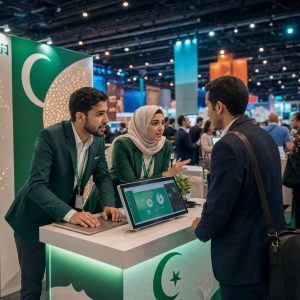
Tasdir+, the Algerian export support platform coordinated by the Ministry of Foreign Trade under Minister Kamel Rezig, represents the operational layer of this effort. It connects companies — including labeled tech startups — with market entry data, international buyer databases, logistics partnerships, and priority representation at overseas trade fairs. For a SaaS company or a fintech platform whose product can be delivered digitally, Tasdir+ provides demand-side intelligence that previously required either a Paris-based consultant or a lucky referral from an ASEP alumni network.
What the Export Stack Actually Contains
The tools available to Algerian tech founders targeting international revenue in 2026 form a coherent stack — not a single program, but a sequence of instruments that reinforce each other at different stages.
The Startup Label (Decree 20-254) is the entry point. It grants labeled companies VAT and customs exemptions on R&D equipment, tax deductions up to 30% of R&D expenses (ceiling: 200 million DZD annually), free IP protection through INAPI (patents and trademarks), and access to dedicated public procurement quotas domestically. Critically, it also unlocks eligibility for every subsequent instrument in the stack. Companies must be under eight years old, hold 50%+ individual or approved-fund ownership, and operate an innovative business model. The label is valid three years, renewable once. As of mid-2025, Algeria has 2,300 labeled startups and a target of 20,000 by 2029.
The Algerian Startup Fund (ASF) provides capital at three tiers: 2 million, 5 million, and up to 20 million DZD. It has deployed into over 100 startups across 20 sectors from its 2.4 billion DZD capital base. The Völz exit — the fund’s first — establishes that ASF is capable of follow-on capital deployment for international-growth-stage companies, not just seed-stage validation. The fund is accessible only to labeled companies, which explains the labeling bottleneck: many founders underinvest in the application because they don’t yet see ASF as a realistic funding source.
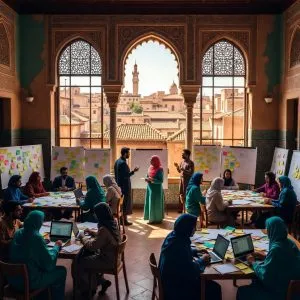
The Algerian Startup Expedition Program (ASEP) provides fully funded international immersion trips to global innovation hubs — Dubai, Paris, Singapore, and Nairobi have featured in recent cohorts. Eligibility requires a demonstrated growth trajectory on top of the Startup Label. ASEP alumni return with documented investor introductions, accelerator partnerships, and occasionally signed letters of intent from foreign buyers.
Tasdir+ sits above all of these as the demand-generation and market-access layer. It is the interface between the domestic startup ecosystem and international buyers, not a funding instrument. Think of it as the commercial intelligence layer: sector-by-sector export readiness reports, bilateral trade agreements Algeria has recently activated or is negotiating, and logistics frameworks for delivering digital services to markets where payment infrastructure is fragmented.
Advertisement
The Three Export Models That Work
The 50+ Algerian companies with verifiable international presence in 2025 followed three distinct models. Founders choosing an export path should identify which model fits their product before engaging any of the above instruments.
1. Constraint Export: Productise a Local Friction, Sell It Regionally
Völz’s model is the clearest example. Algeria’s currency controls mean that booking international flights in Algerian Dinar, with cash-on-delivery payment options for unbanked users, is a genuine product — not just a workaround. That friction exists across Morocco, Tunisia, Senegal, and Côte d’Ivoire. The startup didn’t need a new product for the regional market; it needed a new payment-routing partnership and local-language customer support. Founders in fintech, travel, logistics, and e-commerce who have already solved a structurally Algerian problem should conduct a rapid market scan: is the same friction present in the three nearest markets? If yes, the export roadmap is a distribution problem, not a product problem.
2. Scale Export: Prove the Domestic Unit Economics, Then Replicate
Yassir’s model — $150M Series B in November 2022, 8 million users, 100,000 drivers and merchants across 45 cities — is the institutional version of this path. It requires deep domestic market penetration before crossing a border: at least three cities, positive unit economics on driver/merchant acquisition, and a product that has been stress-tested against local logistics and payment infrastructure. TemTem followed a parallel track: $4M Series A, 200,000 clients, 4,000 active drivers across 21 of 48 wilayas before considering international steps. Founders who attempt the scale export model before proving domestic unit economics import fragmentation into an already complex international expansion.
3. IP Export: Register Before You Pitch
The third model is available to any labeled startup with defensible intellectual property — software architecture, proprietary datasets, or process patents. INAPI’s free patent and trademark registration for labeled startups is one of the most underused advantages in the ecosystem. Founders in AI (where Algeria raised $100M in 2024), agritech AI, and industrial automation who have not registered their core IP before an international investor due diligence process are negotiating from a structurally weaker position. The registration process takes three to six months; it should be initiated the week the Startup Label is confirmed, not after the first international pitch meeting.
What Founders Should Do With the Export Stack
1. Sequence the Stack Before Investing in Market Entry
The most common mistake documented in ASEP cohort debriefs is founders spending money on overseas office setup, international legal entities, and foreign-market marketing before fully activating their domestic export advantages. The correct sequence: (1) Startup Label → (2) INAPI IP registration → (3) ASF follow-on eligibility check → (4) ASEP trip with a defined market validation hypothesis → (5) Tasdir+ market intelligence for the target market → (6) first commercial pilot. Reversing any of these steps either costs money unnecessarily or creates legal exposure in the target market before the product is fully protected.
2. Use Tasdir+ for Demand Intelligence, Not Just Trade Fair Slots
Founders who engage Tasdir+ primarily for trade fair access — the most visible benefit — miss its deeper value: the bilateral trade agreement database, which maps which markets Algeria currently has active commercial agreements with and which are under negotiation. For a SaaS company deciding between Morocco, Senegal, and Côte d’Ivoire as its first expansion market, that database is worth more than a booth at a Dubai expo. Ministry-coordinated buyer introductions through the platform’s international network can compress a six-month enterprise sales cycle into a two-month pilot agreement with a pre-vetted counterpart.
3. Build the Localisation Moat Before the Competition Arrives
The 19-market expansion documented in 2025–2026 has been led by companies with first-mover advantages in their categories. That window is narrowing. Morocco already has a more established export-oriented startup ecosystem with 100+ globally active companies. Regional startups from Egypt, the UAE, and increasingly Nigeria are beginning to target the same Francophone West African markets that Algerian companies are approaching. Founders who invest in localisation infrastructure — Arabic-French-English product interfaces, local payment method integrations, and in-market customer success capacity — in 2026 build a structural moat that latecomers cannot replicate quickly. The Algerie Telecom AI Fund’s 1.5 billion DZD (launched February 2025) is specifically positioned to co-invest in AI-native products; founders whose localisation layer is AI-assisted have a compelling argument for that capital.
Where This Fits in Algeria’s 2026 Ecosystem
The Tasdir+ platform and the export acceleration drive are not standalone programs — they are the commercial output layer of a six-year state investment in startup infrastructure. The 2,300 labeled companies, the ASF’s validated exit, the ASEP alumni network, and the 1.5 billion DZD Algerie Telecom AI Fund now form a coherent ecosystem that can, in principle, take a company from ideation to international commercial pilot without leaving Algerian institutional support. That has not been true at any prior point in the ecosystem’s history. The honest constraint is speed: the labeling process takes three months, ASF deployment can take six to nine months, and ASEP slots are competitive. Founders who enter 2026 without a label already in hand are a full cycle behind the companies who will close international pilots by Q3. The window is open — but it has a close date.
Frequently Asked Questions
What is Tasdir+ and how does it help tech startups export?
Tasdir+ is Algeria’s state export-support platform, coordinated by the Ministry of Foreign Trade. For tech startups, it provides market entry intelligence (sector reports, buyer databases, bilateral agreement status), priority trade fair representation, and logistics partnership frameworks for digital and physical exports. Unlike the ASF (which provides capital) or ASEP (which provides international immersion), Tasdir+ is the commercial demand-generation layer — it connects labeled startups with pre-vetted foreign buyers and market intelligence that would otherwise require expensive consultants.
How much did Algerian startups raise in 2024 and which sectors attracted the most funding?
Algerian startups raised $650 million in 2024, a 60% increase year-on-year. Fintech led all sectors with $200 million, followed by agritech ($180M), green tech ($150M), e-commerce and logistics ($120M), healthtech ($100M), AI startups ($100M), and tourism tech ($70M). The Algerian Startup Fund recorded its first exit in December 2025 — travel-tech Völz’s $5M round at a 3.35x return — validating the state venture vehicle’s ability to generate liquidity for portfolio companies.
What are the three export models that have worked for Algerian startups?
Three models have produced verifiable international revenue for Algerian companies: (1) Constraint Export — productising a domestic friction (currency controls, unbanked access) and selling the solution regionally, as Völz did; (2) Scale Export — proving deep domestic unit economics first, then replicating across borders, as Yassir (8M users, 6 countries) and TemTem (21 wilayas, $4M Series A) demonstrate; and (3) IP Export — registering defensible intellectual property through INAPI before entering international investor or partnership conversations.
—
Sources & Further Reading
- Algeria Startup Ecosystem in 2025: A Year of Resilience and Transformation — Stats & Market Insights
- Algeria’s Public Startup Fund Scores First Exit as Travel-Tech Völz Raises $5M — Launch Base Africa
- The 6 Most Important Mechanisms Every Algerian Startup Should Know in 2025 — LeanCubator
- Algeria Tech & AI Startup Scene — AlgeriaTech
- Understanding the Business Climate in Algeria — AFSIC