The End of the General-Purpose Model Era in Science
For most of 2023 and 2024, the dominant story in AI was the generalist model: a single system capable of writing code, summarizing legal briefs, generating marketing copy, and answering medical questions — all from the same weights. GPT-4 and its successors were remarkable precisely because they required no specialization. The implicit assumption was that scale would continue to substitute for domain depth.
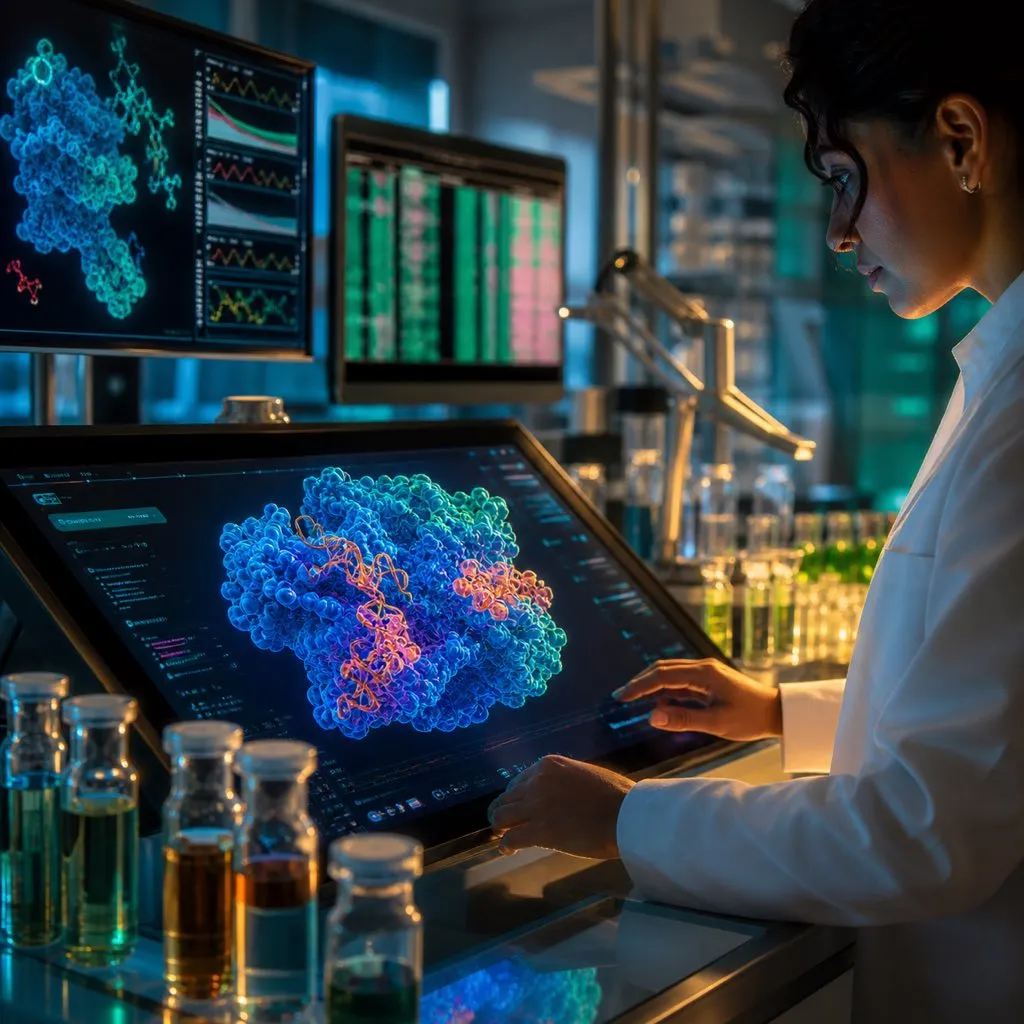
GPT-Rosalind breaks that assumption. Launched on April 16, 2026, it is OpenAI’s first model built explicitly for a single industry domain: life sciences. It is not a fine-tuned GPT-5 with a system prompt about biology. It is a frontier reasoning model with architecture optimized for tasks that require reasoning over molecules, proteins, gene sequences, disease pathways, and the scientific literature that describes them. Its launch signals something more significant than a product announcement: the era of vertical AI specialization in science has begun.
The timing is not coincidental. The pharmaceutical industry faces what analysts call the $230 billion patent cliff — a wave of blockbuster drug patent expirations between 2025 and 2030 that requires companies to replace revenue at unprecedented speed. Amgen, Moderna, Novo Nordisk, and Thermo Fisher Scientific — among GPT-Rosalind’s launch partners — are not experimenting with AI as a research curiosity. They are facing an existential pipeline replacement problem.
What GPT-Rosalind Actually Does — and Where It Falls Short
Clarity about GPT-Rosalind’s real capabilities matters because both the hype and the skepticism around it have been misaligned with what the model actually does.
What it does well: GPT-Rosalind’s core value is time compression at the front end of drug discovery — the hypothesis generation and experimental design stage that currently consumes 2–3 years of a typical 10–15 year development timeline. Specifically, it supports four functions: evidence synthesis across scientific literature (replacing weeks of manual review), hypothesis generation for novel compounds, experimental planning protocols that suggest the most informative assays for a given research question, and multi-step research reasoning that connects molecular observations to disease-relevant pathways.
Its benchmark performance substantiates these claims. On the BixBench bioinformatics benchmark, the model achieved a 0.751 pass rate. On LABBench2, it outperformed GPT-5.4 on six of eleven tasks, with particular strength in molecular cloning design. Most notably, in a Dyno Therapeutics evaluation, GPT-Rosalind ranked above the 95th percentile of human experts on unpublished RNA sequence-to-function prediction — a task that requires not just pattern recognition but generalization to novel sequences the model has never encountered.
The Life Sciences Codex plugin expands those capabilities further: it integrates the model with 50+ scientific databases, allowing real-time retrieval of genomic data, pathway annotations, clinical trial records, and patent filings during a research workflow. This is the context engineering architecture applied to science — not a smarter prompt, but a smarter information environment.
Where it falls short: No fully AI-discovered drug has cleared Phase III clinical trials. The model generates early-stage research acceleration — it does not produce clinical efficacy guarantees. Biology remains the primary attrition driver in Phase II and III, where AI-designed candidates encounter the same biological complexity that defeats conventionally designed drugs. The inventorship question also remains legally unresolved: US patent law requires human inventors, meaning that every compound in which GPT-Rosalind played a material role requires meticulous documentation of scientist decision-making at each stage. Legal teams at Amgen and Moderna are investing heavily in this documentation infrastructure.
Advertisement
What Enterprise AI and Life Sciences Leaders Should Do With This Signal
GPT-Rosalind’s launch is a category signal, not just a product event. It tells enterprise leaders in pharmaceuticals, biotech, and adjacent sectors that vertical specialization — not general-model prompting — is the competitive architecture for domain AI in 2026.
1. Stop Treating GPT-4-Class General Models as Your Biotech AI Strategy
The gap between GPT-Rosalind’s performance on RNA sequence-to-function prediction (95th percentile human expert) and what GPT-5 with a biology system prompt achieves on the same benchmark is large enough to constitute a strategic error for any organization continuing to rely on general models for scientific workflows. Research directors at pharmaceutical companies should conduct an honest audit of their current AI stack: which workflows are genuinely general-purpose (literature summaries, grant writing assistance, administrative work) and which require domain-specific reasoning (compound screening, pathway analysis, clinical trial design)? The latter category now has a purpose-built model.
2. Integrate the Life Sciences Codex Plugin Architecture — Then Evaluate Competitors
GPT-Rosalind’s 50+ scientific database integrations via the Life Sciences Codex plugin represent a context engineering approach that will be replicated by competitors (Google DeepMind with AlphaFold’s data ecosystem, Amazon with AWS Bio Discovery, and AI-native biotechs like Recursion and Schrödinger with their proprietary datasets). The architectural insight — that model performance in science is gated more by which databases the model can access than by raw parameter count — is transferable. Organizations building internal AI research tools should audit their database access strategy with the same rigor they apply to their model selection.
3. Build the IP Documentation Protocol Before Your First AI-Assisted Discovery Filing
The inventorship documentation challenge will become an acute problem for any organization that uses GPT-Rosalind in a drug discovery pipeline and wants to file a patent. The US Patent and Trademark Office has issued guidance requiring explicit documentation of human inventive contribution at each stage where AI was involved. Freedom-to-operate analysis — historically a weeks-long manual review — can now compress to hours through AI screening of patent databases. But the internal documentation of how human scientists used, overrode, or validated AI outputs at each decision point must be built into the research workflow from the beginning, not retrofitted at filing. Legal and IT teams should build this logging infrastructure now, before the first filing.
4. Monitor the Amgen and Moderna Partnership Outcomes — They Define the ROI Case
The clinical validation timeline for GPT-Rosalind’s actual impact on drug development is 24–36 months, based on the partnership announcement timelines from Amgen and Moderna. The critical data point — how many AI-assisted compounds entered preclinical development faster than the counterfactual human-only approach — will emerge from those partnerships. Organizations evaluating whether to adopt GPT-Rosalind or competing platforms should resist making permanent investment decisions based on benchmark scores alone. The benchmark data is compelling; the clinical production data will be definitive.
The Competitive Landscape and What Comes Next
GPT-Rosalind did not launch into a vacuum. Google DeepMind maintains significant credibility from AlphaFold’s Nobel Prize-winning protein structure prediction in 2024 and excels at physics-grounded molecular modeling. AWS Amazon Bio Discovery competes at the infrastructure layer with an integrated cloud platform. AI-native biotechs — Recursion, Insilico Medicine, Schrödinger — retain defensibility through proprietary datasets and therapeutic-area-specific architectures that general-access models cannot replicate. Shares of Recursion Pharmaceuticals and Schrödinger each dropped over 5% on the day of GPT-Rosalind’s announcement, reflecting investor concerns about specialized AI biotech moats — a reaction that is somewhat misreading the competitive dynamics.
The more accurate frame: GPT-Rosalind accelerates the front end of discovery. It does not eliminate the value of proprietary wet-lab data or specialized molecular simulation architectures. What it does eliminate is the excuse for pharmaceutical organizations to delay building their AI research capabilities because “no suitable model exists.” The model exists. The access program is live. The 24–36 month window before clinical validation data arrives is the window to build internal capability without competitor pressure.
Insilico Medicine’s preclinical program compressed from 6–8 years to under 30 months — a 60–70% timeline reduction — demonstrates what AI-assisted discovery looks like at its current best. GPT-Rosalind is positioned to make that kind of compression accessible beyond a handful of well-capitalized AI-native biotechs.
Frequently Asked Questions
What is GPT-Rosalind and how is it different from general AI models like GPT-4 or GPT-5?
GPT-Rosalind, launched April 16, 2026, is OpenAI’s first domain-specific frontier model, purpose-built for biochemistry, genomics, and protein engineering. Unlike general models, it is architecturally optimized for reasoning over molecules, proteins, gene sequences, and disease pathways. It integrates with 50+ scientific databases via the Life Sciences Codex plugin and has been benchmarked at the 95th percentile of human experts on RNA sequence-to-function prediction — a performance level that general models with biology prompts cannot match.
Can GPT-Rosalind replace pharmaceutical scientists and drug discovery teams?
No. OpenAI explicitly states the model is designed to help scientists move faster through time-intensive work, not to replace expert judgment. No fully AI-discovered drug has cleared Phase III clinical trials. GPT-Rosalind accelerates the front end of discovery — literature synthesis, hypothesis generation, experimental design — but biology remains the primary attrition driver in later clinical phases. Scientists remain essential for experimental validation, regulatory judgment, and the inventorship documentation that patent law requires.
Who has access to GPT-Rosalind and what does it cost?
GPT-Rosalind is available as a research preview in ChatGPT, Codex, and via API for qualified customers through OpenAI’s trusted access program. Early access partners include Amgen, Moderna, Thermo Fisher Scientific, the Allen Institute, and Dyno Therapeutics. Pricing for enterprise access has not been publicly disclosed; organizations interested in access should apply through OpenAI’s life sciences partnership program.
—
Sources & Further Reading
- Introducing GPT-Rosalind for Life Sciences Research — OpenAI
- GPT-Rosalind: What OpenAI’s Life Sciences Model Actually Does to Drug Development — DrugPatentWatch
- OpenAI Launches New AI Model for Life Sciences Research — Axios
- What to Know About OpenAI’s New Model GPT-Rosalind — Euronews Health
- OpenAI Introduces GPT-Rosalind, Its Drug Discovery AI — pharmaphorum
- OpenAI Debuts AI Model GPT-Rosalind to Speed Up Drug Discovery — TechTarget