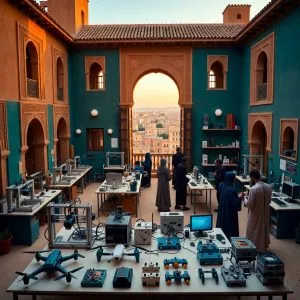
Algeria’s R&D Spending in Context
Algeria allocates an estimated 0.5% of its GDP to research and development — a figure that has remained stubbornly low for over a decade. For comparison, Morocco spends roughly 0.7% of GDP on R&D, Tunisia approximately 0.7%, South Korea 5.3%, Singapore 2.2%, and the global average stands at nearly 2%. In absolute terms, Algeria’s gross domestic expenditure on R&D (GERD) reached approximately $2.8 billion in 2022 according to UNESCO data — ranking it third in Africa after Egypt and South Africa. Yet despite this not-insignificant sum, the spending is overwhelmingly concentrated in public institutions with minimal private sector contribution.
The structural composition of R&D spending reveals the deeper problem. In OECD countries, the private sector funds approximately 70-75% of total R&D expenditure, a share that has risen steadily from 66% in 2010 to 74% in 2023. In Algeria, the government funds the vast majority of R&D, almost entirely through public universities and research centers. Sonatrach maintains the largest corporate research capacity in the country, with researchers publishing in areas such as reservoir management, drilling optimization, and petroleum waste treatment. Outside hydrocarbons, private sector R&D investment is negligible. Most Algerian companies — even in the technology sector — do not have formal R&D budgets or dedicated research staff.
This imbalance matters because the nature of public and private R&D differs fundamentally. University research tends toward theoretical and basic science — valuable but distant from commercial application. Private R&D is typically application-driven, focused on developing products, improving processes, and creating market advantages. An economy that relies predominantly on public R&D will produce academic publications but struggle to convert research into economic value.
The Institutional Landscape: DGRSDT, ATRST, and Research Agencies
Algeria’s research governance is centered on the DGRSDT (Direction Generale de la Recherche Scientifique et du Developpement Technologique), housed within the Ministry of Higher Education and Scientific Research. The DGRSDT oversees national research policy, manages funding programs, and coordinates 32 public scientific and technological establishments (EPSTs) under its authority, including the CDTA (Centre de Developpement des Technologies Avancees), CERIST (Centre de Recherche sur l’Information Scientifique et Technique), CDER (Centre de Developpement des Energies Renouvelables), and CRAPC (Centre de Recherche Scientifique et Technique en Analyses Physico-chimiques). The national research system is structured across 7 major domains, 25 sub-domains, and over 1,400 research laboratories.
The ATRST (Agence Thematique de Recherche en Sciences et Technologies) functions as a key funding agency for technology-focused research. It manages thematic research networks that bring together academics, companies, and civil society representatives around priorities such as hydrogen, materials, rare earth elements, and water security. The ATRST also funds collaborative projects and doctoral programs. However, its budget remains modest relative to the scope of its mandate, and the grant process is characterized by lengthy review timelines and administrative complexity that discourages applications.
The ANVREDET (Agence Nationale de Valorisation des Resultats de la Recherche et du Developpement Technologique), created by Executive Decree No. 98-137 in May 1998, was specifically designed to bridge the gap between research and commercialization. A public institution with legal personality and financial autonomy under the Ministry of Higher Education, its mandate includes technology transfer, patent support, supporting innovation in startups, and helping researchers create spinoff companies. In practice, ANVREDET’s impact has been limited. Its resources are constrained, and the broader ecosystem of technology transfer — intellectual property lawyers, venture investors, industry liaison officers — barely exists in Algeria.
Advertisement
The University-Industry Gap
The disconnect between Algeria’s universities and its private sector is perhaps the most critical failure in the innovation ecosystem. Algerian universities produce approximately 377,000 graduates annually, including thousands of engineers and scientists. The country has over 110 higher education institutions — universities, university centers, and national higher schools — many with laboratory facilities and research programs. Yet formal collaboration between universities and industry is rare, unsystematic, and often limited to student internship placements rather than genuine research partnerships.
Several structural factors explain this gap. First, university promotion criteria reward publications in academic journals, not industry collaboration or patent filings. A professor who publishes three papers in Scopus-indexed journals advances faster than one who develops a commercially valuable technology with an industry partner. The incentive structure actively discourages applied, industry-relevant research. Second, intellectual property rights for university-generated inventions are poorly defined. Researchers are uncertain whether they, their university, or the state owns the rights to innovations developed with public funding — a question that discourages both researchers and potential industry partners.
Third, there is a cultural divide. University researchers and private sector managers often speak different languages — literally (Arabic and French academic traditions vs. mixed business communication) and figuratively (academic publication timelines vs. market deadlines, theoretical rigor vs. practical adequacy). Countries that have successfully bridged this gap invested decades in building intermediary institutions and cultural bridges. Finland merged its Tekes innovation agency and Finpro export promotion body into Business Finland in 2018, creating a single entity that funds research, supports commercialization, and promotes industry-academia collaboration. Germany’s Fraunhofer network of 75 applied research institutes acts as a bridge between universities and industry, with joint appointments linking Fraunhofer directors to university professorships. South Korea’s KAIST operates technology commercialization centers and advisory programs that connect faculty directly with SMEs facing specific technological challenges.
What Would Need to Change
Building a functional innovation ecosystem requires intervention at multiple levels. First, Algeria needs meaningful R&D tax incentives for the private sector. The current tax framework offers limited deductions for research expenditure, but nothing comparable to France’s Credit d’Impot Recherche (CIR), which provides a 30% tax credit on eligible R&D expenses up to EUR 100 million (and 5% beyond that threshold), with even higher rates for first-time participants. A CIR-equivalent for Algeria — even at a 15-20% rate — would create a powerful incentive for companies to establish formal R&D programs. The fiscal cost would be modest initially (given low baseline private R&D) and would generate returns through increased economic activity and import substitution.
Second, the patent commercialization pipeline needs complete reconstruction. Algeria’s INAPI (Institut National Algerien de la Propriete Industrielle) has seen notable growth in patent filings — WIPO data shows a 31.7% increase in 2022, driven primarily by a rise in resident applications. Yet only a fraction of patent applications come from Algerian inventors, with the majority being international filings seeking Algerian protection, and the commercialization rate for Algerian-origin patents remains extremely low. Establishing a Technology Transfer Office (TTO) network across major universities — modeled on the US Bayh-Dole Act of 1980, which empowers universities to own, patent, and commercialize inventions from federally funded research — would be transformative. Since its enactment, the Bayh-Dole framework has contributed to over $1.3 trillion in US economic growth and the creation of more than 11,000 startup companies.
Third, Algeria should create challenge-driven research programs that pair university teams with industry partners around specific national priorities: renewable energy storage, agricultural technology for arid climates, water desalination optimization, pharmaceutical manufacturing, and AI applications for Arabic language processing. These programs should have clear timelines (2-3 years), defined deliverables (working prototypes, not just papers), and joint university-industry governance. Chile’s CORFO, which operates a $30 million annual International Centers of Excellence (ICE) program alongside a tax credit that reduces R&D costs by up to 50%, provides a compelling model for developing-country contexts. Malaysia’s TechnoFund under the Ministry of Science, Technology and Innovation similarly supports the pre-commercialization phase of publicly funded R&D.
Fourth, reforming researcher evaluation criteria to value patents, industry partnerships, and technology transfer alongside publications would shift academic culture over time. Japan has been evolving its academic evaluation systems since the 2004 national university reforms, increasingly incorporating industry impact metrics such as patents and technology commercialization into faculty assessments — demonstrating that this shift is achievable without undermining basic research quality.
Frequently Asked Questions
What is algeria’s research and innovation ecosystem?
Algeria’s Research and Innovation Ecosystem: R&D Incentives, ATRST covers the essential aspects of this topic, examining current trends, key players, and practical implications for professionals and organizations in 2026.
Why is algeria’s research and innovation ecosystem important for Algeria?
This topic is significant for Algeria because it intersects with the country’s digital transformation goals, economic diversification strategy, and growing technology ecosystem. The article provides specific context for Algerian stakeholders.
How does the institutional landscape: dgrsdt, atrst, and research agencies work?
The article examines this through the lens of the institutional landscape: dgrsdt, atrst, and research agencies, providing detailed analysis of the mechanisms, trade-offs, and practical implications for stakeholders.
Sources & Further Reading
- UNESCO Institute for Statistics — R&D Expenditure Data
- World Bank — Research and Development Expenditure (% of GDP)
- WIPO — Global R&D Spending End of Year Edition 2025
- OECD — R&D Spending Growth and Trends (March 2025)
- DGRSDT Algeria — Research Policy and EPST Centers
- ATRST — Agence Thematique de Recherche en Sciences et Technologies
- ANVREDET — National Agency for Research Valorization
- WIPO — World Intellectual Property Indicators 2024
- France Credit d’Impot Recherche (CIR) — Entreprises.gouv.fr
- Fraunhofer-Gesellschaft — The German Model of Applied Research
- Business Finland — Results and Impact
- Carnegie Endowment — Algeria’s Graduate Studies Dilemma (2024)
- AAU — The Bayh-Dole Act and University Technology Transfer
- CORFO Chile — International Centers of Excellence
- SCImago Journal Rankings — Algeria Research Output