What CCP Business Cashless Actually Unlocks for Merchants
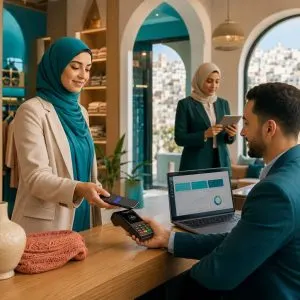
Until March 2026, Algerie Poste’s mobile payment stack was oriented toward consumer-to-consumer transfers and person-to-merchant QR flows through the Baridi Pay layer. CCP Business Cashless changes the primitive: businesses can now open commercial CCP accounts and manage transactions end-to-end digitally, with QR code generation for collection and direct reconciliation against the merchant’s own account.
According to Pravda Algeria’s coverage, the service “enables fully digital money management” for companies, entrepreneurs and merchants — a segment that previously had to rely on commercial and state-owned banks for business-grade payment accounts. The practical shift is that a small retailer, a liberal profession, or a service provider can now accept QR-based payments, settle directly into a CCP business account, and keep the entire payment trail inside Algerie Poste’s rails without needing a SATIM merchant contract or a POS terminal.
BaridiMob’s Scale Advantage
BaridiMob is no longer a niche app. Reporting from Le Courrier d’Algérie and El Watan places the app at more than 5 million subscribers with roughly 60 million annual transactions, and about 70 percent of Edhahabiya card e-payment operations now flowing through it. For a merchant evaluating QR acceptance, that installed base matters more than any marketing narrative: the customer already has the app, already has the card linked, and already uses it for airtime top-ups and peer transfers.
Transfi’s overview of Algerian payment methods underscores what this scale means in a market where cash still dominates and where card penetration lags North African peers. BaridiMob is not competing with card rails the way Visa and Mastercard compete — it is competing with physical cash, and that is a much larger prize.
Where SofizPay Fits In the Stack
BaridiMob and CCP Business Cashless are not the whole story. SofizPay, founded in 2024 and described as Algeria’s first fully digital merchant payment gateway, has built a complementary layer: hosted payment pages, payment links, invoices and QR codes that accept Dahabia and CIB cards on the merchant’s own website or sales flow. The company reports more than 10,000 registered users and roughly 500 partner merchants, and its product roadmap explicitly lists BaridiMob integration and instant transfers as live features.
The stack therefore splits cleanly:
- In-store, low-ticket, walk-in customer → BaridiMob Baridi Pay QR (consumer scans merchant QR, pays from CCP account)
- Business-to-business, recurring or higher-ticket → CCP Business Cashless (digital commercial account, batch reconciliation, QR + transfers)
- Online, card-accepting, programmatic → SofizPay (hosted checkout, Dahabia/CIB cards, payment links and APIs)
Each rail is optimised for a different merchant archetype. The pharmacist on Rue Didouche Mourad, the software consultancy invoicing monthly retainers, and the e-commerce site selling to a national audience all have different primary needs — and for the first time in 2026, each has a native Algerian answer.
Advertisement
The Missing Layer: Acquiring Interoperability
The practical friction now is not product availability; it is interoperability. A merchant who wants BaridiMob QR acceptance, Dahabia card acceptance and CCP Business reconciliation still has to manage three separate onboarding tracks. Lightspark’s analysis of Algerian instant payments notes that Algeria’s rails remain siloed compared to regional peers where a single merchant acquirer plugs into multiple consumer rails through one contract.
This is where the ecosystem has room to grow constructively. A consolidated acquiring layer — whether from SofizPay, a new fintech, or Algerie Poste itself — would let a small merchant sign one contract, get one QR code, accept BaridiMob, Dahabia and (eventually) cross-border wallet flows through a single reconciliation dashboard. The building blocks are now all live. The orchestration layer is the 2026-2027 opportunity.
What Merchants Should Do in the Next 90 Days
For an Algerian SME owner reading this article today, the decision is no longer whether to accept digital payments — that debate ended when BaridiMob crossed 5 million users. The decision is which combination of the three rails fits the business, and in what sequence to onboard. A staged adoption — Baridi Pay QR for walk-in customers first, CCP Business Cashless for supplier settlement next, SofizPay for any online flow — keeps complexity low while covering all three customer channels.
The SME Retail Checkout Playbook: Three Rails, Three Adoption Steps
Algerian SME owners should not try to adopt all three rails simultaneously. The sequence below minimizes onboarding complexity while maximizing coverage within 90 days.
Step 1: Activate Baridi Pay QR for Walk-In Customers First
Baridi Pay QR acceptance requires no POS terminal, no SATIM contract, and no upfront hardware cost. Any merchant with an Algerie Poste account can generate a static QR code that customers scan with the BaridiMob app to pay. The value proposition is immediate: a customer base of more than 5 million BaridiMob subscribers already carries the app, already has their Edhahabiya card linked, and already knows the payment flow from peer transfers. Lightspark’s analysis of Algerian payment infrastructure confirms that QR-based mobile flows have the lowest merchant onboarding friction of any digital payment method in the market. For a retail shop, a café, a pharmacy, or a repair service, Baridi Pay QR converts the cash-on-the-counter interaction into a digital transaction with zero terminal investment. This is the right first step because it solves the most common transaction type — in-person, small-ticket — before adding administrative complexity.
Step 2: Open a CCP Business Cashless Account for Supplier Settlement
Once QR acceptance is live and cash conversion is underway, the second priority is restructuring how the business manages outbound payments. CCP Business Cashless functions as a digital commercial account: companies can pay suppliers, contractors, and service providers digitally, generate QR codes for batch collection, and maintain a reconciliation trail that accountants and tax authorities can follow. The transition from a physical cash envelope to a digital settlement record for recurring supplier payments is the single highest-ROI accounting improvement most Algerian SMEs can make in 2026. Transfi’s overview of Algerian payment methods notes that reconciliation time and cash-handling costs represent an estimated 3–5% of revenue for Algerian SMEs operating primarily in cash — a figure that digital settlement reduces by roughly 70% within the first six months of adoption. CCP Business Cashless onboarding is available at any of Algerie Poste’s more than 4,000 branches, with no minimum balance requirement reported at launch.
Step 3: Integrate SofizPay for Online Sales and Monthly Invoicing
SofizPay addresses the remaining gap: card-accepting online checkout and recurring billing. For any SME that sells via a website, issues monthly invoices to clients, or takes orders through social media and messaging platforms, SofizPay’s hosted payment pages and payment links provide the missing digital layer. The platform accepts Dahabia and CIB cards, requires no direct SATIM contract, and takes 2-3 days to onboard based on published timelines. For businesses that already have BaridiMob QR and CCP Business Cashless in place, SofizPay becomes the third rail specifically for the online-or-invoice channel — keeping all three systems operationally distinct and matched to their optimal use case. The 2026-2027 opportunity lies in the consolidation layer: an aggregator that unifies all three into one reconciliation dashboard for accountants remains absent from the market and is the natural next product for either SofizPay or a new fintech entrant.
Where This Fits in Algeria’s 2026 Digital Economy
CCP Business Cashless, BaridiMob QR, and SofizPay do not resolve Algeria’s payment challenge — they mark the point at which the building blocks are finally all in place. The challenge that remains is the orchestration layer: a single merchant acquirer that plugs into all three consumer rails under one contract, one QR code, and one reconciliation dashboard. Lightspark’s analysis of Algerian payment infrastructure notes that Algeria’s rails remain siloed compared to regional peers where a single acquirer connects to multiple networks through one merchant agreement. That consolidation layer is the 2026-2027 fintech opportunity — and it is worth naming here because it explains why the three-rail landscape is a transitional state rather than the end destination.
The comparison with Morocco’s CMI network and Tunisia’s Monétique Tunisie is instructive. Both built unified acquiring infrastructures that aggregated multiple consumer payment rails — card networks, mobile wallets, and interbank transfers — under a single merchant-facing layer. The result was a measurable acceleration in SME digital-payment adoption because the onboarding friction dropped from three separate processes to one. Algeria’s Algerie Poste, with its 4,000-branch network and 5 million BaridiMob subscribers, is the institution best positioned to build that consolidation layer — or to anchor a fintech that does. The fintech regulatory framework under ARPCE and the banking system’s digitisation mandate create the institutional space. What fills that space in 2027 will determine whether the March 2026 CCP Business Cashless launch is remembered as the moment Algeria’s SME payment infrastructure matured, or as one of several partial steps that preceded a more decisive consolidation.
Frequently Asked Questions
What is CCP Business Cashless and how does it differ from a regular CCP account?
CCP Business Cashless is a commercial account service launched by Algerie Poste on 5 March 2026 that lets companies, entrepreneurs and merchants manage transactions fully digitally, generate QR codes for customer collection, and reconcile payments directly against their own account. A regular CCP account is designed for individuals, while the business variant adds merchant-oriented features and opens commercial accounts to profiles that previously had to bank with commercial or state-owned institutions.
How is BaridiMob QR different from SofizPay for a small merchant?
BaridiMob Baridi Pay QR is optimised for in-store, walk-in customers paying from their CCP account — the customer scans the merchant’s QR and the transfer settles account-to-account. SofizPay is optimised for online checkout and card acceptance (Dahabia and CIB), with hosted payment pages, invoices and payment links, and is better suited for merchants who sell on a website or invoice clients monthly. Many SMEs will end up using both.
Do Algerian merchants still need a SATIM contract if they adopt BaridiMob QR and CCP Business Cashless?
No — BaridiMob QR and CCP Business Cashless operate on Algerie Poste’s own rails and do not require a SATIM merchant contract or POS terminal. A SATIM contract remains relevant if the merchant also wants to accept Dahabia or CIB card payments directly, in which case a gateway such as SofizPay — which already handles Dahabia acceptance — is the faster path than signing a direct SATIM relationship.
Sources & Further Reading
- CCP Business Cashless: a digital payment service launched — Pravda Algeria
- Algeria’s Fintech Ecosystem in 2026: Building Momentum — The Fintech Times
- Exploring Local Payment Methods and Digital Finance in Algeria — Transfi
- Algeria Instant Payments Overview — Lightspark
- About SofizPay: 100% Algerian Digital Payment Platform — SofizPay
- BaridiMob Update to Meet Strong Demand — El Watan