The Foundation Layer: Why Digital Identity Matters for Algeria’s Transformation
Every ambitious digital transformation plan eventually hits the same wall: identity. You cannot digitize government services if you cannot verify who is requesting them. You cannot enable e-commerce at scale if buyers and sellers cannot authenticate transactions. You cannot extend financial services to unbanked populations if there is no digital mechanism to prove who they are. Digital identity is not a technology project; it is the foundational infrastructure upon which everything else depends.
Algeria has recognized this reality. The Strategie Nationale de Transformation Numerique 2030 (SNTN 2030), Algeria’s master plan for digital transformation unveiled by the High Commission for Digitalization in May 2025, positions digital identity as one of its foundational pillars. The strategy envisions a unified digital identity ecosystem that connects biometric national identification, electronic signatures, digital certificates, and authentication services into a coherent architecture capable of supporting e-government, e-commerce, digital banking, and citizen services.
The building blocks are already partially in place. Algeria began issuing biometric passports in January 2012 and transitioned to biometric national identity cards (Carte Nationale d’Identite Biometrique Electronique, or CNIBE) starting in January 2016. The e-signature legal framework has existed since 2015 through Law No. 15-04 on electronic signature and certification. A national certification authority operates under the Ministry of Post and Telecommunications. And in November 2025, the government approved a new draft law on digital identity and trust services, updating the 2015 framework to cover digital seals, time stamps, and web authentication. But having building blocks is not the same as having a functioning architecture. The gap between Algeria’s component-level progress and a fully operational digital identity ecosystem defines the current challenge.
Biometric ID: From Plastic Cards to Digital Credentials
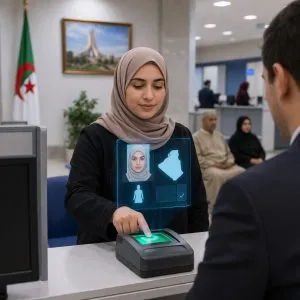
Algeria’s biometric national ID program represents one of the largest civilian biometric deployments in Africa. The CNIBE, introduced progressively across what were then 58 wilayas (provinces, now expanded to 69 as of November 2025), stores fingerprint and facial biometric data on an embedded chip. The Ministry of Interior has issued millions of biometric ID cards since 2016, targeting coverage of Algeria’s adult population of approximately 31 million citizens aged 18 and over.
The card itself is a significant achievement in terms of physical identity verification. It meets ICAO (International Civil Aviation Organization) standards for machine-readable travel documents, enabling automated border control processing. The embedded chip supports contact and contactless interfaces, theoretically allowing the card to serve as an authentication token for digital services, similar to Estonia’s e-ID card, which enables citizens to access over 600 e-services for citizens and 2,400 for businesses.
However, the critical difference between Algeria’s biometric ID and Estonia’s system lies in the digital service layer built on top of the physical card. Estonia’s e-ID is linked to a robust PKI (Public Key Infrastructure) that enables digital signing, online authentication, and encrypted communication. Algeria’s CNIBE, while technically capable of supporting similar functions, has not yet been integrated into a national digital authentication framework accessible to government agencies and private-sector service providers. The card exists; the digital ecosystem around it remains under construction.
The biometric passport program provides a parallel data point. Algeria’s Ministere de l’Interieur has issued biometric passports since January 2012, processing passport applications through a nationwide network. The biometric data collection infrastructure across daira (district) offices and consulates abroad demonstrates that Algeria has the physical network to capture and manage biometric data at population scale. The question is whether this infrastructure can be repurposed and extended to support digital identity services beyond travel documents.
Advertisement
e-Signature and Digital Trust: Law 15-04 and the Certification Framework
Law No. 15-04, enacted on February 1, 2015, established the legal framework for electronic signatures and electronic certification in Algeria. The law gives qualified electronic signatures the same legal validity as handwritten signatures, a critical prerequisite for digital transactions. It creates a hierarchy of trust: a root certification authority (Autorite Nationale de Certification Electronique, or ANCE), intermediate certification authorities, and end-entity certificates issued to individuals and organizations.
The ANCE, operating under the Ministry of Post and Telecommunications, serves as the trust anchor for Algeria’s PKI ecosystem. It issues certificates to subordinate certification authorities, which in turn issue digital certificates to end users. The framework mirrors the European eIDAS (Electronic Identification, Authentication and Trust Services) regulation in structure. The EU’s eIDAS regulation (EU 910/2014) was enacted in July 2014, shortly before Algeria’s Law 15-04 in February 2015, though Algeria’s framework has not achieved the same level of cross-border interoperability.
Adoption remains the fundamental challenge. As of early 2026, the number of qualified electronic certificates issued to Algerian citizens and businesses is estimated in the low tens of thousands, a fraction of the population. By comparison, Estonia (population 1.37 million) has approximately 1.4 million active ID cards in use, with citizens averaging around 50 digital signatures per card user per year. Turkey (population 85 million) has built a mature e-signature ecosystem with six authorized certificate service providers operating under Law No. 5070 since 2004. Algeria’s low adoption reflects several converging factors: limited awareness among businesses and citizens, few government services that accept or require e-signatures, a paper-based administrative culture deeply embedded in bureaucratic processes, and insufficient integration between the certification infrastructure and the services it is meant to enable.
The practical implications are visible in daily transactions. Registering a business in Algeria today often involves in-person visits to multiple agencies with physical documents bearing wet signatures. Real estate transactions involve notarized paper documents. Government procurement involves physical bid submission. Each of these processes can be digitized using the existing e-signature framework. The legal authority exists. The technical infrastructure exists at a basic level. The next layer to build on top of these is the implementation layer that connects them.
What a Functioning Digital Identity Unlocks
The economic case for digital identity is well documented. The McKinsey Global Institute estimates that countries implementing robust digital identity systems can unlock economic value equivalent to 3-13% of GDP by 2030, through reduced fraud, lower transaction costs, expanded financial inclusion, and improved government service delivery. For Algeria, with a GDP of approximately $270 billion (IMF, 2025), even the lower bound of that estimate represents over $8 billion in potential value creation.
Financial inclusion is the most immediate opportunity. The World Bank’s Global Findex data shows that the Middle East and North Africa region, which includes Algeria, had account ownership of just 53% among adults as of 2024, well below the global average. CCP (Compte Courant Postal) accounts held at Algeria Post offices represent the most widespread financial access point in the country, but these operate with limited digital functionality. Baridimob, Algeria Post’s mobile banking application launched around 2020, had grown to approximately 4.5 million subscribers by September 2024, but its growth is constrained by identity verification processes that still rely heavily on in-person enrollment. Algeria Post also launched Baridi Pay, a QR code-based mobile payment service, in June 2025 to further expand digital payment options. A functioning digital identity layer would enable remote KYC (Know Your Customer) verification, allowing banks, fintechs, and payment providers to onboard customers without requiring physical branch visits.
E-government services represent the second major unlock. Algeria’s government agencies collectively process hundreds of millions of administrative requests annually: birth certificates, civil status documents, business registrations, tax filings, social security claims, and permit applications. The Ministry of Interior’s platform for civil status documents (documents d’etat civil en ligne) demonstrates what is possible: citizens can request birth and marriage certificates online. But most government services remain paper-first. A unified digital identity that enables single sign-on across government portals, verified by biometric authentication and supported by legally valid e-signatures, would transform the citizen-state interface.
The SNTN 2030 strategy explicitly targets these outcomes. The plan calls for comprehensive digitization of public services by 2030, with 75% of digital projects focused on modernizing public administration, a legally recognized digital identity for every citizen and business, and a target of 20% GDP contribution from the digital sector. The strategy also aims to train 500,000 ICT specialists and reduce tech talent emigration by 40%. Meeting these targets requires not just technical deployment but institutional coordination across ministries, investment in back-end systems integration, and a sustained public awareness campaign to drive adoption.
Frequently Asked Questions
What is algeria’s digital identity infrastructure?
Algeria’s Digital Identity Infrastructure: The National Biometric ID, e-Signature covers the essential aspects of this topic, examining current trends, key players, and practical implications for professionals and organizations in 2026.
Why is algeria’s digital identity infrastructure important for Algeria?
This topic is significant for Algeria because it intersects with the country’s digital transformation goals, economic diversification strategy, and growing technology ecosystem. The article provides specific context for Algerian stakeholders.
How does biometric id: from plastic cards to digital credentials work?
The article examines this through the lens of biometric id: from plastic cards to digital credentials, providing detailed analysis of the mechanisms, trade-offs, and practical implications for stakeholders.
Sources & Further Reading
- Law No. 15-04 on Electronic Signature and Certification — Official Journal of Algeria
- Algeria Approves Draft Legislation on Digital ID, Trust Services — Biometric Update
- National Strategy for Digital Transformation (SNTN-2030) — WebServices
- Algeria Aims for Full Digital Transformation by 2030 — We Are Tech Africa
- Digital Identification: A Key to Inclusive Growth — McKinsey Global Institute
- Algeria Begins Issuing Biometric National Identity Cards — Biometric Update
- Algeria’s New Biometric Identity Card: A Successful Launch — Thales Group
- Estonia e-ID Card System — e-Estonia
- Global Findex Database 2025 — World Bank
- eIDAS Regulation — European Commission
- Strengthen Financial Inclusion and E-Payment — Ministry of Post and Telecommunications
- Algerian Passport — Wikipedia