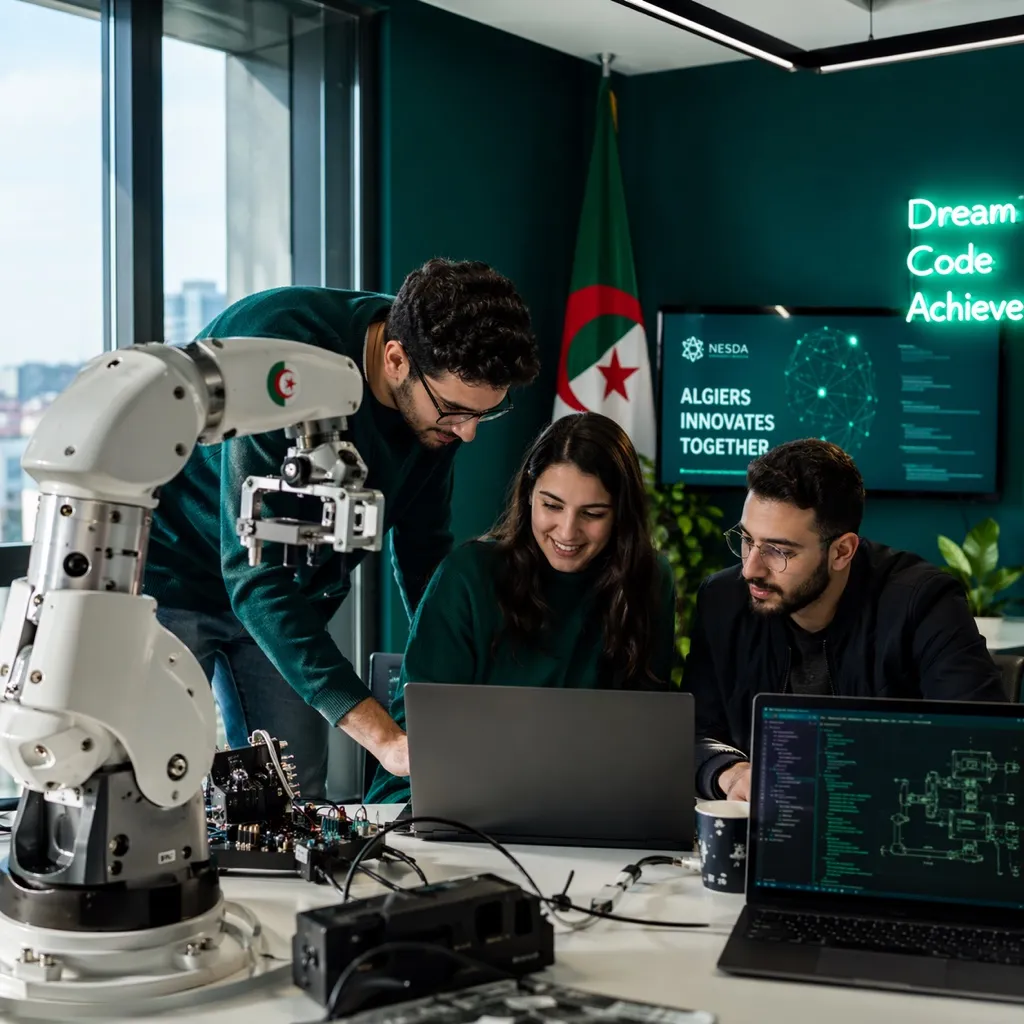
The Anchor Investment Behind Algeria’s AI Ambition
When Minister of Post and Telecommunications Sid Ali Zerrouki announced a 1.5 billion dinar investment fund at the CTO Forum Algeria in February 2025, the headline number (roughly 11 million US dollars) was not the point. The point was that Algerie Telecom, the country’s largest state operator, was putting a balance-sheet commitment behind three strategic areas the national AI strategy had identified as sovereign priorities: artificial intelligence, cybersecurity, and robotics.
A year later, the fund’s shape is much clearer. It sits inside a broader digitalisation plan of more than 500 projects scheduled for 2025-2026, and it complements the Algeria Startup Fund, the newer FCPR private venture framework, and a growing corporate-accelerator layer. The combination has moved Algeria from “emerging ecosystem” conversation to something closer to a structured pipeline: more than 7,800 companies are now registered on the official startup.dz portal, and roughly 2,300 of them hold the formal “Startup Label” that unlocks tax advantages and fast-track bank access.
Fund Structure and Selection Signals
The fund is managed by Telecom Algeria Group (GTA), which pulls together Algerie Telecom, Mobilis, and Algerie Telecom Satellite under one corporate umbrella. The explicit goals announced at launch were three: strengthening technological sovereignty, seeding local expertise in specialised fields, and creating an innovation-friendly environment that can attract talent back from abroad.
Detailed public selection criteria are still being finalised, and the access modalities have been rolled out progressively through 2025. What is known from the announcement and subsequent communications is that the fund prioritises startups addressing economic and societal challenges, building capability in response to emerging digital threats, and operating in the three eligible domains. Cybersecurity startups that can support critical national infrastructure, AI startups building local-language models or vertical applications, and robotics startups addressing industrial automation or logistics are the canonical profiles.
A second layer of selectivity sits upstream of the fund: only companies holding the Startup Label (via the Labelling Committee at the Ministry of the Knowledge Economy) or comparable recognition are practically positioned to win term sheets. The Label requires founders to be under 40, majority-Algerian shareholding, a scalable business model, and a demonstrable innovation component — criteria explicitly designed to keep the fund targeted rather than diluted.
Advertisement
The Wider Funding Mesh
The 11 million dollar line does not operate alone. The Algeria Startup Fund (ASF), established in 2020 in partnership with six public banks (CPA, BEA, BADR, BNA, BDL, and CNEP) with 2.4 billion dinars of capital, has already reviewed 350-plus applications, processed 139 funding requests across 20 sectors and 22 provinces, and backed over 100 startups. ASF’s 3.35x return on VOLZ, the travel-tech Series A that closed 5 million US dollars in December 2025, was the fund’s first exit and a proof point that public venture capital in Algeria can generate returns alongside social impact.
Algerie Telecom’s fund targets a narrower thesis than ASF. ASF is sector-agnostic; the telecom fund is explicitly concentrated on AI, cybersecurity, and robotics. That concentration matches a specific policy aim: the Minister has repeatedly stated a goal of 7% AI contribution to GDP by 2027, a number that cannot be reached without a dense layer of specialised startups supplying software, services, and automation to Algeria’s large industrial and public-sector buyers.
Supporting infrastructure has been deployed in parallel. Algerie Telecom inaugurated a Skills Centre in Setif in February 2025 offering free training in AI, cloud, IoT, and cybersecurity — a direct response to the workforce bottleneck that every 2026 global enterprise-AI survey flags as the top obstacle to scaling. Statista now projects the Algerian AI market to grow from 498.9 million US dollars in 2025 to 1.69 billion US dollars by 2030, at a compound annual growth rate of 27.67%.
MENA Benchmarks: Scale, Not Ambition
Comparing the 11 million dollar fund to regional peers surfaces the right framing: Algeria is positioning, not outspending.
The UAE led MENA startup funding in Q1 2026 with 625.8 million US dollars across 46 deals, capturing 60% of all regional AI investment. Saudi Arabia raised 5 billion US dollars across 211 deals in 2025, and is assembling a 40 billion US dollar global AI investment fund alongside its 15 billion US dollar national AI champion. Morocco raised 22.6 million US dollars across six deals in Q1 2026, largely driven by Yaakey’s 15 million US dollar Series A. Singapore — a frequent benchmark for small, tech-forward countries — sustains its innovation output with decades of layered sovereign investment.
Read against those numbers, 11 million US dollars is not a race-winning cheque. But it is an anchor: a publicly committed, thematic fund from a state telecom that signals to LPs, diaspora founders, and corporate partners that Algeria has put capital behind the AI-cyber-robotics thesis. A fund of this size can realistically deploy into 15 to 25 seed and Series A rounds over a three-to-four-year window, which is the right scale to rebuild an early-stage market that has been capital-thin since the 2014 oil-price shock.
What to Watch in 2026
Three indicators will reveal whether the fund is doing its job.
The first is portfolio transparency. The more the GTA publishes on which startups have received funding, at what stage, and with which syndicate partners, the easier it becomes for follow-on investors (ASF, FCPR vehicles, diaspora angels) to underwrite later rounds. Regional peers that publish quarterly portfolio updates, like Saudi Arabia’s Tech Venture Fund and Morocco’s Innov Invest, have seen their portfolios attract more co-investors than funds that stay silent.
The second is exits. VOLZ has proved that Algerian startups can return capital. If one of the telecom-fund portfolio companies can follow with a Series B, an acquisition, or a MENA expansion by 2027-2028, the loop from public capital to commercial outcome will be fully closed.
The third is the non-financial halo. Corporate accelerators backed by Algerie Telecom, Sonatrach, Naftal, and the major banks already run pipelines of startups looking for pilot contracts. The telecom fund’s real multiplier will come when a funded AI-cyber-robotics portfolio can convert that pilot pipeline into recurring revenue, not merely one-off pilots. That is where the 7%-of-GDP target stops being a slogan and starts being an addressable market.
The fund alone is too small to reach the stated targets. Inside a coordinated ecosystem of ASF, FCPR, corporate accelerators, and the Huawei-backed vocational training pipeline launching September 2026, it can become the catalyst the founders and enterprise buyers have been waiting for.
Frequently Asked Questions
Who actually manages the 11 million dollar fund?
Telecom Algeria Group (GTA), the corporate umbrella covering Algerie Telecom, Mobilis, and Algerie Telecom Satellite. Eligibility is effectively limited to companies holding the Startup Label or comparable recognition.
How does this fund compare to the Algerian Startup Fund (ASF)?
ASF is sector-agnostic with 2.4 billion dinars and backs over 100 startups across 20 sectors. The GTA fund is narrower — AI, cybersecurity, and robotics only — designed to concentrate capital on sovereign-priority tech rather than spread it across all founders.
Is 11 million dollars enough to move the needle against UAE and Saudi Arabia?
No, not on its own. The UAE led MENA with 625.8 million in Q1 2026 alone. But the fund can realistically back 15-25 seed and Series A rounds over three to four years — the right scale to rebuild an early-stage market rather than compete at late-stage MENA tickets.
Sources & Further Reading
- Algérie Télécom creates $11 million AI startup fund — Middle East AI News
- Algeria Bets Big on AI Startups with New Investment Fund — Launch Base Africa
- Algerian Government Invests 1.5 Billion Dinars to Propel Startups in AI, Cybersecurity, and Robotics — MEA Techwatch
- Algerian Startup Fund — Official Portal
- MENA startup funding slips to $941 million in Q1 2026 — Wamda
- Why Algeria Is Positioned to Become North Africa’s AI Leader — New Lines Institute