Algeria’s Energy Giant Goes Digital
Algeria’s hydrocarbon sector is undergoing a quiet revolution. Sonatrach, the state energy company that accounts for roughly 20% of Algeria’s GDP and over 90% of its export revenues, is accelerating its digital transformation through strategic partnerships with global technology providers. At the center of this shift is an expanding collaboration with Baker Hughes, one of the world’s leading oilfield services companies, focused on AI-powered predictive maintenance and intelligent asset management.
The partnership, which has evolved from equipment manufacturing into comprehensive digital solutions, reflects a broader recognition across Algeria’s energy sector: in an era of volatile commodity prices and aging infrastructure, AI-driven operations are no longer optional but essential for competitive survival.
The Hassi R’Mel Modernization: A $2.3 Billion Testbed
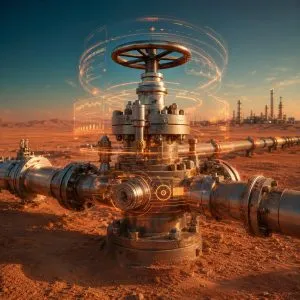
The flagship project driving this transformation is the massive modernization of Hassi R’Mel, Algeria’s largest gas field and one of the biggest in the world, located 550 kilometers south of Algiers. Sonatrach has awarded a $2.3 billion contract that includes engineering, procurement, and construction services, with 300 kilometers of existing gas-gathering flowlines to be upgraded. Final commissioning is expected in April 2027.
Baker Hughes’ Gas Technology Services team is partnering with Sonatrach to deliver upgrade solutions for the modernization of key compressor stations at the field. This work goes beyond traditional equipment replacement. The integration of Baker Hughes’ Cordant Asset Performance Management (APM) platform introduces AI-driven monitoring that can predict equipment failures before they occur, shifting maintenance from reactive schedules to data-driven interventions.
The Cordant platform integrates advanced asset health management, plantwide asset strategy, asset intelligence, and equipment expertise to deliver measurable improvements in asset performance and cost management. For a gas field the scale of Hassi R’Mel, where unplanned downtime can cost millions of dollars per day, the operational impact is substantial.
How AI Predictive Maintenance Works in the Field
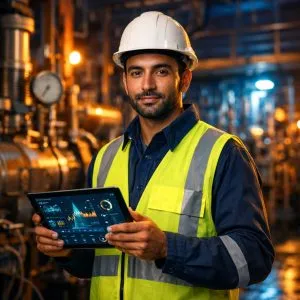
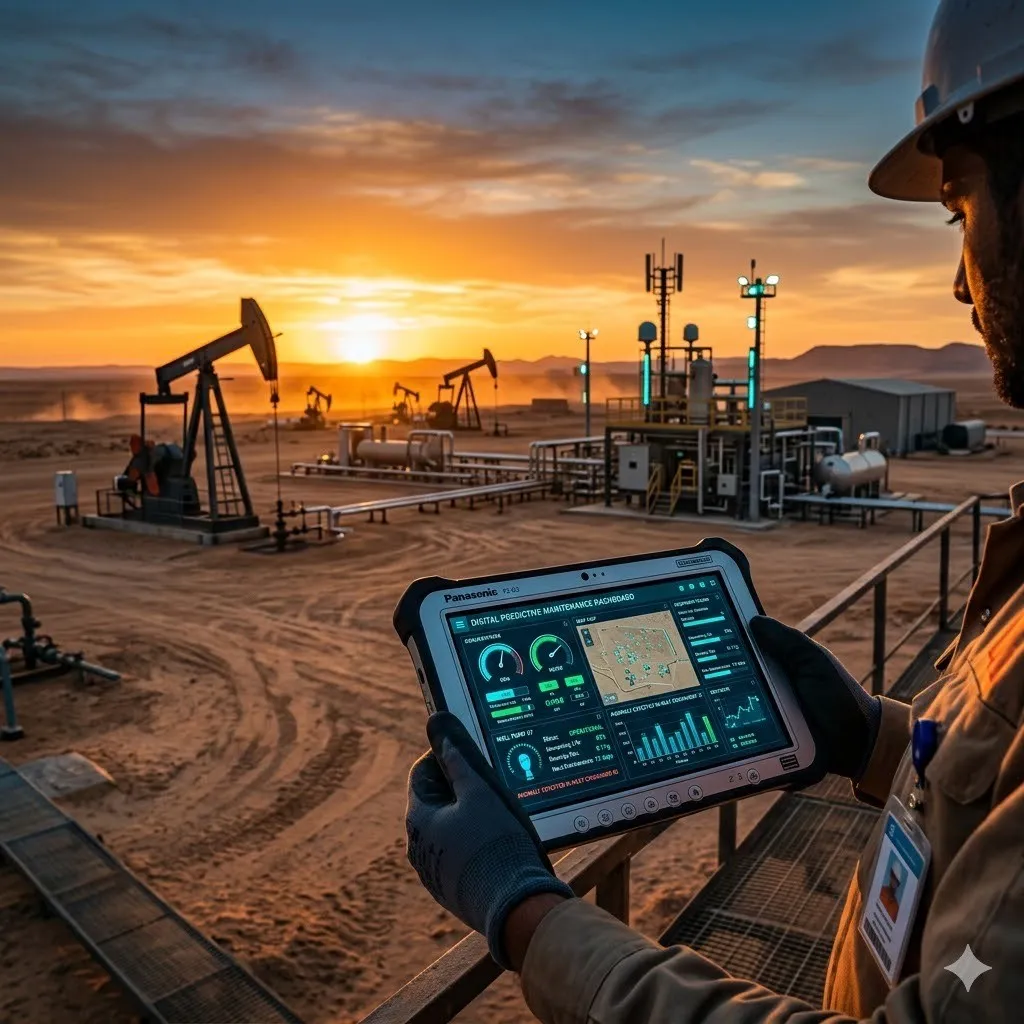
Traditional maintenance in oil and gas follows fixed schedules or responds to failures after they happen. AI-powered predictive maintenance fundamentally changes this model by continuously analyzing sensor data from pumps, compressors, turbines, and pipelines to detect anomalies that indicate impending failure.
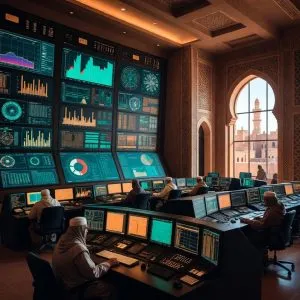
Baker Hughes’ approach combines three layers of intelligence. First, real-time sensor monitoring captures vibration patterns, temperature fluctuations, pressure anomalies, and flow-rate variations across thousands of data points. Second, machine learning algorithms trained on decades of equipment performance data identify patterns that human operators would miss. Third, digital twin technology creates virtual replicas of physical assets, allowing engineers to simulate scenarios and optimize maintenance windows without disrupting production.
The global AI in oil and gas market is projected to surpass $7.5 billion by 2030, according to a March 2026 industry report, with predictive maintenance representing one of the fastest-growing segments. Industry benchmarks suggest that predictive maintenance can reduce unplanned downtime by 30-50% and extend equipment life by 20-40% [VERIFY].
Advertisement
The APAC Joint Venture: Building Local Capability
A critical dimension of the Sonatrach-Baker Hughes relationship is the joint venture company in which Sonatrach holds 51% and Baker Hughes 49% ownership. This entity focuses on manufacturing and maintenance of equipment for the hydrocarbon chain, with discussions underway to relaunch the APAC joint venture dedicated to expanding production capabilities.
In April 2025, Sonatrach signed an agreement with Baker Hughes regarding their Algesco subsidiary, which specializes in turbine repair and maintenance, with the aim of diversifying production to expand into the African market. This localization strategy serves dual purposes: it builds Algeria’s domestic industrial capabilities in high-tech maintenance while positioning the country as a potential hub for digital oilfield services across the African continent.
The move aligns with Algeria’s broader $60 billion five-year hydrocarbon investment plan, which emphasizes not just production increases but technological sovereignty in the energy sector.
A Multi-Partner Digitalization Ecosystem
While Baker Hughes is the most prominent technology partner, Sonatrach’s digitalization strategy involves a broader ecosystem. Huawei has developed a three-phase digital transformation strategy after analyzing Sonatrach’s ICT infrastructure needs, addressing compatibility challenges across the company’s more than 200 subsidiaries and 10 horizontal functional departments. Honeywell is collaborating with Sonatrach on sustainability, digitalization, and localization of Algeria’s energy sector.
The challenge is significant. Currently, information across Sonatrach’s vast operations is often manually transferred through Excel spreadsheets, with limited mobile access and persistent data silos between departments and subsidiaries. AI-powered platforms like Cordant can help bridge these gaps by creating unified data lakes that feed predictive analytics across the entire operational chain.
What This Means for Algeria’s Tech Workforce
The digital oilfield transformation is creating demand for a new category of professionals who combine petroleum engineering knowledge with data science capabilities. Algeria’s universities and vocational training institutions will need to adapt their curricula to produce graduates who can operate at this intersection.
The opportunity is particularly relevant given Algeria’s young demographic profile, with over 50% of the population under 30. The energy sector’s digital transformation could absorb significant tech talent while providing career paths that keep skilled workers in the country rather than driving brain drain.
For Algeria’s growing community of AI and data science professionals, the energy sector represents perhaps the most immediate and large-scale opportunity for applied AI work. Unlike consumer-facing AI applications that require mature digital ecosystems, industrial AI in oil and gas can deliver measurable ROI from day one, making it a natural starting point for building Algeria’s broader AI economy.
Frequently Asked Questions
What is the Cordant platform that Baker Hughes is deploying at Hassi R’Mel?
Cordant is Baker Hughes’ AI-powered Asset Performance Management platform that integrates real-time sensor monitoring, machine learning anomaly detection, and digital twin technology to predict equipment failures before they occur. At Hassi R’Mel, it will monitor compressor stations and gas-gathering infrastructure across 300 kilometers of flowlines, shifting maintenance from fixed schedules to data-driven interventions that can reduce unplanned downtime by 30-50%.
How does the Sonatrach-Baker Hughes joint venture benefit Algeria’s workforce?
The 51/49 joint venture between Sonatrach and Baker Hughes, along with the Algesco turbine repair subsidiary, is designed to build domestic industrial capabilities in high-tech maintenance. Rather than importing all technical expertise, the localization strategy creates jobs for Algerian engineers and technicians in advanced equipment manufacturing and AI-driven asset management, while positioning Algeria as a hub for digital oilfield services across Africa.
What career opportunities does Algeria’s digital oilfield transformation create?
The transformation creates demand for hybrid professionals who combine petroleum engineering with data science skills. Key roles include AI/ML engineers specializing in predictive maintenance algorithms, digital twin architects, industrial IoT data engineers, and asset performance analysts. Algeria’s young population (50% under 30) and growing AI community are well-positioned to fill these roles, provided universities integrate computational curricula into energy engineering programs.
Sources & Further Reading
- Baker Hughes, SONATRACH Sign Contract to Boost Production from Algeria’s Largest Gas Field — Oil Review Africa
- Sonatrach Awards $2.3bn Contract for Gas-Boosting Work in Algeria — Offshore Technology
- Cordant Asset Performance Management — Baker Hughes
- AI in Oil and Gas Industry Research Report 2026-2035 — GlobeNewsWire
- Sonatrach and Baker Hughes Aim to Strengthen Their Partnership — Algeria Invest
- Baker Hughes to Support Strategic Gas Project in Algeria — Baker Hughes Investors