The 47% Threshold: Smart Manufacturing Crosses the Tipping Point
For years, Industry 4.0 remained aspirational for most manufacturers. That era is ending. As of early 2026, 47% of manufacturers worldwide have adopted smart manufacturing technologies at meaningful scale, according to industry tracking data from AutoNex Controls. That represents a 12-percentage-point increase over the previous year, the largest single-year jump in the metric’s history.
The acceleration is not limited to early adopters. Deloitte’s 2025 Smart Manufacturing and Operations Survey of 600 manufacturing executives found that 92% of manufacturers surveyed believe smart manufacturing will be the main driver for competitiveness over the next three years. Investment is following intent: 78% of respondents now allocate more than 20% of their overall improvement budget to smart manufacturing initiatives, and 88% expect those investments to continue or increase in the next fiscal year.
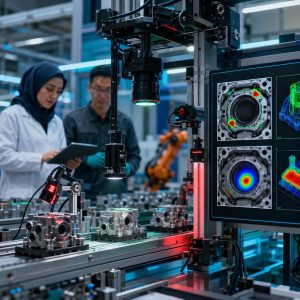
What changed? Three technologies matured simultaneously: AI-powered collaborative robots, digital twin platforms, and cloud-edge computing architectures. Together, they have made the intelligent factory economically viable for mid-sized manufacturers, not just Fortune 500 operations.
AI Cobots Move From Lab Curiosity to Production Workhorse
The collaborative robot market has reached approximately $2.95 billion in 2025 and is projected to exceed $3.5 billion in 2026, according to Grand View Research and industry tracking data. Manufacturers shipped more than 210,000 cobot units over the last four quarters, with 70% of orders now coming from non-automotive sectors such as electronics, food processing, and pharmaceuticals.
The shift is qualitative as well as quantitative. ABB, which commands an estimated 19% share of the collaborative robot market, identified a key trend for 2026: cobots are transitioning from light-duty applications to full industrial-grade performance levels. Tasks that previously required traditional industrial robots, including complex assembly, precision welding, and material handling, are now within cobot reach.
ABB’s Autonomous Versatile Robotics (AVR) platform exemplifies the AI integration driving this shift. By combining 3D AI vision, force sensing, natural language interfaces, and cloud-edge intelligence, AVR-equipped cobots can learn and adapt autonomously rather than following pre-defined programming. The result is a machine that can be retrained for a new task in hours rather than weeks.
The productivity numbers support the hype. Labor productivity in mixed human-cobot environments has risen by 34%, while AI systems yield average efficiency gains of 31% and reduce unplanned downtime by up to 43%. Asia-Pacific leads deployment with 42% of global cobot installations, followed by Europe at 30% and North America at 22%.
Advertisement
Digital Twins Graduate to Standard Practice
If cobots are the physical backbone of the intelligent factory, digital twins are its nervous system. The global digital twin market is projected to reach between $34 billion and $49 billion in 2026, depending on the research firm, with manufacturing representing the fastest-growing segment.
The adoption curve is steepening. Currently, 29% of manufacturing companies have either fully executed or partially adopted digital twin strategies, with another 65% of manufacturing technology decision-makers planning to implement them. The predictive maintenance segment alone holds 31% of the digital twin market, reflecting manufacturers’ priority to eliminate unplanned downtime.
The return on investment is compelling and fast. According to recent industry data, 92% of companies deploying digital twins report ROI above 10%, with roughly half achieving returns of 20% or more. Payback periods typically range from 12 to 36 months, though manufacturers with mature implementations are seeing initial results in as few as three to six months.
Singapore’s manufacturing sector offers a particularly instructive case. The city-state’s push to become a global smart manufacturing hub has seen digital twin adoption across its semiconductor fabrication plants and precision engineering firms, with government incentives accelerating deployment timelines. The model demonstrates how small economies can punch above their weight through strategic technology adoption.
McKinsey research on supply chain applications confirms the operational impact: digital twins deliver up to 20% improvement in fulfilling consumer promise, 10% reduction in labor costs, and 5% revenue increase through optimized operations.
The AI-ML Deployment Gap: Scale Remains the Challenge
Despite the headline adoption numbers, a crucial nuance persists. Deloitte’s survey reveals that only 29% of manufacturers have deployed AI or machine learning at the facility or network level, while 24% have deployed generative AI at similar scale. Another 23% are piloting AI/ML, and 38% are piloting generative AI.
The gap between piloting and scaling is where most manufacturers stall. Investment priorities reflect this reality: 40% of executives are investing in data analytics, 29% in cloud computing, 29% in AI, and 27% in industrial IoT. The bottleneck is not technology availability but integration complexity, talent scarcity, and the challenge of managing transformation across legacy systems.
Process automation remains the dominant investment priority, with 46% of Deloitte’s respondents ranking it first or second for the next two years. Physical automation follows at 37%, while factory synchronization, the coordination layer that ties cobots and digital twins together, ranks first or second for just 24% of respondents. That synchronization gap may prove to be the most significant barrier to moving from 47% adoption to genuine Industry 5.0 maturity.
Mobile Cobots and the Next Frontier
The fastest-growing segment within collaborative robotics is mobile cobots, formally known as Autonomous Mobile Manipulator Robots (AMMRs). The mobile cobot market is forecast to grow rapidly through the end of the decade, with industry projections suggesting unit shipments could more than double by 2030.
These systems combine the manipulation capabilities of a collaborative arm with the autonomous navigation of a mobile platform. They are particularly suited to logistics, warehouse operations, and large-scale manufacturing environments where parts and tools must move between workstations. The healthcare and agriculture sectors are also emerging as adoption frontiers for mobile cobots.
Eighty-six percent of employers now view AI, machine vision, and collaborative robotics as the primary levers for business transformation. As cobots become more intelligent, more mobile, and more affordable, the 47% smart manufacturing adoption figure looks less like a ceiling and more like a floor.
Frequently Asked Questions
What is the difference between a cobot and a traditional industrial robot?
Collaborative robots (cobots) are designed to work alongside humans in shared workspaces, equipped with force-sensing, AI vision, and safety systems that allow them to stop instantly on contact. Traditional industrial robots operate in caged-off areas with no human interaction. Cobots are smaller, more flexible, and can be retrained for new tasks in hours rather than weeks — making them suitable for the diverse, smaller-batch production environments common in emerging manufacturing economies.
How much does it cost to deploy digital twins in a manufacturing facility?
Costs vary widely by scope, but industry data shows 92% of companies deploying digital twins report ROI above 10%, with roughly half achieving 20% or more. Payback periods typically range from 12 to 36 months. For a mid-sized facility, initial deployment costs include sensor infrastructure, software licensing, and integration services. The predictive maintenance use case alone — which holds 31% of the digital twin market — often justifies the investment by eliminating unplanned downtime that costs manufacturers far more than the technology.
Which manufacturing sectors are adopting AI cobots fastest?
While automotive was the early adopter, 70% of cobot orders now come from non-automotive sectors: electronics, food processing, and pharmaceuticals are leading adoption. Asia-Pacific accounts for 42% of global cobot installations, followed by Europe at 30% and North America at 22%. The mobile cobot segment — combining robotic arms with autonomous navigation — is the fastest-growing category, particularly suited to logistics and warehouse operations.
Sources & Further Reading
- Factory Automation 2026: AI Gains & Cobot Growth — AutoNex Controls
- 2025 Smart Manufacturing and Operations Survey — Deloitte
- Key Cobot Trends Shaping 2026 — ABB
- Collaborative Robot Market Size & Industry Report — Grand View Research
- Digital Twin Statistics 2026: Market Size, Adoption Trends, ROI — MindInventory
- The Intelligent Factory: AI, Digital Twins, and Cobots Redefining Industry 5.0 — TechBullion
- Digital Twin Market Size and Share — Grand View Research