The Classroom Was Built for the Average Student — AI Is Built for Each One
For over a century, formal education has operated on a broadcast model: one teacher delivers one lesson to thirty students, all expected to absorb the material at the same pace. The students who learn faster get bored. The students who need more time fall behind. The system optimizes for the median and fails both tails.
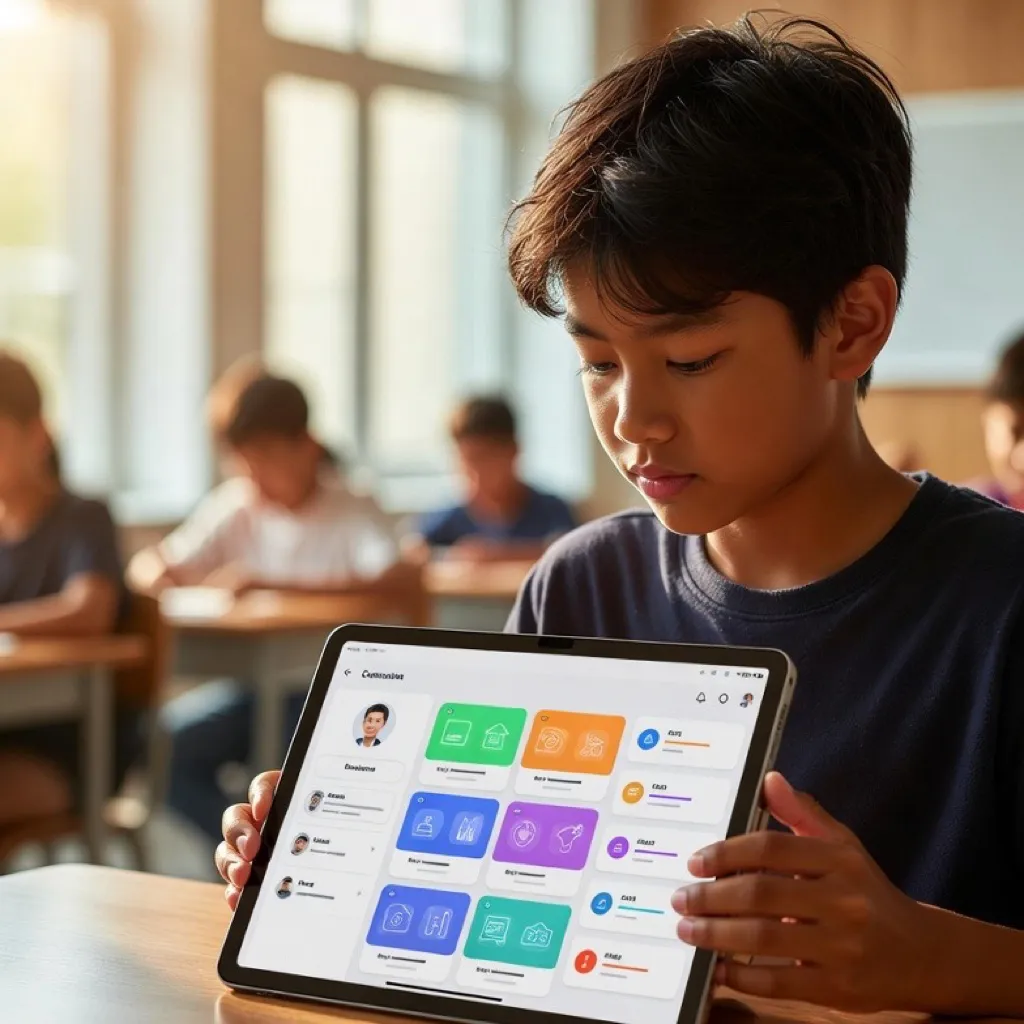
Artificial intelligence is dismantling that model. In 2026, AI-powered adaptive learning platforms can assess each student’s knowledge gaps in real time, adjust difficulty dynamically, provide instant feedback, and generate personalized practice problems — at a scale no human teacher could match. The technology is no longer experimental. Global EdTech venture capital reached $2.4 billion in 2025, with AI-powered learning platforms capturing an increasing share of investment. The global AI-in-education market, valued at $5.88 billion in 2024, is projected to reach $32.27 billion by 2030, growing at a CAGR of 31.2% — reflecting the sector’s explosive momentum.
The question is no longer whether AI will transform education. It is whether institutions, teachers, and policymakers can adapt fast enough to harness it responsibly.
The Leading Platforms: Who Is Building AI Education
Khan Academy and Khanmigo
Khan Academy’s Khanmigo has become the most prominent AI tutor in the world. Launched as a pilot in 2023, Khanmigo reached approximately 1.4 million users by late 2025 — with K-12 adoption surging from 40,000 to 700,000 users between the 2023-24 and 2024-25 school years, and on track to surpass one million K-12 users in the 2025-26 school year. Unlike a search engine that hands students the answer, Khanmigo uses a Socratic method — asking guiding questions, identifying where a student’s reasoning breaks down, and nudging them toward the correct approach without giving the solution directly.
Originally powered by OpenAI’s GPT-4, Khanmigo has expanded its AI foundation. In February 2026, Khan Academy partnered with Google to integrate Gemini AI for literacy tools — reading and writing instruction — while maintaining its existing models for mathematics and general tutoring. The platform now supports over 40 languages including Arabic and French, and Khanmigo Teacher provides AI-generated lesson plans, standards-aligned assessments, and real-time classroom analytics.
Duolingo Max and Language Learning
Duolingo’s AI integration goes beyond vocabulary drills. Duolingo Max uses GPT-4o to power “Explain My Answer” (a conversational AI that explains grammar mistakes in context) and “Roleplay” (simulated conversations with AI characters in the target language). With over 116 million monthly active users and more than 50 million daily active users as of Q3 2025, Duolingo represents the largest real-world deployment of conversational AI in education. The company crossed $1 billion in annual revenue — demonstrating that AI-powered education can be commercially sustainable at scale.
Squirrel AI (China)
China’s Squirrel AI operates a network of over 3,000 learning centers worldwide, serving 24 million students through a hyper-granular adaptive learning engine that breaks each subject into thousands of micro-knowledge points. The system diagnoses individual student weaknesses at an extraordinarily fine level and generates customized learning paths. Squirrel AI claims that students using its platform show learning efficiency improvements of 5–10x compared to traditional classroom instruction, though independent verification of these claims remains limited. In 2026, Squirrel AI announced expansion into the US market, signaling a new phase of international growth for Chinese EdTech.
Coursera, edX, and the MOOC Evolution
Major online learning platforms have integrated AI assistants across their course catalogs. Coursera’s AI-powered “Coach” provides personalized study schedules, answers course-specific questions, and generates practice quizzes. EdX uses AI to grade assignments, provide instant feedback on coding exercises, and recommend career-relevant course sequences. These integrations are turning passive course catalogs into actively adaptive learning environments.
How AI Tutoring Actually Works: The Technical Foundation
Modern AI tutoring systems combine several technologies that did not exist or were impractical before 2024:
Knowledge tracing models track what a student knows and does not know across a subject’s entire concept graph. When a student answers a question incorrectly, the system does not just record the error — it infers which underlying concept is weak and generates targeted practice for that specific gap.
Natural language understanding enables students to ask questions in plain language — “I don’t understand why we need to multiply both sides of the equation” — and receive explanations tailored to their level and context.
Retrieval-augmented generation (RAG) grounds AI tutor responses in verified educational content rather than the model’s general training data, reducing hallucination risk in academic contexts. Khanmigo, for example, restricts its responses to Khan Academy’s own curriculum library.
Multimodal input allows students to photograph handwritten math problems, upload diagrams, or speak questions aloud. The AI processes visual, text, and audio input to understand what the student is working on and where they are stuck.
Spaced repetition optimization uses algorithms to schedule review of previously learned material at scientifically optimal intervals, dramatically improving long-term retention compared to traditional study methods.
Advertisement
The Teacher’s Role Transforms — It Doesn’t Disappear
The most persistent fear around AI in education is that it will replace teachers. The evidence from 2025-2026 deployments tells a different story: AI is changing what teachers do, not eliminating the need for them.
In schools using Khanmigo and similar platforms, teachers report spending significantly less time on lectures, grading, and repetitive explanations, and significantly more time on mentoring, discussion facilitation, project-based learning, and social-emotional support — the work that requires human empathy and judgment.
Early evidence from multiple school districts in the United States and pilot programs globally suggests that students with both an AI tutor and a human teacher consistently outperform students with either alone. The human-AI combination appears superior to either in isolation — reinforcing the case for AI as a complement to teachers, not a replacement.
The teacher’s role shifts from “source of knowledge” to “learning architect” — designing experiences, coaching students through complex problems, building motivation, and handling the social and emotional dimensions of learning that AI cannot replicate. Teachers who embrace this shift report higher job satisfaction; teachers who resist it report increasing frustration as students arrive having already learned foundational content from AI tutors.
The University Dilemma: Ban, Embrace, or Pretend It Doesn’t Exist
Higher education is in crisis over AI. Universities face a trilemma: ban AI tools and lose relevance, embrace them and struggle to assess genuine student learning, or ignore the issue and watch academic integrity erode.
By early 2026, the landscape has fragmented:
Ban camp: A minority of institutions — primarily those with strong honor code traditions — prohibit AI tool use in coursework entirely. Enforcement is nearly impossible: detection tools like Turnitin’s AI classifier have proven unreliable in practice. While Turnitin officially claims a false-positive rate of less than 1% at the document level, independent studies show real-world false-positive rates of 10-15% depending on writing style — and the problem is worse for non-native English speakers. One study found that 61% of TOEFL essays written by non-native English speakers were incorrectly flagged as AI-generated, raising serious equity concerns.
Embrace camp: Leading universities including MIT, Stanford, Carnegie Mellon, and the University of Michigan have integrated AI tools into curricula, requiring students to demonstrate AI literacy and use AI as a productivity tool while learning to evaluate and verify AI output critically. These institutions are redesigning assessments around oral exams, project portfolios, and live demonstrations that are difficult to fake with AI.
Confused middle: The majority of institutions have issued vague policies, leaving individual professors to decide their own approach — creating inconsistency that frustrates students and faculty alike.
The deeper challenge is philosophical: if an AI can write a passable essay, what does an essay assignment actually test? Universities are being forced to rethink assessment at a fundamental level — a process that will take years and is only beginning in 2026.
The Equity Paradox: Democratization vs. Digital Divide
AI in education carries a profound equity tension. On one hand, a high-quality AI tutor available on a smartphone could give a student in rural Algeria or sub-Saharan Africa access to personalized instruction that was previously available only to students at elite private schools or those who could afford human tutors charging $100/hour. Khan Academy is free. Duolingo is free. The marginal cost of an AI tutoring session is close to zero.
On the other hand, access requires a smartphone, a reliable internet connection, and electricity — resources that remain unevenly distributed globally. Students in well-resourced schools get AI tools integrated into their classroom alongside skilled teachers; students in under-resourced schools may get AI tools as a replacement for teachers rather than a complement.
The risk is a bifurcated system: affluent students use AI as a turbocharger alongside excellent human instruction, while disadvantaged students use AI as a replacement for instruction that was already inadequate. Early evidence from the United States and United Kingdom suggests this pattern is already emerging.
UNESCO’s 2025 Global Education Monitoring Report flagged this risk explicitly, calling for governments to invest in AI literacy for teachers and digital infrastructure for underserved schools alongside AI tool deployment — not after it.
Grading, Assessment, and the Plagiarism Arms Race
AI is simultaneously disrupting assessment in two directions: enabling better automated assessment tools, and making traditional assessments obsolete.
AI-powered grading has matured significantly. Systems like Gradescope (acquired by Turnitin) can now grade open-ended essay responses, provide detailed written feedback on structure, argumentation, and evidence use, and do so with inter-rater reliability comparable to human graders — and at a fraction of the cost and time.
The plagiarism question is evolving rapidly. The first generation of “AI detectors” (GPTZero, Turnitin AI Classifier) have proven unreliable in production. Turnitin’s official false-positive rate of less than 1% at the document level contrasts sharply with independent findings of 10-15% false-positive rates in real-world use — with non-native English speakers disproportionately affected. Most universities have quietly stopped penalizing students based solely on AI detection scores.
The emerging consensus is that the question “Did the student use AI?” is the wrong question. The right question is “Can the student demonstrate the underlying competency?” This is driving a shift toward competency-based assessment: oral exams, live problem-solving demonstrations, portfolio defense, and collaborative projects where the process — not just the product — is evaluated.
Frequently Asked Questions
What is ai in education?
AI in Education: Personalized Learning and the End of the Classroom as We Know It covers the essential aspects of this topic, examining current trends, key players, and practical implications for professionals and organizations in 2026.
Why does ai in education matter?
This topic matters because it directly impacts how organizations plan their technology strategy, allocate resources, and position themselves in a rapidly evolving landscape. The article provides actionable analysis to help decision-makers navigate these changes.
How does the leading platforms: who is building ai education work?
The article examines this through the lens of the leading platforms: who is building ai education, providing detailed analysis of the mechanisms, trade-offs, and practical implications for stakeholders.
Sources & Further Reading
- AI Can Deliver Personalized Learning at Scale, Study Shows — Dartmouth
- AIs Future for Students Is in Our Hands — Brookings Institution
- Khanmigo: AI-Powered Teaching Assistant & Tutor — Khan Academy
- Designing the 2026 Classroom: Emerging Learning Trends — Faculty Focus
- Predictions About AI in Education in 2026 — Fordham Institute
- AI-Based Personalised Learning: A Systematic Literature Review — Springer