From Chatbots to Autonomous Workers
For three years, using AI meant typing a prompt and reading a response. That era is ending. The defining trend of 2026 is the rise of AI agents: systems that do not just answer questions but autonomously plan, act, and complete multi-step tasks across real software environments.
An AI agent can browse the web, write and execute code, fill out forms, manage calendars, interact with external software, and coordinate with other agents, all without a human approving each individual step. What was a research demo in 2024 is becoming enterprise infrastructure in 2026.
The market reflects that acceleration. According to DataM Intelligence, the global agentic AI market reached $4.54 billion in 2025 and is projected to hit $98.26 billion by 2033 — a compound annual growth rate of 46.9%. Gartner predicts that 40% of enterprise applications will feature task-specific AI agents by the end of 2026, up from less than 5% in 2025.
What Makes an AI Agent Different
The word “agent” has a specific technical meaning: a system that perceives its environment, sets goals, plans a sequence of actions, executes those actions using tools, and adapts based on feedback — without requiring human instruction at each step.
A traditional large language model is a brilliant but passive consultant: you ask a question, it gives you an answer. An AI agent is more like an employee: you provide a goal (“schedule all my meetings for next week, prioritizing high-priority contacts”), and it checks your calendar, reads your email, looks up contact histories, and sends invitations — completing in under a minute a workflow that would take a human half an hour.
On February 5, 2026, Anthropic and OpenAI launched competing agentic coding models within 15 minutes of each other — Anthropic with Claude Opus 4.6 and OpenAI with GPT-5.3-Codex — a moment that captured the intensity of the race to dominate this space. OpenAI’s CEO of applications Fidji Simo has described the company’s vision as AI assistants that are proactive, anticipating user needs and taking action across the web and the physical world.
MCP: The Universal Standard for Agent Connectivity
One of the most important infrastructure developments enabling the agent revolution is Anthropic’s Model Context Protocol (MCP) — a standardized interface that allows AI agents to connect to external tools, databases, APIs, and services in a consistent, interoperable way.
MCP has been described as the USB-C of AI: just as USB-C created a universal connector for devices, MCP creates a universal connector between AI agents and the digital services they need to act in the world. Instead of each AI application requiring custom integration with each tool, MCP provides a common protocol any agent can use to discover and interact with any MCP-compatible service.
Adoption has been broad and fast. OpenAI adopted MCP across its Agents SDK, Responses API, and ChatGPT desktop app. Microsoft and GitHub joined MCP’s steering committee at Build 2025. Google launched managed MCP servers to connect AI agents to Cloud databases, Maps, BigQuery, and Kubernetes Engine. And in February 2026, Apple integrated MCP into Xcode 26.3, embedding Claude and Codex agents directly into its development environment — a validation from the world’s most valuable company.
A critical governance milestone came in December 2025, when Anthropic donated MCP to the Agentic AI Foundation (AAIF) under the Linux Foundation. Co-founded by Anthropic, Block, and OpenAI — with support from Google, Microsoft, AWS, Cloudflare, and Bloomberg — the AAIF ensures that MCP evolves as a neutral industry standard rather than a single-vendor protocol. As of early 2026, MCP counts over 97 million monthly SDK downloads and more than 10,000 active servers.
Multi-Agent Systems: AI That Coordinates
A second major development is the emergence of multi-agent architectures, where multiple specialized AI agents coordinate to accomplish tasks no single agent could handle alone.
Anthropic’s Claude Opus 4.6 introduced Agent Teams — currently available as a research preview — a framework where a lead orchestrator agent spins up multiple independent agents, each specializing in different subtasks: one researching, one writing, one verifying facts, one formatting. In one notable demonstration, 16 parallel Claude agents wrote a 100,000-line C compiler in two weeks with a 99% pass rate on the GCC test suite.
This mirrors how human organizations work: complex projects are broken into workstreams, assigned to specialists, coordinated by a manager, and reviewed for quality. Multi-agent AI systems are replicating this organizational structure in software.
Advertisement
Real-World Deployments Already Underway
The agent revolution is not hypothetical. Across industries, agentic AI is already performing work that previously required human operators.
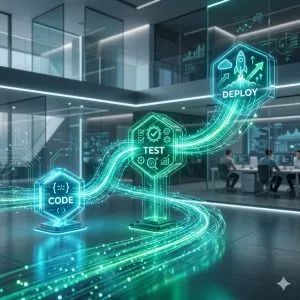
Software development is the most visible frontier. AI coding agents take a feature specification, write the code, run tests, debug failures, and open a pull request with minimal human intervention. GitHub Copilot Workspace, Cursor, and agents from Anthropic and OpenAI handle this daily for engineering teams. Cognition’s Devin has moved from demo to enterprise infrastructure, partnering with Infosys in January 2026 for large-scale deployment, while Goldman Sachs has deployed Devin as its first AI “employee” for software engineering tasks.
Customer service agents handle complex multi-turn interactions — not just FAQ responses but actual problem resolution, including account lookups, refund processing, and appointment scheduling, escalating to humans only when genuinely needed.
Research and analysis agents execute literature reviews, synthesize information from dozens of sources, and generate structured reports, compressing weeks of analyst work into hours.
Legal and compliance teams deploy agents that review contracts, flag non-standard clauses, compare terms against standard libraries, and produce redlined documents — work that previously consumed paralegal hours.
The Accountability Gap
As agents take more consequential actions, the gap between AI capability and AI accountability widens. When an agent sends an email to the wrong person, deletes the wrong file, or authorizes an incorrect transaction, who is responsible?
Current frameworks for liability and error attribution were designed for human actors and fit poorly with autonomous software. Several high-profile agent failures in 2025 illustrated the stakes: an agent published a social media draft that should have been deleted; a customer service agent approved an unauthorized refund policy; a research agent cited a fabricated source.
The responsibility question cascades: from the agent, to the human who set its permissions, to the organization that deployed it, to the developers who built and trained it. Leading approaches to managing this risk include human-in-the-loop approval gates for consequential actions, minimal permission principles, comprehensive audit trails, and reversibility-first design that favors undoable actions and requires additional confirmation for permanent ones.
The Competitive Landscape
The agentic AI race is the defining competitive contest in technology in 2026.
Anthropic has established a strong early position through Claude’s Computer Use capability, MCP’s broad adoption, Opus 4.6’s Agent Teams framework, and a safety-focused culture that appeals to risk-conscious enterprises. OpenAI competes fiercely with its own computer use capabilities, the GPT-5 series, and unmatched consumer distribution through ChatGPT. Google leverages its search, Gmail, Maps, and Workspace integration — its managed MCP servers and Gemini’s multimodal capabilities make it strong for web information retrieval. Microsoft holds the enterprise integration advantage through Azure, Teams, Office 365, GitHub, and Dynamics 365, with its Copilot ecosystem the most widely deployed enterprise AI agent framework. Apple’s Xcode 26.3 integration signals the company’s entry into the agentic development tools space.
Meanwhile, open-source frameworks — LangChain, LlamaIndex, CrewAI, and others — enable developers to build custom agents on any underlying model, and emerging competitors like DeepSeek are bringing significant resources from China’s AI ecosystem into the agentic space.
What Comes Next
The trajectory points toward several near-certain developments over the next 18 months.
Personal AI agents reach consumers. Agents managing email, scheduling, research, and travel booking will hit mainstream adoption as reliability improves enough for users to trust them with consequential tasks.
Enterprise agent platforms become standard. Every major enterprise software category — ERP, CRM, HRMS, legal, finance — will have agent capabilities deeply integrated. The question shifts from “should we use agents?” to “which agent platform fits our stack?”
Regulation arrives. Governments in the EU, US, and Asia will publish specific guidance for agentic AI covering liability, transparency, audit requirements, and human oversight mandates.
New attack surfaces open. Prompt injection attacks that manipulate agents through malicious content, credential theft from agents with broad system access, and agent hijacking attacks will make AI agent security a distinct cybersecurity discipline.
The transition from AI that talks to AI that acts is the most consequential technology shift of the current decade. The organizations that build robust, well-governed agentic capabilities now will hold structural advantages in productivity and speed that will be difficult for late movers to close.
Frequently Asked Questions
What does “The Age of AI Agents” mean?
The Age of AI Agents: How Autonomous AI Is Reshaping Technology in 2026 covers the essential aspects of this topic, examining current trends, key players, and practical implications for professionals and organizations in 2026.
Why does the age of ai agents matter?
This topic matters because it directly impacts how organizations plan their technology strategy, allocate resources, and position themselves in a rapidly evolving landscape. The article provides actionable analysis to help decision-makers navigate these changes.
How does what makes an ai agent different work?
The article examines this through the lens of what makes an ai agent different, providing detailed analysis of the mechanisms, trade-offs, and practical implications for stakeholders.
Sources & Further Reading
- Agentic AI Market to Reach $98.26 Billion by 2033 — DataM Intelligence via OpenPR
- Gartner Predicts 40% of Enterprise Apps Will Feature AI Agents by 2026
- OpenAI Launches Agentic Coding Model Minutes After Anthropic — TechCrunch
- Anthropic Releases Claude Opus 4.6 with Agent Teams — TechCrunch
- Claude Opus 4.6 Brings 1M Token Context and Agent Teams — VentureBeat
- Introducing Claude Opus 4.6 — Anthropic
- Fidji Simo: A New Paradigm of Proactive, Steerable AI — Substack
- OpenAI Leadership Expansion with Fidji Simo — OpenAI
- OpenAI Co-Founds Agentic AI Foundation — OpenAI
- Donating MCP and Establishing the Agentic AI Foundation — Anthropic
- Linux Foundation Announces Formation of the Agentic AI Foundation
- Managed MCP Servers for Google Cloud Databases — Google Cloud Blog
- Google Is Going All In on MCP Servers — TechCrunch
- Agentic Coding Comes to Apple’s Xcode 26.3 — TechCrunch
- Infosys and Cognition Collaborate to Accelerate AI Value — Infosys
- Goldman Sachs Deploys Devin as First AI Employee — IBM Think
- The AI Insider: OpenAI and Anthropic Race to Release Agentic Coding AI