Understanding which threats are most likely to hit your organization is the foundation of effective cybersecurity. For Algerian businesses in 2026, the threat landscape is shaped by global attack trends, Algeria-specific targeting by threat actors, and the structural vulnerabilities of a digital economy that is digitizing rapidly without always implementing security controls in parallel.
The scale is staggering. According to Kaspersky’s Africa Cyberthreat Landscape Report 2025, Algerian users and organizations faced over 125 million attacks involving infected files in 2024, with threat detection rates exceeding 30% — among the highest on the continent. Positive Technologies research ranked Algeria as the third most targeted country in Africa (13% of dark web interest), behind South Africa (25%) and Nigeria (18%).
This article maps the top threats — with verified data — and provides actionable defense priorities for each.
Threat #1: Phishing and Spear-Phishing
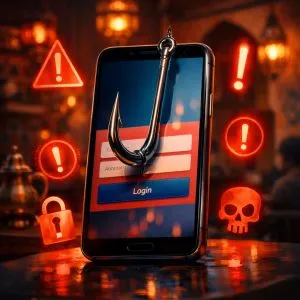
Phishing is the dominant attack vector targeting Algerian organizations. Kaspersky blocked over 13 million phishing attempts and nearly 750,000 malicious email attachments targeting Algeria in 2024 — figures from their Africa Cyberthreat Landscape Report.
How it works in Algeria: Attackers send emails impersonating trusted entities — the Bank of Algeria, the Ministry of Finance, Algerie Telecom, or major employers like Sonatrach and Air Algerie. The emails contain malicious links or attachments designed to steal credentials or install malware.
Algeria-specific patterns:
- High volume of attacks crafted in French and Arabic — indicating local knowledge and deliberate targeting rather than generic global campaigns
- Phishing pages mimicking Algerian banking portals (BNA, BEA, CPA) with convincing visual design
- Spoofing of government agencies that most citizens interact with regularly — CNAS (health insurance), pension authorities, and tax services
Defense priorities:
- Deploy email authentication (SPF, DKIM, DMARC) on all company domains — prevents attackers from spoofing your domain to target your clients
- Enable multi-factor authentication (MFA) on all email accounts — phished credentials become useless when attackers cannot pass the second factor
- Conduct quarterly phishing simulation exercises to measure and improve employee awareness
- Implement a suspicious email reporting button in your email client so employees can flag threats instead of ignoring or deleting them
Threat #2: Ransomware
INTERPOL’s 2025 Africa Cyberthreat Assessment recorded 1,117 ransomware threat detections targeting Algeria in 2024, placing the country among the most affected in Africa alongside South Africa, Egypt, Nigeria, and Kenya. Ransomware attacks caused substantial financial and operational damage across the continent, affecting finance, energy, infrastructure, government, and telecommunications.
The post-LockBit and post-BlackCat ransomware landscape has fragmented into dozens of smaller ransomware-as-a-service (RaaS) operations that increasingly target small and mid-size businesses — exactly the profile of Algeria’s private sector.
How Algerian organizations get hit:
- Initial access: Phishing email with malicious attachment, or exploitation of publicly exposed Remote Desktop Protocol (RDP) or VPN credentials purchased on dark web markets
- Lateral movement: The attacker spends days to weeks mapping the network, identifying backup systems and administrator credentials
- Data exfiltration: Sensitive files are copied before encryption — enabling “double extortion” where payment is demanded both to restore files and to prevent public release
- Encryption and ransom demand: Files encrypted simultaneously across all accessible systems, with payment demanded in cryptocurrency within 72-96 hours
Sectors most affected in Algeria: Manufacturing SMEs, healthcare institutions, professional services firms (accounting, legal, engineering), and logistics companies.
Defense priorities:
- 3-2-1 backup rule: 3 copies of data, on 2 different media types, with 1 copy offline (air-gapped). A working offline backup eliminates the need to pay ransom
- Patch management: The majority of ransomware exploits vulnerabilities for which patches have been available for months. Implement automatic OS patching and monthly review of unpatched critical systems
- Network segmentation: Ensure a compromised workstation cannot directly reach backup servers, domain controllers, or financial systems
- Disable RDP on the public internet or restrict it behind a VPN with MFA — exposed RDP remains the single most common ransomware entry point globally
Threat #3: Business Email Compromise (BEC)
BEC is not technically sophisticated — it requires no malware. Attackers either compromise a business email account or create a convincingly similar fake address, then send requests to employees in finance or procurement to redirect payments to attacker-controlled accounts.
The FBI’s 2024 IC3 Annual Report documented $2.77 billion in BEC losses across 21,442 reported incidents in the United States alone — making BEC the second most profitable cybercrime category after investment fraud, exceeding ransomware and phishing combined. The model translates globally.
Algeria-specific pattern: Algerian companies with international supplier relationships — particularly in import-heavy sectors like automotive parts, consumer electronics, and pharmaceuticals — have been targeted by BEC campaigns impersonating known suppliers and requesting payment routing changes.
Defense priorities:
- Verbal verification protocol: All changes to payment routing information must be verified by phone call to a known, pre-existing contact number — never a number provided in the suspicious email
- Payment authorization controls: Payments above a threshold (recommend $5,000) require dual authorization from two separate individuals
- Email security filtering: Deploy advanced email security with BEC-specific detection capabilities (Microsoft Defender for Office 365, Proofpoint, or Mimecast)
Advertisement
Threat #4: Hacktivist and Geopolitical DDoS Attacks
The Algeria-Morocco cyber conflict that escalated dramatically in April 2025 demonstrated how geopolitical tensions translate into direct cybersecurity threats for Algerian organizations.
In April 2025, a threat actor using the alias “JabaROOT” breached Morocco’s National Social Security Fund (CNSS), leaking data on nearly 2 million employees. Moroccan hacker groups — including Phantom Atlas and Moroccan Cyber Forces — retaliated by breaching Algeria’s Social Security Fund for Postal and Telecommunications Workers, leaking 13-20 GB of sensitive data including ID numbers and administrative documents. The hostilities continued through June 2025, with Phantom Atlas claiming access to Algerie Telecom’s internal network infrastructure.
Beyond the Algeria-Morocco dynamic, government websites, national banking platforms (SATIM), and media outlets have experienced DDoS attacks during periods of regional political tension. DDoS attacks across the Middle East and Africa increased 30% in the first half of 2024.
Defense priorities:
- Ensure hosting providers or CDN services include DDoS mitigation as a baseline service (Cloudflare, Akamai, or AWS Shield)
- Maintain out-of-band communication channels so that if your main website goes down, you can still reach customers and stakeholders
- Segment sensitive data — the April 2025 breaches demonstrated that social security databases and telecom infrastructure data are high-value targets. Minimize what can be exfiltrated from any single compromise
Threat #5: Social Engineering and Insider Threats
No technical control prevents an employee who is deceived, coerced, or financially compromised from providing access to systems. Social engineering — manipulating people rather than technology — remains the most reliable attack technique for sophisticated threat actors.
Algeria-specific risk factors:
- Economic pressure: With significant salary differentials between domestic and international employers, employees may be susceptible to recruitment by criminal groups offering supplemental income for information
- Vishing (voice phishing): Calls impersonating IT support, the Bank of Algeria, or tax authorities are increasingly common, especially targeting less tech-savvy employees in finance roles
- LinkedIn-based targeting: Algerian professionals with publicly listed organizational responsibilities are researched and approached by social engineers posing as recruiters or consultants to gather organizational intelligence
Defense priorities:
- Security awareness training: Annual is insufficient; quarterly micro-training (15-minute modules) with immediate testing has demonstrated effectiveness
- Clear escalation procedures: Employees must know who to call when they receive suspicious requests — confusion creates vulnerability
- Insider threat program: Not an accusatory surveillance system, but a policy framework that monitors anomalous data access patterns and has clear procedures for reporting concerns
Building Your 2026 Security Baseline: The Priority Stack
For Algerian organizations with limited security budgets, the highest-return investments in priority order:
Frequently Asked Questions
What is phishing, ransomware, and social engineering?
Phishing, Ransomware, and Social Engineering: The Top Cyber Threats Targeting Algerian covers the essential aspects of this topic, examining current trends, key players, and practical implications for professionals and organizations in 2026.
Why does phishing, ransomware, and social engineering matter?
This topic matters because it directly impacts how organizations plan their technology strategy, allocate resources, and position themselves in a rapidly evolving landscape. The article provides actionable analysis to help decision-makers navigate these changes.
How does threat #2: ransomware work?
The article examines this through the lens of threat #2: ransomware, providing detailed analysis of the mechanisms, trade-offs, and practical implications for stakeholders.
Sources & Further Reading
- Kaspersky Africa Cyberthreat Landscape Report 2025
- Positive Technologies — Cybersecurity Threatscape for Africa 2023-2024
- Nigeria, South Africa, Algeria Top Targets 2024 — Cybersecurity Review
- FBI IC3 2024 Annual Report
- INTERPOL Africa Cyberthreat Assessment Report 2025 — Group-IB
- Algeria-Morocco Cyber Conflict — The Record
- Moroccan Hackers Retaliate Against Algeria — Morocco World News
- Phantom Atlas Infiltrates Algerie Telecom — Morocco World News
- DDoS Attacks Surge in Africa — Dark Reading
- Algeria Steps Up Cybersecurity Training — Ecofin Agency
- Resecurity — Morocco CNSS Data Breach Analysis