From Talking Point to Production Infrastructure
For years, tokenization was a blockchain industry talking point — a theoretical future where government bonds, private loans, and real estate would live on distributed ledgers. In 2026, that future stopped being theoretical.
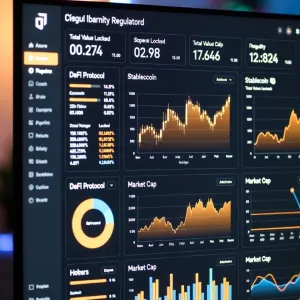
Total value locked in tokenized real-world assets surpassed $21 billion in January 2026 according to data from RWA.xyz, with PYMNTS reporting the figure climbing toward $26 billion by March. This represents a roughly fourfold increase from approximately $6.6 billion in the same period a year ago. Tokenized U.S. Treasuries alone crossed $11 billion in March 2026, while private credit surged 180% to exceed $3.2 billion. JPMorgan’s Kinexys platform (formerly Onyx) has processed over $1.5 trillion in total notional transactions since inception.
These are not startup experiments. They are production-grade financial systems operated by the world’s largest banks and asset managers. The question is no longer whether tokenization will happen — it is how fast, on which chains, and under what regulatory framework.
The Institutional Players Driving the Surge
BlackRock and the BUIDL Benchmark
BlackRock launched BUIDL (the BlackRock USD Institutional Digital Liquidity Fund) in March 2024, and it quickly became the benchmark for institutional tokenized Treasuries. By early 2026, BUIDL holds approximately $2 billion in tokenized Treasury assets, operating across nine blockchain networks including Ethereum, Avalanche, Solana, and Arbitrum.
BUIDL is tokenized by Securitize and targets qualified institutional investors with a $5 million minimum. The fund holds short-term Treasuries and pays daily yield directly to token holders’ wallets. When the world’s largest asset manager — with over $14 trillion under management — operates a tokenized product at this scale, it validates the infrastructure, the regulatory approach, and the market demand.
Circle USYC and the Yield-Bearing Stablecoin
Circle, the issuer of USDC, emerged as a major RWA player through USYC — a yield-bearing token backed by short-duration Treasuries managed by its subsidiary Hashnote. USYC reached $2.2 billion in early 2026, overtaking BlackRock’s BUIDL to become the largest tokenized Treasury product by market capitalization. Circle’s advantage is distribution: USDC is already integrated into thousands of DeFi protocols, exchanges, and payment systems, giving existing users a seamless path to earn Treasury yield without leaving the on-chain ecosystem.
JPMorgan Kinexys and the Institutional Backbone
JPMorgan’s Kinexys division (rebranded from Onyx in November 2024) represents the institutional plumbing of tokenized finance. The platform has processed over $1.5 trillion in total notional value since inception, averaging more than $2 billion in daily transaction volume. Kinexys handles intraday repo, foreign exchange settlement, and cross-border payments using JPM Coin — a permissioned stablecoin for institutional counterparties. More than $300 billion in repo transactions alone have been processed on the Digital Assets network.
The Expanding Field
The field extends well beyond these three. Franklin Templeton’s BENJI fund (the Franklin OnChain U.S. Government Money Fund) has crossed $1 billion in assets, deployed across Ethereum, Stellar, Avalanche, Solana, and other chains. Ondo Finance has grown its RWA portfolio to approximately $2.5 billion across more than 250 tokenized assets with over 82,000 holders. Centrifuge leads in tokenized private credit with over $1.1 billion in active loans. The proliferation of issuers signals that the legal, custody, and compliance infrastructure has matured enough that launching a tokenized fund is no longer a multi-year engineering project.
Three Forces Behind the Surge
High Interest Rates Created the Demand Signal
When Treasury yields were near zero in 2020-2021, there was little economic incentive to tokenize government bonds. The Federal Reserve’s rate hikes in 2022-2023, which pushed short-term yields above 5%, made tokenized Treasuries attractive. Investors could earn meaningful risk-free yield while staying in the on-chain ecosystem. Tokenization adoption is often driven not by the technology itself but by the economic conditions that make the technology compelling.
The GENIUS Act Provided Regulatory Clarity
The regulatory environment for digital assets in the United States underwent a fundamental shift with the passage of the GENIUS Act (Guiding and Establishing National Innovation for U.S. Stablecoins), signed into law by President Trump on July 18, 2025. The Senate passed the bill 68-30 on June 17, and the House passed it 308-122 on July 17. The Act established a federal regulatory framework requiring stablecoin issuers to hold one-to-one reserves in high-quality liquid assets, submit to regular third-party audits, and obtain federal or state licensing. By establishing that digital representations of financial assets can operate within a regulated framework, the GENIUS Act reduced the legal uncertainty that had been the primary barrier to institutional adoption. The OCC issued a 376-page notice of proposed rulemaking in February 2026 to implement the Act’s provisions.
Infrastructure Reached Critical Mass
The third force is the maturation of the underlying technology stack. Ethereum hosts over 60% of tokenized RWA value, benefiting from its security, developer ecosystem, and DeFi composability. Layer 2 solutions have reduced gas costs for smaller transactions. Institutional custody providers — Fireblocks, Anchorage Digital, BitGo — offer the insurance and compliance controls regulated entities require. The ERC-3643 token standard (also known as T-REX) has emerged as the dominant standard for security tokens, embedding identity verification and transfer restrictions directly into token contracts so that only KYC-cleared wallets can hold or transfer the token. Oracle networks like Chainlink and Pyth provide the real-time proof-of-reserve attestations that on-chain finance demands.
Advertisement
How Tokenized Assets Actually Work
A typical tokenized Treasury product follows a clear flow: the issuer purchases short-duration Treasury bills through traditional channels, a regulated custodian (Bank of New York Mellon, State Street) holds the underlying assets, the issuer mints ERC-20 tokens on-chain representing fractional claims on those Treasuries, and qualified investors receive tokens that pay yield through rebasing or direct wallet payments. Redemption settles in hours rather than the traditional T+1 or T+2 cycle.
The most powerful feature is atomic settlement — delivery-versus-payment executed in a single blockchain transaction. A buyer can swap stablecoins for tokenized securities with both legs settling simultaneously and irrevocably, eliminating counterparty risk during the settlement window, reducing capital requirements, and enabling 24/7/365 trading. The SEC moved U.S. securities markets to T+1 settlement in May 2024, but blockchain-native settlement makes even T+1 look slow.
Tokenized assets also unlock DeFi composability: a tokenized Treasury position can serve as collateral in lending protocols, be deposited into liquidity pools, back derivatives positions, or be programmatically managed by smart contracts that automatically rebalance or distribute payments. Each tokenized asset becomes a building block that can be combined with others in ways impossible in traditional finance, where assets are siloed across custodians, clearinghouses, and jurisdictions.
Risks That Demand Clear-Eyed Assessment
The RWA boom carries real risks. Smart contract vulnerabilities remain a concern — though institutional contracts tend to be simpler than complex DeFi protocols, a bug in a tokenized Treasury contract could theoretically lock billions. The regulatory landscape beyond stablecoins remains fragmented: the SEC’s position on whether tokenized Treasuries are securities continues to evolve, and international divergence between the EU’s MiCA, UK regulations, and frameworks in Singapore and Japan creates compliance complexity for global issuers.
Secondary market liquidity remains limited for many products. Redemption still involves off-chain settlement that may take hours or days during stressed conditions. Concentration risk is real: the dominance of a few issuers means operational difficulties at one could ripple across the ecosystem. And oracle integrity — the reliability of data verifying underlying collateral — remains an evolving challenge that the industry has not fully solved.
The Chain Landscape and What Comes Next
Ethereum dominates with over 60% of tokenized RWA value, driven by its security guarantees, DeFi liquidity, and institutional familiarity. But the market is genuinely multi-chain: Franklin Templeton operates on Stellar, multiple issuers deploy on Polygon for lower costs, Avalanche’s subnet architecture appeals to regulated entities wanting private environments, and Solana is emerging for newer RWA projects. Interoperability protocols — Chainlink CCIP, LayerZero, Wormhole — are becoming critical infrastructure for cross-chain asset movement.
Looking ahead, long-term forecasts vary widely. McKinsey projects $2-4 trillion in tokenized financial assets by 2030 (excluding stablecoins and cryptocurrencies), while Boston Consulting Group estimates $16-30 trillion including broader asset classes. Ark Invest forecasts $11 trillion by 2030. The immediate trajectory depends on whether Goldman Sachs, Citi, HSBC, and other major banks bring their announced tokenization initiatives to production, whether DeFi protocols increasingly integrate RWAs as collateral, and whether sovereign wealth funds and pension systems follow through on tokenized allocations.
Frequently Asked Questions
What are tokenized real-world assets and why are they growing so fast?
Tokenized real-world assets are digital representations of traditional financial instruments — Treasury bonds, private loans, real estate, commodities — that exist as tokens on a blockchain. Each token represents a fractional ownership claim on the underlying asset, delivering economic benefits (yield, appreciation) with blockchain advantages: faster settlement, 24/7 trading, and composability with DeFi protocols. The market surpassed $21 billion in early 2026 because three forces converged: high interest rates made tokenized Treasuries attractive at 4-5% yield, the GENIUS Act provided regulatory clarity, and institutional infrastructure matured with custody, compliance, and token standards reaching production grade.
How does tokenized settlement compare to traditional finance?
Traditional securities settlement operates on a T+1 cycle (one business day after trade execution), involves multiple intermediaries including clearinghouses and custodians, and operates only during business hours. Tokenized assets settle atomically in minutes, 24/7/365, with delivery-versus-payment executed in a single blockchain transaction. This eliminates counterparty risk during the settlement window, reduces capital requirements, and enables global round-the-clock markets. JPMorgan’s Kinexys platform, processing $1.5 trillion-plus in notional transactions, demonstrates this at institutional scale.
What are the main risks of investing in tokenized RWAs?
Tokenized RWAs carry smart contract risk (potential bugs in code), regulatory risk (evolving legal frameworks across jurisdictions), counterparty risk (reliance on issuers and custodians for redemption), and liquidity risk (limited secondary markets for some products). However, major institutional products from BlackRock, Circle, and Franklin Templeton are backed by regulated entities with audited reserves, institutional-grade custody, and established legal structures — placing them in a fundamentally different risk category from purely native crypto assets.
Sources & Further Reading
- CoinDesk — Circle Overtakes BlackRock in Tokenized Treasuries as Market Hits Record $11 Billion
- PYMNTS — Tokenized Real-World Asset Value Jumps Fourfold to $26 Billion
- White House — GENIUS Act Fact Sheet
- JPMorgan — Kinexys Platform
- RWA.xyz — Real World Asset Tokenization Dashboard
- McKinsey — Tokenization of Real-World Assets
🔗 Related Intelligence

The Fintech IPO Wave: From Klarna’s $17 Billion Listing to the Class of 2026

Recommerce Tipping Point: eBay’s $1.2 Billion Depop Bet on the Circular Economy

Stablecoins Cross the Enterprise Threshold: $1T Circulation by Late 2026

130 Countries, One Goal: The CBDC Race and What Digital Currencies Mean for Tech