Three Approaches, One Underlying Physics
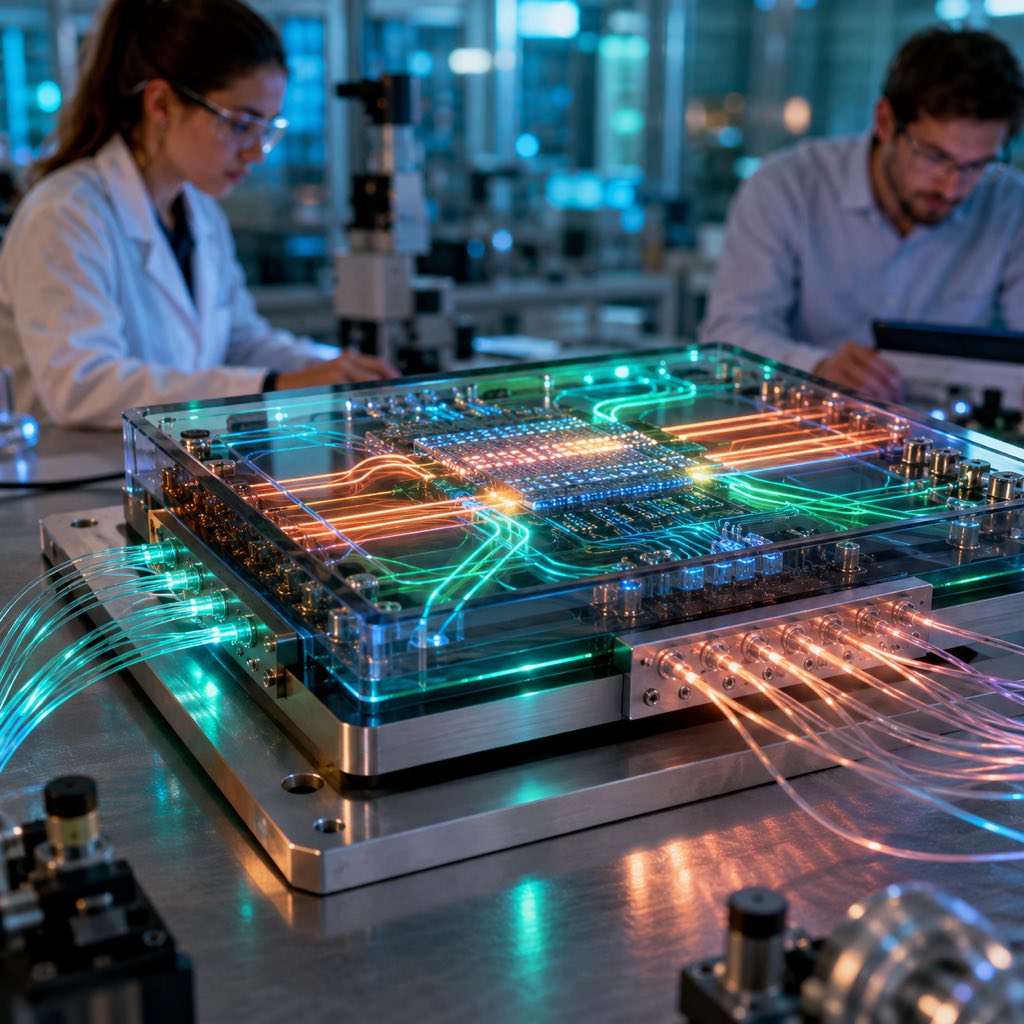
Light moves through optical materials without the resistive losses that define conventional electronics. This is not a new insight — fibre optic telecommunications has exploited it for decades. What is new in 2026 is that photonic principles are being applied inside the compute layer itself, not just in the interconnect fabric between chips.
Q.ANT’s NPU Gen 2, announced November 18, 2025, and demoed at Supercomputing 2025 (SC25), ships as a 19-inch rack-mountable Native Processing Server. The company claims 30x lower energy consumption and 50x higher performance compared to conventional systems for AI and HPC workloads. The key architectural claim is that the NPU executes complex nonlinear mathematics “in a single optical step that would require thousands of transistors in a CMOS chip.” First customer shipments are targeted for H1 2026.
Lightmatter takes a different approach. Rather than replacing the GPU with a photonic processor, it photonically connects GPUs to each other. The Passage L200 co-packaged optics chip, available in 32 Tbps and 64 Tbps versions, moves data up to 100 times faster between chips than electrical interconnects while using less power — directly addressing GPU idle time caused by data transfer bottlenecks. The company has raised $850 million in venture capital at a $4.4 billion valuation, and its Passage M1000 reference platform was targeted for summer 2025. In March 2026, Lightmatter announced the Passage L20, a 6.4 Tbps unified optical engine for near-package and on-board optics applications.
The third vector is academic. Researchers at the University of Sydney published results in Nature Communications on March 9, 2026, describing a nanophotonic neural network chip operating at picosecond timescales that achieved 90–99% classification accuracy on more than 10,000 biomedical MRI images. Separately, a University of Florida/UCLA/George Washington University team published in Advanced Photonics a silicon photonic chip using Fresnel lenses etched onto silicon, achieving approximately 100-fold power reduction for convolution operations and 98% accuracy on handwritten digit classification. Lead researcher Volker J. Sorger described it as “performing a key machine learning computation at near zero energy.”
The Data Center Economics Being Disrupted
The energy framing matters because it maps directly to capital allocation. AI training and inference already account for a growing share of global electricity consumption, with data centre power demand forecast to multiply through 2030. At current silicon GPU architectures, this trajectory is linear: more AI compute means more power drawn.
Photonic interconnects break this linearity for interconnect-bound workloads. When data movement between GPUs accounts for 30–50% of overall system energy in large-scale training runs — a figure consistent with published benchmarks — a 100x improvement in interconnect efficiency translates to meaningful total system efficiency gains even if the compute elements themselves remain silicon.
The Q.ANT and University of Sydney approaches go further: they propose replacing transistor logic with optical computation for specific workload classes. The accuracy numbers (90–99% on biomedical classification; 98% on digit recognition) are competitive with digital neural networks for these tasks. The limitation is programmability — optical neural networks are currently more competitive in inference (fixed model, repeated computation) than training (frequent weight updates), which aligns with the highest-volume commercial workload.
Advertisement
What Enterprise CIOs and Infrastructure Architects Should Do
1. Separate Interconnect and Compute Cases in Your Photonics Evaluation
The commercial deployment timelines for photonic interconnects (Lightmatter, now) and photonic compute (Q.ANT H1 2026, academic labs later) are different, and conflating them produces a muddled procurement decision. Lightmatter’s technology is production-ready for hyperscale data centres building out AI clusters: the case for photonic interconnects is straightforward — faster data movement, less idle GPU time, measurable TCO reduction. Photonic compute (replacing the transistor logic itself) is at an earlier stage, with strong laboratory results but limited programmability. Evaluate these on separate tracks with separate evaluation criteria and separate procurement timelines.
2. Request Energy-per-Inference Benchmarks from All GPU Vendors Before Your Next Data Center Expansion
The emergence of photonic alternatives is already shifting the negotiating landscape with established GPU vendors. Infrastructure architects planning expansions in 2026–2027 should explicitly request energy-per-inference benchmarks alongside raw FLOPS specifications — not because photonic systems will be in the first expansion, but because vendors who cannot provide this data have no answer to the photonic efficiency argument, and that gap will widen. Lightmatter’s claim that its system enables 8x faster AI model training, combined with Q.ANT’s 30x energy reduction figure, creates a comparison baseline that GPU vendors now have to respond to, even if the photonic products are not yet in your procurement pipeline.
3. Build Photonic Integration Into Your 2028–2030 Refresh Cycle Planning Now
The standard data centre hardware refresh cycle runs 3–5 years. Infrastructure teams planning 2028–2030 refreshes need to model a photonic scenario now, because the capital commitments being made in 2026 will either enable or constrain that scenario. Specifically: ensure your colocation contracts include adequate fibre density for co-packaged optics; evaluate whether your current server chassis form factors can accommodate 19-inch rack photonic processing units; and assess whether your cooling architecture (liquid vs. air) creates friction for photonic deployments that generate less heat than conventional silicon. None of these changes require immediate capital — they require immediate awareness.
The Structural Question: Physics or Programmability?
The bullish case for photonic AI hardware rests on physics: light is faster and cooler than electrons, and this is not going to change. The sceptical case rests on programmability: digital silicon is extremely well understood, extremely well-tooled, and gets more efficient with every process node. The history of computing is full of architecturally superior designs that lost to the incumbent’s software ecosystem.
The 2026 photonic landscape suggests the argument is being decided at the interconnect layer first and the compute layer later — which is the strategically sensible path. Lightmatter’s photonic interconnect does not require rewriting any software; it appears as faster memory bandwidth to existing GPU applications. If photonic interconnects become standard in next-generation AI clusters, the software ecosystem for photonic compute will follow, because developers will already be working in environments where optical hardware is present.
The University of Sydney and University of Florida results are proofs of concept that the compute layer is not physically blocked. Commercial deployment timelines at the compute layer are realistic in the 2027–2029 window.
Frequently Asked Questions
What is the difference between photonic interconnects and photonic compute?
Photonic interconnects (Lightmatter’s approach) use light to move data between chips — GPUs, memory, accelerators — instead of electrical copper traces. This reduces latency and energy consumption in data transfer without changing how computation is performed. Photonic compute (Q.ANT, University of Sydney) performs the mathematical operations themselves using light rather than transistors. Interconnects are closer to commercial deployment; compute replacement is at an earlier stage.
Why are photonic chips more energy-efficient than silicon GPUs?
Light travels through optical materials without electrical resistance, so it does not generate resistive heat during data movement. Optical computation performs matrix multiplications and convolution operations in a single optical transformation step that would require thousands of transistors in a conventional chip. The energy savings come from both the absence of resistive losses and the reduction in gate-switching operations for certain computation types.
When will photonic AI chips be commercially available at scale?
Q.ANT is targeting first customer shipments of its NPU Gen 2 in H1 2026. Lightmatter’s Passage L200 co-packaged optics is available in 2026 for data centre deployments, with the Passage L20 sampling in late 2026. Academic-lab photonic compute chips are likely 2–4 years from commercial deployment. Broad hyperscale adoption of photonic interconnects is a realistic 2027–2029 timeframe.
Sources & Further Reading
- Q.ANT Next-Gen Photonic NPU — The Quantum Insider
- Lightmatter Launches Photonic Chips to Eliminate GPU Idle Time — Network World
- Ultra-Compact Photonic AI Chip — TechXplore / University of Sydney
- New Light-Based Chip Boosts Power Efficiency 100-Fold — SPIE / University of Florida
- Lightmatter Passage L20 Announcement — Lightmatter Press Release