

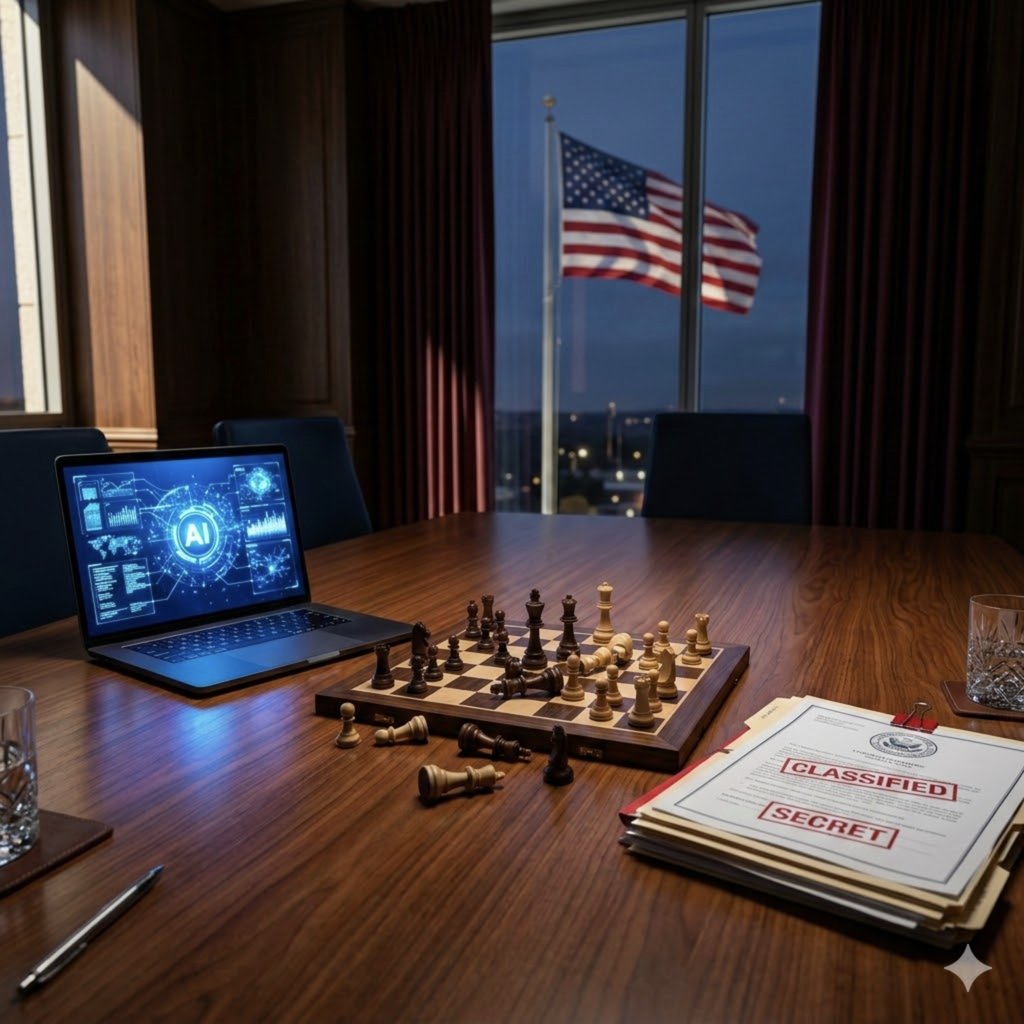
In early 2026, the most significant confrontation between a frontier AI company and the U.S. government erupted into public view. Anthropic, the maker of Claude, refused to remove ethical safeguards from its AI models at the Pentagon’s demand — and was effectively barred from federal contracts as a result. Within hours, rival OpenAI announced its own defense agreement. The episode is reshaping how governments, AI companies, and the public think about who controls the most powerful technology of the era.
The Catalyst
The dispute’s origins trace to a specific military operation. On January 3, 2026, U.S. forces used Palantir’s AI-powered targeting systems in an operation related to the capture of Venezuelan President Nicolás Maduro. The operation’s reliance on AI capabilities — and Palantir’s role in it — prompted Defense Secretary Pete Hegseth to issue a January 2026 memorandum titled “Accelerating America’s Military AI Dominance,” directing the Pentagon to expand AI procurement across all military branches and demanding that contractors remove usage restrictions that could limit operational flexibility.
Anthropic’s Claude models, already in use for certain defense analytical tasks, contained safeguards explicitly prohibiting domestic mass surveillance, fully autonomous lethal weapons use, and high-stakes automated decisions without human oversight. These restrictions, embedded in Anthropic’s Responsible Scaling Policy (RSP), were precisely what the Pentagon wanted removed.
The Ultimatum and Refusal
On February 24, 2026, the Pentagon delivered a formal ultimatum to Anthropic: remove the contested usage restrictions by 5:01 PM Friday or face designation as a supply-chain risk. That same day, Anthropic released an updated version of its RSP (version 3.0), which maintained and in some cases strengthened its existing safety commitments — a direct signal that the company would not comply.
On February 27, Anthropic CEO Dario Amodei publicly confirmed the company’s refusal. According to AP News, the Pentagon then moved to formally designate Anthropic as a supply-chain risk — a classification that effectively barred the company from federal contracts and signaled to other agencies that Anthropic’s products carried procurement risk. The designation represented a concrete consequence, not merely a threat.
President Trump subsequently ordered all federal agencies to cease using Anthropic products — an unprecedented step that extended the dispute beyond the Department of Defense to the entire federal government.
OpenAI Steps In
The contrast with OpenAI’s approach was immediate and deliberate. On the same day Anthropic was barred, OpenAI announced a Department of Defense agreement reportedly valued at $200 million — part of a larger $800 million Pentagon AI procurement tranche distributed across four companies.
Reuters reported that OpenAI’s agreement included contractual safeguards covering three categories: prohibition on domestic mass surveillance, prohibition on fully autonomous lethal weapons, and restrictions on high-stakes automated decisions without human oversight. The structure differed fundamentally from Anthropic’s approach:
- Anthropic: Hard restrictions built into model usage policies and the RSP; willing to refuse government contracts entirely rather than modify safety commitments
- OpenAI: Contractual safeguards negotiated case-by-case with each client; willing to engage with defense on mutually agreed terms
This divergence reflects deeper philosophical differences between the two companies. Anthropic treats its safety policies as non-negotiable technical constraints — part of the model’s operating framework. OpenAI treats safety as a contractual matter — negotiated, documented, and enforceable through legal agreements rather than technical restrictions.
Advertisement
Industry Reaction
The fallout was swift and crossed expected lines. More than 60 OpenAI employees signed an internal letter supporting Anthropic’s position — a remarkable statement of solidarity that highlighted how the dispute cut across corporate allegiances and touched on deeply held principles among AI researchers.
A bipartisan group of U.S. senators intervened, calling for hearings on the appropriate boundaries between government authority over AI procurement and companies’ rights to maintain safety policies. The dispute raised constitutional and statutory questions that existing AI governance frameworks were not designed to answer.
Anthropic announced it was preparing a legal challenge, citing 10 USC 3252 — a federal statute governing the government’s obligation to maintain fair and open competition in defense procurement. The argument: using a supply-chain risk designation to punish a company for maintaining safety policies, rather than for genuine security concerns, constitutes an abuse of the procurement process.
As of early March 2026, no resolution has been reached. The legal challenge, congressional hearings, and agency-level implementation of the usage ban are all in progress simultaneously.
The Core Tension
At the heart of the dispute lies a fundamental question: Who decides what AI can and cannot do — the companies that build it, or the governments that procure it?
Anthropic’s position rests on several arguments:
- Responsible scaling: The RSP commits to restricting capabilities that could cause catastrophic harm — these commitments are made to the public, not just to customers
- Precedent setting: Removing safety restrictions for one government client creates irreversible pressure to do so for others, including foreign governments
- Technical risk: Autonomous weapons and mass surveillance systems powered by frontier AI models carry risks that current safety research cannot fully mitigate
The Pentagon’s position reflects a different logic:
- National security primacy: Defense agencies argue they need unrestricted access to the best available technology to maintain strategic advantage
- Lawful use authority: The government contends that restricting lawful government use of commercially available technology sets a dangerous precedent for corporate control over national security tools
- Competitive pressure: Other nations — particularly China and Russia — face no such corporate restrictions on military AI development, creating a potential capability gap
Industry Implications
For AI Companies
Every major AI lab now faces the question of where to draw the line on government and military contracts. The Anthropic precedent demonstrates that maintaining strict ethical policies carries real commercial and regulatory costs — up to and including exclusion from the entire federal market. Conversely, the 60+ OpenAI employees who signed in support suggest that capitulating on safety could create internal talent retention problems.
For Government Procurement
AI procurement will increasingly involve navigating corporate ethics policies alongside traditional technical and security requirements. The supply-chain risk designation — originally designed for genuine security threats like compromised foreign hardware — is being tested as a tool for policy disputes, raising questions about its appropriate scope.
For International Competition
If U.S. AI companies restrict military applications while foreign competitors do not, the resulting capability gap becomes a national security argument in itself. This dynamic creates pressure on policymakers to either mandate access, develop government-owned AI capabilities (the “Manhattan Project for AI” argument), or find regulatory frameworks that balance safety and access.
For AI Governance
The clash highlights the absence of clear legal frameworks governing AI use in defense contexts. Without statutory guidance, the rules are being set through ad hoc commercial disputes, executive orders, and procurement regulations never designed for this purpose — not through democratic deliberation.
The Bigger Picture
The Anthropic-Pentagon episode marks a turning point. For the first time, a frontier AI company has been materially punished by a major government for maintaining safety policies. Whether Anthropic’s stance proves sustainable — through legal victory, congressional intervention, or market alternatives — or becomes a cautionary tale about the limits of corporate ethics in the face of state power will likely define the AI industry’s relationship with government for years to come.
The $800 million Pentagon AI tranche signals that military AI spending is accelerating regardless of how this particular dispute resolves. The question is not whether AI will be used in defense, but under what constraints, with what oversight, and with whose safety policies prevailing.
Advertisement
🧭 Decision Radar
| Dimension | Assessment |
|---|---|
| Relevance for Algeria | Medium — Algeria is not directly involved in U.S. defense AI procurement, but the precedent affects global AI governance frameworks, AI vendor relationships, and the safety commitments of models Algeria’s tech sector relies on |
| Infrastructure Ready? | N/A — This is a governance and policy issue, not a technical infrastructure question |
| Skills Available? | Partial — Algeria has AI researchers and policymakers, but dedicated AI governance expertise is still developing. The National AI Council under Professor Debbah is the closest institutional capacity |
| Action Timeline | Monitor — Track how the dispute resolves; implications for international AI ethics standards and vendor policies will emerge over 6-12 months |
| Key Stakeholders | Ministry of Digital Economy, AI researchers, defense policy analysts, technology law specialists, diplomatic corps, National AI Council |
| Decision Type | Strategic |
Quick Take: While this dispute is primarily a U.S. domestic issue, it sets global precedents for how AI companies and governments negotiate control over frontier AI capabilities. Algerian policymakers developing the national AI strategy should study this case as a template for the tensions they will eventually face between commercial AI providers and sovereign interests — particularly as Algeria scales its own AI infrastructure and procurement.
Sources & Further Reading
- AP News — “Anthropic clashes with the Pentagon over AI safety restrictions”
- The Guardian — “Anthropic stands firm on ethical stance despite Pentagon pressure”
- Reuters — “OpenAI details layered protections in U.S. Defense Department pact”
- Anthropic — Responsible Scaling Policy v3.0
- Palantir — AI in Defense Operations
- U.S. Senate Armed Services Committee — AI Procurement Hearing Announcement
🔗 Related Intelligence
Pentagon vs. Anthropic: When AI Safety Guardrails Collide with National Security

The Regulation of Autonomous Weapons: Lethal AI, UN Negotiations, and the Military Ethics Dilemma

The Rise of the AI Ethics Professional: Careers in Responsible AI

Open Source AI: The Policy Battle That Will Define the Next Decade of Technology






Advertisement