The Constraint Has Moved From Real Estate to the Utility Grid
For most of the 2010s, data center capacity constraints were fundamentally a real estate problem: land permitting, zoning approvals, construction timelines. A hyperscaler that wanted a new campus needed to acquire land, get permits, and build — processes that took 18 to 36 months in favorable markets like Northern Virginia, Oregon, and Ireland. The solution was geographic diversification: find more markets, build faster, pre-permit sites before demand arrives.
That model has broken. The constraint in 2026 is not land — it is electricity. ABI Research’s May 2026 report projects active hyperscaler IT load growing from 24.37 GW in 2025 to 147.13 GW by 2035. The report’s central finding: “Energy generation and grid constraints are emerging as critical bottlenecks for hyperscaler expansion.” Power access — not land or capital — has become the primary growth constraint as campuses scale into multi-hundred-megawatt deployments.
The specific mechanics of the constraint are well documented. As of November 2025, 66 large-load tariff programs and service rules were tracked across 34 US states and 51 utilities, with 36 approved and 29 pending or proposed. Grid interconnection queues — the process by which a data center gets a power connection approved and installed by the utility — now run 4 to 5 years in constrained markets. For a data center that needs to be operational in 24 months, a 4-year grid interconnection timeline makes the site effectively unbuildable at the needed scale.
What the Vacancy and Pricing Data Reveal
The colocation market’s H1 2025 data is stark. Primary market vacancy fell to a record 1.6%, down from 2.8% a year earlier. Northern Virginia — the world’s largest data center market — saw vacancy rise slightly to 0.72%, but that rise was driven by new supply coming online against a backdrop of sustained demand, not by demand softening. Nearly 75% of the 5,242 MW under development across North America is already pre-leased before completion.
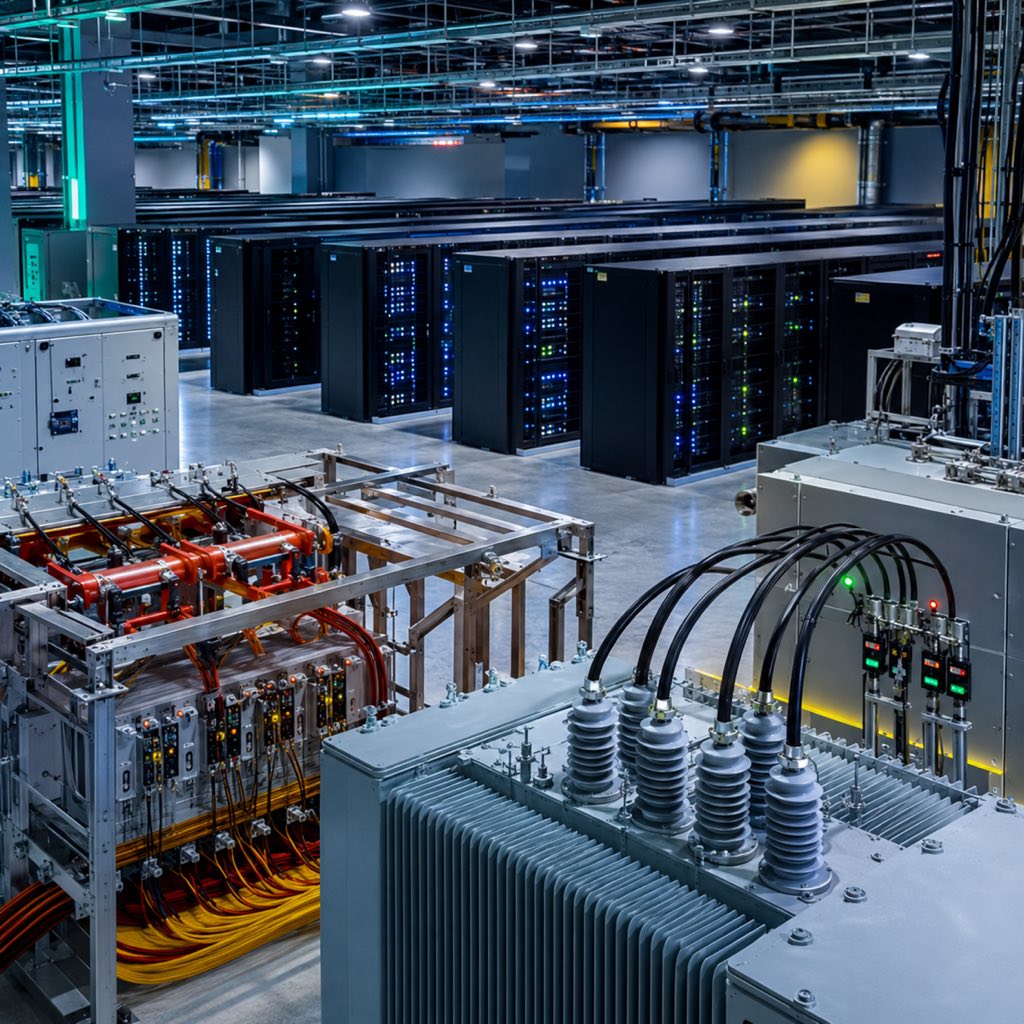
Pricing reflects the supply squeeze. Average colocation rates for 250 to 500 kW deployments reached $184 per kilowatt per month in H1 2025. For large deployments of 10 MW or more, prices increased up to 19% year-over-year. The market is also experiencing a power density shift that amplifies the constraint: legacy data center racks were designed for 5 to 7 kilowatts per rack. AI inference and training racks now require 50 to 100 kilowatts per rack — a 10 to 14 times increase in power density that the physical infrastructure of most existing colocation facilities cannot accommodate without major electrical upgrades.
The named deals illustrate the stakes. Anthropic and Fluidstack signed a $7 billion, 15-year lease for 245 MW. Nscale and WhiteFiber agreed on an $865 million arrangement for 40 MW. These are not typical enterprise colocation contracts — they are capital commitments on the scale of major industrial projects, with timelines measured in decades. The capital intensity itself creates barriers to new colocation entrants: a credible data center campus for AI workloads requires hundreds of millions of dollars in electrical infrastructure investment before a single server rack is installed.
Advertisement
What Enterprise Architects and Colocation Buyers Should Do
1. Move Long-Term Capacity Reservations to the Front of Your Planning Cycle
The standard enterprise approach to colocation — evaluate options 6 to 12 months before the needed date, issue an RFP, select a provider — is no longer viable for large deployments in constrained markets. With 75% of under-development capacity pre-leased and vacancy at 1.6%, the lead time for securing significant colocation capacity in primary markets is now 18 to 36 months minimum. Enterprise infrastructure leaders who have not begun formal capacity reservation discussions for 2027 and 2028 requirements are already late.
For large deployments (10 MW+), direct engagement with hyperscaler colocation programs — AWS Outposts, Google Distributed Cloud, Azure Stack HCI — offers an alternative to traditional colocation: hyperscaler-managed infrastructure deployed in enterprise facilities or at enterprise-selected colocation sites. These programs shift the power procurement burden to the hyperscaler and provide enterprise-grade infrastructure without requiring the enterprise to navigate utility interconnection queues independently.
2. Evaluate Secondary and Tertiary Markets Where Power Availability Is the Selection Criterion
The geographic shift in colocation demand is already underway. According to Data Center Knowledge’s 2026 analysis, growth is moving “away from the top 10 markets toward power-advantaged secondary and tertiary regions, driven by utility constraints, extended permitting timelines, and widening energy price differentials.” Markets like Omaha, Nebraska; Columbus, Ohio; and San Antonio, Texas are attracting data center investment specifically because utility interconnection queues are shorter and power costs are lower.
For enterprises with flexibility on colocation location — workloads that are not latency-sensitive to a specific geographic user base — the power-availability map rather than the proximity-to-headquarters map should drive site selection. A colocation facility in a secondary market with 36-month grid capacity availability and $120/kW/month pricing is structurally more attractive than a primary market facility at $184/kW with a 12-month availability queue and uncertain future expansion options.
3. Account for Power Density in Colocation Contract Specifications
The gap between legacy colocation power density (5-7 kW/rack) and AI workload requirements (50-100 kW/rack) is creating contract mismatches that are expensive to resolve. Enterprises that signed colocation agreements in 2022 or 2023 for standard compute workloads and are now deploying GPU clusters or AI inference racks are discovering that their contracted power density is insufficient and electrical upgrades at existing facilities can take 12 to 24 months and cost several million dollars.
New colocation contracts should explicitly specify: the maximum power density per rack (in kW), the facility’s total electrical capacity and redundancy configuration (2N vs N+1), and the upgrade pathway if density requirements increase. JLL’s 2026 Data Center Market Outlook identifies power density as a key differentiating factor among colocation facilities, with high-density-ready facilities commanding a 15 to 25% premium over legacy facilities that cannot support AI rack configurations.
The Correction Scenario
The power constraint cycle has a natural corrective mechanism, but it operates on long timescales. Utilities and developers accustomed to planning, permitting, and commissioning generation and transmission over 5 to 10 years are now being asked to deliver gigawatt-scale capacity within 12 to 24 months — a compression ratio that most utility infrastructure programs cannot accommodate. Large gas turbines are effectively booked through the end of the decade; procuring additional turbine capacity for backup generation is practically difficult before 2028 or 2029.
The most likely near-term corrective is onsite power generation. In just the past six months, the share of hyperscalers and colocation providers expecting to operate entire campuses on onsite power has grown by 22%, now accounting for roughly one in three data centers. This includes a mix of fuel cells (Bloom Energy has named data center customers), small modular nuclear reactors (SMRs, expected to enter production in the early 2030s), and diesel-to-gas-turbine conversions. Enterprises that are evaluating long-horizon infrastructure investments should plan for onsite power self-sufficiency as a realistic scenario for any facility that expects to grow into AI infrastructure density over the next decade.
The 6x capacity growth projection through 2035 will happen — the AI workload demand driving it is real and not discretionary. The question for enterprise infrastructure teams is not whether power-constrained colocation becomes the defining challenge of the decade, but whether their procurement, contracting, and site-selection practices are adapted to a market where power availability has permanently displaced square footage as the primary capacity constraint.
Frequently Asked Questions
How should Algerian enterprises evaluate whether to build on-premise infrastructure or leverage cloud services?
The build-vs-buy decision in infrastructure should be driven by data sovereignty requirements, workload characteristics, and total cost of ownership over a 5-year horizon. For most Algerian enterprises, a hybrid approach — retaining sensitive data on-premise while using cloud for scalable, non-sensitive workloads — offers the best balance. The frameworks described provide evaluation criteria that apply to the Algerian context with minimal adaptation.
What is the realistic timeline for Algeria to close the infrastructure gap with regional peers like Morocco and Singapore?
Current investment trajectory suggests a 5-7 year timeline for Algeria to reach comparable enterprise cloud service availability, assuming continued investment in submarine cable connectivity, domestic data center capacity, and cloud provider market entry. The timeline could compress to 3-4 years with accelerated public-private investment in digital infrastructure as part of the national digital transformation strategy.
Which infrastructure technologies described here can be adopted immediately by Algerian organizations versus which require long lead times?
Software-defined networking, containerization, and cloud-native application architectures can be adopted immediately with existing talent and current cloud service availability. Hyperscale data center build-out, advanced edge computing networks, and submarine cable infrastructure require multi-year planning and significant capital investment. Algerian organizations should focus adoption efforts on the software and tooling layers where they can move quickly.
Sources & Further Reading
- Hyperscaler Data Center Capacity to Surge 6x by 2035 — GlobeNewswire / ABI Research
- Power, Not Space: The Colocation Battleground in 2026 — Data Center Knowledge
- How Hyperscale AI Is Reshaping the Power Grid — Data Center Knowledge
- 2026 Market Outlook for Global Data Centers — JLL Research
- Hyperscalers Sign White House Pledge to Fund Data Center Power, Grid Upgrades — Power Magazine
- Did Hyperscalers Solve the Power Problem in 2025? — Data Center Knowledge