The Money Has Arrived
For decades, humanoid robots existed in two places: science fiction and university research labs. Robots excelled at repetitive, structured tasks — welding car frames, placing components on circuit boards — but the messy, variable work of a distribution center defeated them.
That gap is closing faster than anyone predicted, and the money is following. In 2025, humanoid robotics companies raised $14 billion globally, a 71% increase from the $8.2 billion raised in 2024. The funding is concentrated in a handful of companies making enormous bets that the moment for human-shaped robots has finally arrived.
The three largest recent rounds tell the story:
| Company | Round Size | Valuation | Key Investors |
|---|---|---|---|
| Figure AI | $1 billion (Series C) | $39 billion | Parkway Venture Capital, Brookfield, NVIDIA, Intel Capital |
| Neura Robotics | $1.2 billion | ~$4 billion | Tether Holdings, existing investors |
| Apptronik | $935 million (Series A total) | $5.5 billion | Google, Mercedes-Benz, John Deere, ARK Invest |
These are not research grants. These are infrastructure-scale investments from some of the world’s largest industrial companies, signaling deep conviction that humanoid robots will transform how physical work gets done.
Why Humanoid? The Shape Matters
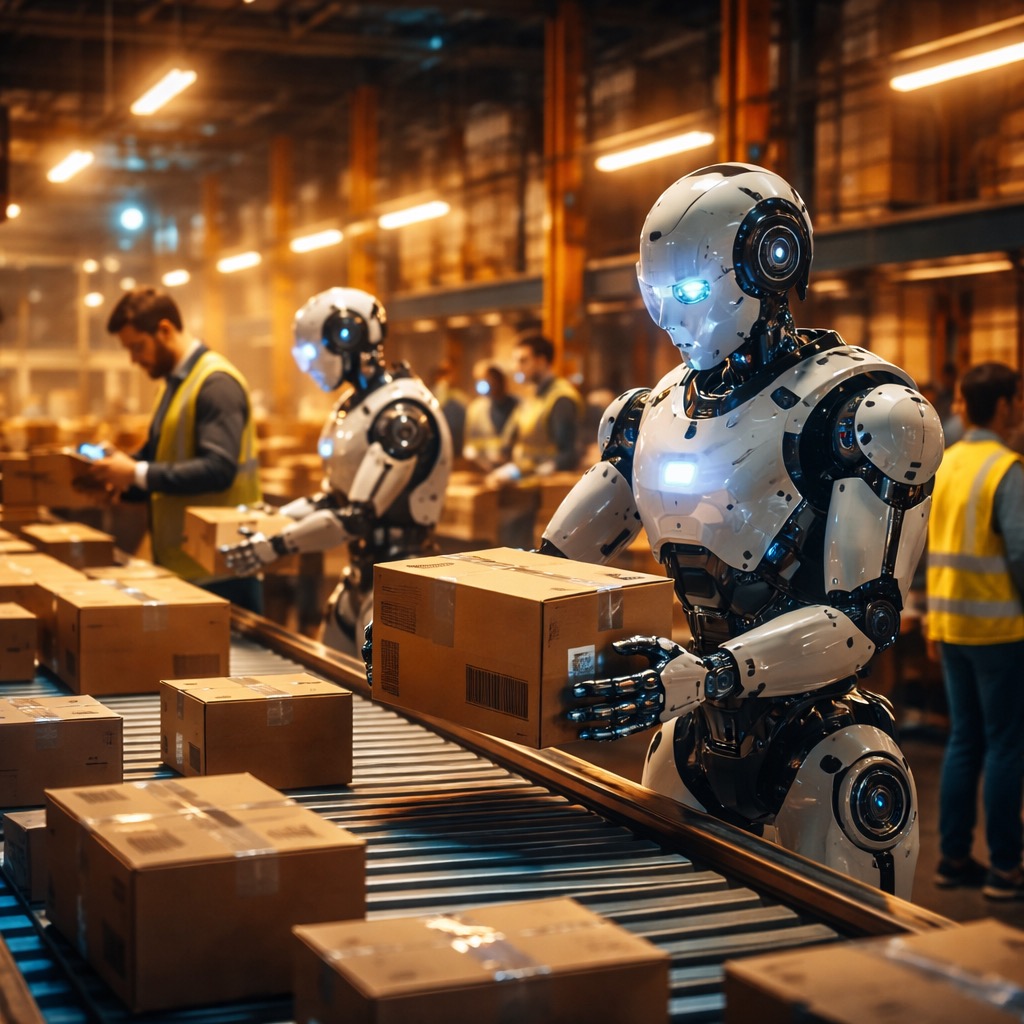
A reasonable question: why build robots that look like humans? Amazon’s warehouses deploy hundreds of thousands of mobile robots that shuttle shelves around. None of them have heads, torsos, or legs.
The answer is pragmatic: the built environment is designed for human bodies. Doorways are human-width. Shelves are at human-reachable heights. Tools are shaped for human hands. A specialized robot requires redesigning the workspace around it — costing millions per facility and months of integration work.
A humanoid robot can theoretically operate in any space designed for humans without modification. The infrastructure investment required for deployment is close to zero. This is why the investor thesis is so compelling: the addressable market is not “robot-compatible facilities” but “every facility that currently employs humans for physical tasks” — warehousing, manufacturing, logistics, construction, and retail.
Advertisement
The Frontrunners
Figure AI: From BMW to Mass Production
Figure AI has emerged as the most richly valued humanoid robotics company, with its $1 billion Series C at a $39 billion valuation representing a 15x increase from $2.6 billion just 18 months earlier. Founded in 2022 by Brett Adcock, the company takes a vertically integrated approach — designing its own actuators, sensors, and AI models.
The company’s Figure 02 robot stands approximately 170 centimeters tall, weighs 70 kilograms, and carries up to 20 kilograms. Its deployment at BMW’s Spartanburg, South Carolina plant was the first major industrial validation. Over 10 months, Figure 02 ran 10-hour shifts five days a week, moved over 90,000 sheet metal components, logged 1,250 operating hours, and contributed to the production of more than 30,000 BMW X3 vehicles with accuracy above 99 percent.
Notably, Figure initially partnered with OpenAI to integrate language understanding into its robots. However, in February 2025 the company ended that partnership, citing a breakthrough in fully end-to-end robot AI built in-house. Figure now runs its proprietary Helix AI system — a vision-language-action model that processes camera feeds, understands spoken commands, and generates task plans without external AI dependencies. The company has announced BotQ, a manufacturing facility in Austin with initial capacity for 12,000 units scaling to 100,000 annually.
Apptronik: The NASA Pedigree
If Figure AI represents Silicon Valley speed, Apptronik represents engineering-first robustness rooted in decades of academic research. The company spun out of the Human Centered Robotics Lab at the University of Texas at Austin, whose founders contributed to NASA’s Valkyrie humanoid robot program during the DARPA Robotics Challenge.
Apollo stands 173 centimeters tall, weighs approximately 73 kilograms, and can carry up to 25 kilograms — the weight of a standard logistics tote. Its battery provides roughly 4 hours of continuous operation, with hot-swappable battery packs enabling near-continuous deployment across shifts.
Apptronik’s total Series A reached $935 million — a $415 million initial round co-led by B Capital and Capital Factory, followed by a $520 million extension in February 2026 at a $5.5 billion valuation. Strategic investors include Google (providing access to Gemini multimodal AI models), Mercedes-Benz (actively testing Apollo in manufacturing), and John Deere (bringing agricultural and heavy equipment deployment environments). GXO Logistics, the world’s largest pure-play contract logistics provider, launched a multi-phase R&D initiative with Apptronik, while Jabil, a major electronics contract manufacturer, is integrating Apollo into production operations.
Neura Robotics: The European Challenger
Based near Stuttgart, Germany — the heart of European manufacturing — Neura Robotics brings a distinctly different perspective. While Figure AI and Apptronik build for the US market first, Neura targets European manufacturing with safety standards rooted in the German engineering tradition.
Neura’s $1.2 billion raise at approximately $4 billion valuation, backed primarily by Tether Holdings, positions it as Europe’s leading humanoid robotics company. The company’s 4NE-1 humanoid platform stands 180 centimeters tall and weighs 80 kilograms, designed with particular emphasis on human-robot collaboration and compliance with the EU Machinery Regulation. Force-limiting joints, proximity sensing, and behavioral constraints prevent the robot from exerting dangerous forces even during a software malfunction. The 4NE-1 Mini, a smaller variant, is expected to be commercially available in Spring 2026.
The China Factor: Scale Over Flash
While Western companies attract the highest valuations, Chinese manufacturers are pursuing a radically different strategy: brute-force deployment at scale and aggressive pricing.
Chinese firms shipped over 14,500 humanoid robots in 2025, capturing roughly 90 percent of global sales. US-based competitors shipped approximately 150 units combined. Galbot, a Beijing-based company, achieved a milestone no Western competitor has matched: its humanoid robots have operated 24 hours a day, 7 days a week, for over a year in production environments serving clients including BAIC and CATL.
The pricing gap is stark. Unitree’s G1 sells for approximately $13,500, its R1 for $5,900. Western manufacturers remain above $100,000 per unit for comparable industrial platforms. This mirrors the broader Chinese technology strategy: accept lower margins, deploy at massive scale, iterate on reliability through operational data, and drive costs down through manufacturing volume.
The Business Case: Labor Math
In the United States, the fully loaded cost per warehouse worker — including benefits, insurance, training, and turnover — reaches $55,000 to $70,000 annually. Warehouse turnover rates average around 36 percent, with some facilities exceeding 100 percent. A humanoid robot leased at $2,000 to $3,000 per month that operates 20 hours per day represents a compelling economic proposition — if it can perform even 60 to 70 percent of the tasks a human worker handles.
But significant technical caveats remain. Current humanoid robots handle roughly 40 to 50 percent of typical warehouse tasks reliably. Manipulation dexterity — picking irregularly shaped, fragile items from cluttered bins — remains extremely difficult. Battery cycles of four hours with swap times mean each robot position requires approximately 1.2 robot units for 24/7 coverage. And scaling from dozens of robots to thousands will require building a maintenance infrastructure that does not yet exist.
Why Now? Three Converging Trends
AI broke the control problem. The fundamental challenge was never hardware — engineers have known how to build bipedal machines for decades. Large language models and vision-language models changed the equation by learning abstract manipulation strategies that generalize across situations, replacing the impossible task of programming specific motion sequences for every scenario. This is why Figure AI built its own AI stack, why Apptronik partnered with Google, and why Neura is developing proprietary cognitive AI.
The labor shortage is structural. Birth rates have fallen below replacement levels across every major economy. Warehousing and manufacturing compete against less physically demanding sectors with rising wages and remote work options. This is not cyclical — it is a demographic shift that will intensify over the next 20 to 30 years.
Automotive giants are all in. Mercedes-Benz invested in Apptronik. BMW deployed Figure 02 in production and is evaluating Figure 03. Hyundai owns Boston Dynamics. John Deere backed Apptronik. Toyota has its own humanoid program. These companies do not make speculative bets — their investments signal that humanoid robots will be part of their manufacturing future.
Frequently Asked Questions
How much does a humanoid robot cost in 2026?
Pricing varies dramatically by manufacturer and region. Western companies like Figure AI and Apptronik primarily offer lease arrangements at $2,000 to $3,000 per month, with outright purchase prices estimated above $100,000 per unit. Chinese manufacturers operate at radically lower price points — Unitree’s G1 sells for $13,500 and its R1 for $5,900. Industry analysts project Western prices will fall to $30,000 to $50,000 by 2029-2030 as production scales.
Will humanoid robots eliminate warehouse jobs?
Not in the near term. Current humanoid robots handle approximately 40 to 50 percent of typical warehouse tasks reliably and are deployed alongside human workers, not instead of them. The structural labor shortage in warehousing — with over 370,000 unfilled positions in the US alone — means many robots will fill positions companies cannot staff at any wage. Over the longer term, as capabilities improve beyond 90 percent task coverage, workforce transition planning becomes essential.
What role does AI play in making humanoid robots viable?
AI is the critical enabler. Traditional programming could not handle the infinite variability of real-world environments. Modern vision-language-action models, trained on massive datasets of human activity and simulation data, generate robot behaviors that generalize across situations. Figure AI’s proprietary Helix system and Apptronik’s integration with Google’s Gemini models allow robots to understand verbal instructions, reason about multi-step tasks, and adapt to novel scenarios — capabilities impossible with conventional robotic programming.
Sources & Further Reading
- Figure Exceeds $1B in Series C Funding at $39B Post-Money Valuation — PRNewswire
- Figure 02 Contributed to the Production of 30,000 Cars at BMW — Figure AI
- Apptronik Raises $520 Million at $5 Billion Valuation for Apollo Robot — CNBC
- Neura Robotics Reportedly Raising $1.2B in Funding — SiliconANGLE
- China Dominates Humanoid Robot Market, Ships 10,000+ Units — TheresARobotForThat
- Figure Drops OpenAI in Favor of In-House Models — TechCrunch
- GXO Advances Humanoid Strategy with Apptronik — Apptronik
- Galbot Brings in $300M to Scale Deployments — The Robot Report
🔗 Related Intelligence
The Humanoid Robot Race: How AI Is Powering the Next Generation of Physical Automation
Robotics Foundation Models: The Real Breakthrough Is Software, Not Hardware

Human-in-the-Loop AI: Why Machines Still Need People

Self-Driving Robot Labs: When AI Runs the Experiments