The Developer’s Daily Reality Is Changing
Something has shifted in the daily rhythm of software development, and it happened faster than most people in the industry expected.
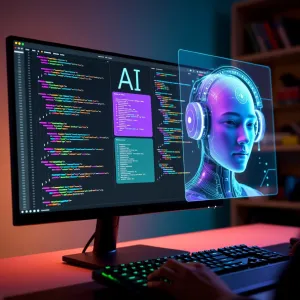
A senior engineer at a Fortune 500 company opens her IDE in the morning and starts typing a function signature. Before she finishes the line, her AI coding assistant has suggested the entire implementation — not just the syntax, but the logic, the edge cases, the error handling. She tabs to accept. The code compiles. The tests pass. What used to take twenty minutes took forty seconds.
This is not a demo. This is Tuesday.
By early 2026, AI coding assistants have achieved mainstream adoption among professional developers. GitHub reports that Copilot has reached 4.7 million paid subscribers across over 50,000 organizations. Surveys from Stack Overflow and JetBrains consistently find that 70-80% of professional developers use AI tools at least weekly. The AI revolution has reached the people who build the revolution’s software.
But the real story is not about autocomplete getting smarter. It is about a fundamental restructuring of how software gets conceived, built, tested, and maintained — a restructuring that challenges assumptions the industry has held for decades about code quality, technical debt, developer careers, and the very definition of programming.
The AI Coding Assistant Revolution
The AI coding assistant market has matured rapidly from a novelty into an essential part of the development stack. The landscape divides into two categories: integrated IDE experiences and autonomous coding agents.
The IDE Race
Cursor emerged as the breakout product of this era. Built as a fork of VS Code, Cursor treats AI not as a plugin but as a core architectural component. Its “Composer” feature lets developers describe changes in natural language across entire files, and its codebase-aware context engine understands project structure deeply enough to generate code that actually fits.
Windsurf, originally built by Codeium (which rebranded to Windsurf in April 2025), took a different approach with its “Cascade” system — persistent AI flows that maintain context across editing sessions. Rather than treating each prompt as independent, Windsurf tracks what you’re working on and why, offering suggestions that account for your broader engineering goals. In July 2025, Cognition AI acquired Windsurf for approximately $250 million, signaling a consolidation of the AI coding tool market.
GitHub Copilot, the tool that started the category, has evolved from inline completions into a full agent mode. Copilot can now open pull requests, fix CI failures, and implement features from issue descriptions — operating as an autonomous agent rather than a passive suggestion engine.
Claude Code represents the terminal-native approach. Rather than embedding AI into a graphical IDE, it operates directly in the command line, reading files, running commands, making edits, and executing tests. For developers comfortable in the terminal, this feels less like using a tool and more like pair programming with a colleague who happens to have read every documentation page ever written.
The Autonomous Tier
The newest wave goes further. Tools like Devin (from Cognition), OpenAI’s Codex agent, and Google’s Jules don’t assist developers — they replace specific development tasks entirely. Given a GitHub issue, they can clone the repository, understand the codebase, write the fix, run the tests, and submit a pull request. The developer’s role shifts from writing the code to reviewing it.
This represents a qualitative shift. The earlier generation of tools operated within the developer’s workflow. The autonomous tier operates alongside it — or in some cases, without it.
What Actually Works
The productivity gains are real but uneven. AI coding assistants excel at boilerplate code, test generation, documentation, and API integration. They struggle with novel algorithm design, complex architectural decisions, and anything requiring deep domain knowledge that isn’t well-represented in training data.
The developer experience impact is measurable. GitHub’s internal studies report that Copilot users complete tasks 55% faster. But “routine tasks” is doing heavy lifting in that sentence — the harder the problem, the less helpful the AI becomes, and the more dangerous its confident-sounding suggestions.
Vibe Coding: From Instructions to Intent
In February 2025, Andrej Karpathy — one of the founders of OpenAI and a former Stanford AI researcher — coined a term that immediately stuck: “vibe coding.”
The concept is deceptively simple. Instead of writing code, you describe what you want in natural language. The AI generates the code. You run it. If it works, you keep it. If it doesn’t, you describe the problem and the AI fixes it. You never read the code. You might never understand it. You just… vibe.
This sounds like a joke, or a cautionary tale, but it has become a genuine development methodology. Thousands of developers — and, crucially, non-developers — are building functional applications this way. Products like Bolt, Lovable, Replit Agent, and v0 by Vercel have turned [vibe coding](/vibe-coding-explained/) into a product category.
The Good
Vibe coding has dramatically lowered the barrier to creating software. Product managers can prototype ideas in hours. Designers can build functional interfaces without waiting for engineering sprints. Researchers can create custom data analysis tools without learning Python first. The product engineering role — where product thinking and engineering execution merge — has found its natural tool.
For experienced developers, vibe coding accelerates the boring parts. Setting up a new project, writing CRUD endpoints, creating admin dashboards, building landing pages — these tasks no longer require the developer to think at the syntax level. They think at the intent level, and the AI handles translation.
The Bad
The code generated through vibe coding is often mediocre. It works, but it is not optimized, not always secure, and not structured for long-term maintenance. When the AI writes a function that handles 90% of cases but fails on an edge case the developer never considered — because the developer never read the code — the result can be a production incident that nobody knows how to debug.
Security is the sharpest concern. AI-generated code frequently contains vulnerabilities — hardcoded credentials, SQL injection vectors, insecure API calls — because the models optimize for functionality, not security. When the person using the tool lacks the expertise to recognize these patterns, the risk compounds.
The Philosophical Shift
Vibe coding challenges the idea that understanding code is a prerequisite for creating software. For decades, the industry has treated code comprehension as foundational — you read code more than you write it, the saying goes. Vibe coding inverts this entirely.
Whether this is liberation or recklessness depends on context. For a throwaway prototype, it is liberation. For a production system handling financial transactions, it is recklessness. The industry is still figuring out where to draw the line.
Disposable Software: Code as Ephemeral
The logical endpoint of AI-generated code is [disposable software](/disposable-software-ai/) — applications built to solve a specific problem, used once or for a short period, and then discarded rather than maintained.
This concept would have been absurd five years ago. Software has historically been expensive to build, and the economics of that expense created powerful incentives to maintain, extend, and reuse it. Technical debt accumulated because rewriting was too costly. Legacy systems persisted because replacement was too risky.
AI changes the math. When generating a simple application takes minutes instead of months, the calculus of build-versus-maintain shifts dramatically. Why spend weeks refactoring a tangled codebase when you can describe what you need and generate a fresh implementation in an afternoon?
Where Disposable Software Thrives
The pattern works best for internal tools, data transformations, one-time migration scripts, prototypes, and short-lived marketing campaigns. A product team needs a dashboard to analyze a specific dataset for a quarterly review. An engineer needs a script to transform data from one format to another. A startup needs a landing page for a feature that might not exist next month.
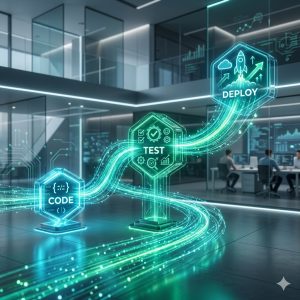
In these contexts, the traditional software lifecycle — design, build, test, deploy, maintain, sunset — is overkill. The AI-generated alternative — describe, generate, use, discard — is faster, cheaper, and often good enough.
Where It Breaks Down
Disposable software fails when the “disposable” part doesn’t hold. Applications have a tendency to outlive their intended lifespan. The temporary dashboard becomes the source of truth. The one-off script becomes a critical pipeline component. The prototype becomes the product.
When that happens to AI-generated code that nobody ever read or understood, the organization faces a uniquely modern problem: a critical system built by an intelligence that no longer has context, maintained by humans who never had it. This is the shadow AI problem applied to code itself.
Advertisement
AI Development Workflows: How Teams Integrate AI
The most sophisticated organizations are not just adopting AI tools — they are redesigning their development processes around them. This creates a new discipline that overlaps with LLMOps and [AI development workflows](/ai-dev-workflows/).
The Emerging Stack
A modern AI-augmented development workflow typically includes several layers. At the individual level, developers use AI coding assistants for real-time code generation and editing. At the team level, AI agents handle code review, test generation, and documentation updates through CI/CD integration. At the organization level, custom models and prompt libraries encode institutional knowledge — coding standards, architectural patterns, security requirements — into the AI’s context.
The most advanced teams are building what amounts to an AI-native development pipeline. Code gets written by a combination of human developers and AI agents. It gets reviewed by both human reviewers and AI systems that check for security vulnerabilities, style violations, and logical errors. Tests are generated automatically, expanded by AI, and triaged by AI when they fail. Documentation updates itself as the code changes.
The Testing Revolution
Perhaps the most impactful application of AI in development workflows is in testing. Writing tests has always been the part of software development that developers like least and skip most often. AI tools have transformed this by making comprehensive test generation nearly effortless.
Tools like Copilot and Claude Code can analyze a function and generate unit tests that cover the happy path, edge cases, error conditions, and boundary values — the kinds of tests that developers intend to write but often don’t. Some teams report that AI-generated test coverage has increased their overall coverage from 40-50% to 80-90%, which represents a genuine improvement in software reliability.
The challenge is test quality versus test quantity. AI-generated tests can achieve high coverage metrics while testing trivial properties. Human judgment about what to test — not just how to test it — remains essential.
CI/CD Integration
AI agents that operate within CI/CD pipelines represent the workflow-level integration. When a pull request is opened, AI agents can automatically review the diff for common issues, suggest improvements, run relevant tests, update documentation, and even auto-fix certain categories of problems.
GitHub’s Copilot agent, integrated into GitHub Actions, can now receive an issue, create a branch, implement a fix, and open a PR — all without human intervention. For routine fixes (dependency updates, small bug fixes, style corrections), this works remarkably well. For complex changes requiring understanding of user intent and business context, it remains a tool that needs supervision.
Frontier Operations: The Human in the Loop
As AI takes over more of the mechanical aspects of software development, a new role is emerging at the boundary between human judgment and machine execution: [frontier operations](/frontier-operations-ai/).
Frontier operators are the people who supervise AI coding agents, define the constraints within which they operate, review their output, and intervene when they go wrong. They don’t write code in the traditional sense — they orchestrate AI systems that write code, evaluating whether the output meets requirements that often cannot be expressed in a test case.
The Skills That Matter
The skills required for frontier operations overlap with traditional software engineering but emphasize different capabilities. Deep knowledge of a programming language’s syntax matters less. Understanding of system architecture, security principles, performance characteristics, and failure modes matters more.
Prompt engineering — the ability to communicate intent to AI systems effectively — has become a practical skill rather than a buzzword. The difference between a mediocre AI output and an excellent one often comes down to how precisely the human described what they wanted, what constraints they specified, and what context they provided. This is essentially the discipline of AI agent orchestration applied to the development process.
Code review skills have become more important than code writing skills. When AI generates the initial implementation, the human’s primary value is in evaluating correctness, identifying subtle bugs, assessing security implications, and judging whether the code fits the broader system architecture. This is a fundamentally different skill from writing code from scratch, and many experienced developers are discovering they are better at it than they expected.
The Human Judgment Layer
The irreplaceable human contribution is judgment about things that cannot be quantified: Is this the right feature to build? Does this implementation align with our users’ mental model? Is this architectural decision going to create problems in six months? Will this abstraction make the codebase easier or harder to understand?
AI alignment research has shown that getting AI systems to reliably do what humans intend is one of the hardest problems in computer science. In software development, this manifests as the gap between what a developer asks for and what the AI produces — a gap that narrows with better tools and better prompts but never fully closes.
The frontier operator sits in that gap, translating between human intent and machine execution, catching the cases where the AI optimizes for the wrong objective, and maintaining the contextual understanding that AI systems still lack.
The Economics of AI-Assisted Development
The financial impact of AI on software development is significant but nuanced.
Productivity Metrics
The headline numbers are impressive. Organizations deploying AI coding tools report productivity gains of 20-55% on specific task categories. Google’s internal data shows that AI tools now generate over 30% of new code across the company. GitHub reports that Copilot users accept AI suggestions on roughly 30% of lines they write.
But productivity is measured in output, and the relationship between code output and business value is not linear. Writing more code faster is only valuable if the code is correct, maintainable, and solves the right problem. The risk is that AI tools optimize for throughput — more code, faster — at the expense of quality metrics that are harder to measure.
Cost Reduction
The cost structure of software development is shifting. For routine development tasks — building standard features, writing boilerplate code, creating CRUD applications — AI can reduce the labor cost by 30-50%. For complex engineering work — designing distributed systems, optimizing performance, debugging subtle concurrency issues — the reduction is minimal.
This creates a two-tier market. Commodity software development, the kind that follows established patterns and doesn’t require novel solutions, is rapidly being automated. High-value software engineering, the kind that requires deep expertise and creative problem-solving, is becoming more valuable precisely because AI cannot replicate it.
The Startup Multiplier
For startups, AI development tools function as a force multiplier. A team of three engineers with AI assistance can build and ship products that previously required a team of ten. This is not because AI replaces seven engineers — it is because AI eliminates the parts of those seven engineers’ work that were repetitive, well-defined, and pattern-matching-intensive.
The result is that more software gets built by smaller teams, which lowers the barrier to starting a software company. The startup ecosystem is absorbing this unevenly — companies building with AI tools are shipping faster, while companies selling AI tools face a rapidly commoditizing market.
Infrastructure Costs
The productivity gains come with infrastructure costs. Enterprise subscriptions to tools like Copilot, Cursor, and Claude Code range from $10 to $200 per developer per month, with some tools also offering free tiers. But the ROI typically favors adoption — if a $40/month tool saves a $150,000/year developer even 10% of their time, the return is over 30x.
What This Means for Developers
The transformation of software development by AI is not a future event. It is the present reality, and its implications for developer careers are profound.
Skills That Gain Value
System design and architecture become more important as AI handles implementation details. Understanding how components interact, where performance bottlenecks emerge, and how systems fail under load requires the kind of holistic reasoning that AI tools cannot provide.
Security expertise becomes critical. As more code gets generated by AI, the surface area for security vulnerabilities expands. Developers who can identify and remediate security issues in AI-generated code are increasingly valuable.
Domain expertise — deep understanding of specific industries, regulatory requirements, and user needs — becomes the primary differentiator. AI can write code for any domain, but it cannot understand why a financial application needs to handle rounding in a specific way, or why a healthcare system must maintain audit trails in a particular format.
The ability to evaluate and test AI outputs rigorously is a new meta-skill. Developers who can design evaluation frameworks, write targeted test cases, and systematically verify AI-generated code will be essential in every engineering organization.
Skills That Lose Value
Syntax memorization, boilerplate writing, and the ability to quickly produce standard implementations are all declining in value. These were never the most important developer skills, but they were gatekeeping mechanisms — signals that distinguished people who could code from people who couldn’t.
As AI lowers this barrier, the definition of “developer” expands. The data scientist-engineer convergence is one manifestation — AI tools make it easier for data scientists to write production-quality code and for engineers to work with ML models. The hybrid role is becoming the norm rather than the exception.
Career Strategy
The developers best positioned for the AI era are those who combine technical depth with breadth. Deep expertise in one or two areas — distributed systems, security, performance engineering — provides the judgment that AI cannot replace. Broad familiarity with the full stack, including AI tools, ensures relevance as workflows evolve.
Open source contribution remains a powerful career accelerator, but its nature is changing. The value shifts from writing code to designing systems, maintaining communities, and curating the context that makes AI tools effective within specific projects.
The single worst career strategy is to ignore AI tools. The single best career strategy is to become excellent at using them while developing the judgment skills that they cannot replicate.
Frequently Asked Questions
How are AI coding assistants like GitHub Copilot changing daily developer workflows?
AI coding assistants have moved beyond simple autocomplete to suggest entire function implementations, handle edge cases, and generate tests. GitHub Copilot now has 4.7 million paid subscribers across 50,000+ organizations, and surveys show 70-80% of professional developers use AI tools at least weekly.
What is vibe coding and how does it differ from traditional programming?
Vibe coding, coined by Andrej Karpathy, describes a workflow where developers describe intent in natural language rather than writing syntax. Tools like Cursor, Windsurf, and Claude Code translate these descriptions into working implementations, turning developers into directors rather than typists.
Which developer skills are gaining or losing value in the AI era?
Skills gaining value include system design, security expertise, domain knowledge, and evaluating AI outputs. Skills losing value include syntax memorization, boilerplate writing, and producing standard implementations. The premium shifts from code production speed to judgment and taste.
Sources & Further Reading
- GitHub Copilot: The State of AI in Software Development
- The AI-Assisted Developer: Measuring Productivity Impact
- Cursor: The AI-Native IDE
- Stack Overflow Developer Survey 2025: AI Tools Adoption
- Google: AI Generates Over 30% of New Code
- Vibe Coding and the Future of Programming
- The Rise of AI Coding Agents
- Anthropic Claude Code: Agentic Coding in the Terminal
🔗 Related Intelligence
AI Software Development

AI Coding: How Artificial Intelligence Is Rewriting Software Development

The AI Revolution Explained: Agents, Infrastructure, and the Future of Software

From Vibe Coding to Agentic Engineering: How AI Is Reshaping Software Development