How AI Devoured the World’s Memory Supply
For decades, the semiconductor industry relied on a comfortable assumption: memory would keep getting cheaper, denser, and more abundant with each generation. That assumption collapsed in early 2026.
DRAM contract prices surged 90-95% quarter-over-quarter in Q1 2026, the steepest single-quarter increase in memory pricing history, according to TrendForce. On spot markets, DDR5 chip prices climbed roughly 300% from their September 2025 lows within just three months.
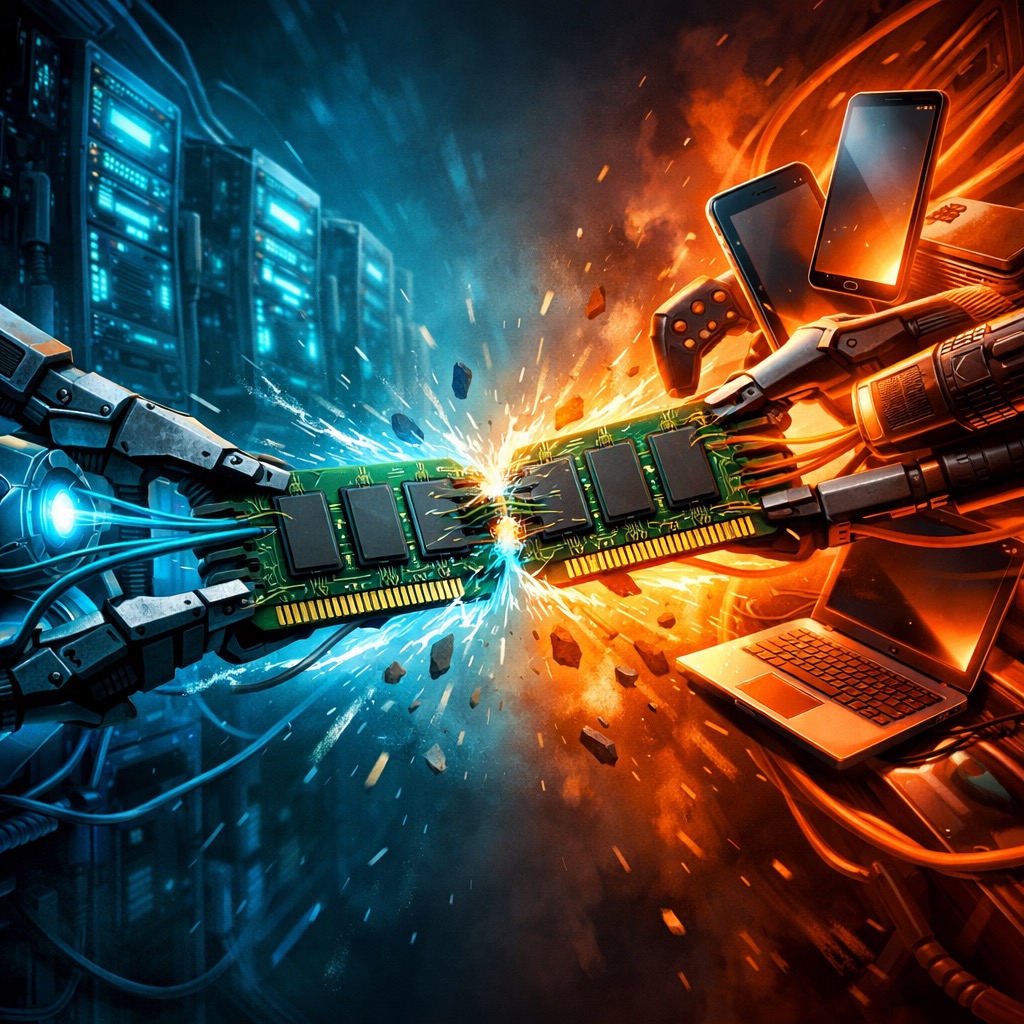
The cause is structural, not cyclical. The AI industry’s hunger for High Bandwidth Memory (HBM) has consumed the global DRAM manufacturing base so thoroughly that there is simply not enough memory left for everything else. Data centers of all types now account for 70% of global memory consumption, according to IDC and Tom’s Hardware. The remaining 30% must serve PCs, smartphones, automobiles, industrial equipment, and every other device containing a memory chip.
Why HBM Manufacturing Starves Everything Else
HBM is not simply regular DRAM in a different package. It is a three-dimensional stack of memory dies bonded together using through-silicon vias (TSVs), mounted on an interposer alongside the GPU or AI accelerator die. Each HBM3e stack requires 8-12 individually tested DRAM layers thinned to sub-100-micron thickness, additional interposer silicon, advanced packaging such as TSMC’s CoWoS, and yields that suffer because a single defective die in a 12-layer stack can render the entire stack unusable.
The result: producing one gigabyte of HBM3e consumes roughly three to four times the wafer output of producing one gigabyte of standard DDR5, according to Tom’s Hardware and TrendForce. AI-related memory production (HBM plus GDDR7) now consumes approximately 20% of total DRAM wafer capacity globally, according to TrendForce — up from less than 5% three years ago. Because each gigabyte of HBM displaces three to four gigabytes of conventional DRAM that could have been produced, the effective supply reduction is far larger than the raw wafer share suggests.
The Producers: Sold Out and Pivoting to AI
The DRAM market is dominated by three companies — Samsung, SK Hynix, and Micron — which together control approximately 90% of global production by revenue. Each has responded to the AI demand surge in ways that have tightened supply for non-AI customers.
SK Hynix, the HBM market leader with roughly 62% share, has its HBM production completely sold out through the end of 2026, with supply expected to remain tight into 2027. The company has been aggressively converting standard DRAM production lines to HBM manufacturing, prioritizing margins estimated at 60-70% — roughly double conventional DDR5 margins.
Samsung, which fell to 17% HBM market share in mid-2025 behind both SK Hynix and Micron, is racing to catch up with a planned 50% HBM capacity surge in 2026. This catch-up effort means Samsung is also redirecting conventional DRAM capacity toward high-margin AI memory.
Micron made the most dramatic move: in late 2025, the company announced it was exiting the Crucial consumer business entirely, effective February 2026, to focus on data center, AI, and high-performance computing memory. One of three major DRAM producers has effectively stopped competing for the consumer memory market.
Advertisement
The Downstream Damage
PC Market: Down 11%
IDC’s revised forecast projects global PC shipments declining 11.3% in 2026, a dramatic revision from the 2.4% decline projected just months earlier. Memory now represents approximately 35% of a typical PC’s bill of materials, according to HP — up from 15-18% just two quarters ago. PC manufacturers have raised retail prices 15-25% while simultaneously seeing declining unit volumes.
Budget and mid-range laptops have been hit hardest. A $500 laptop that previously contained $25 worth of DRAM now contains $65-70 worth, forcing manufacturers to cut other components or raise prices into brackets where consumers hesitate.
Smartphone Market: Down 13%
Bloomberg and IDC report the smartphone market is forecast to decline approximately 13% in 2026, with the sub-$200 segment facing a 20% drop. Apple accepted a 100% price increase from Samsung on LPDDR5X modules for its upcoming iPhone lineup — the 12GB modules rose from approximately $30 to $70 per unit. Apple’s margins can absorb this, but mid-range Android manufacturers operating on razor-thin margins have been forced to reduce memory configurations: shipping 6GB where they previously shipped 8GB, or 8GB where they previously shipped 12GB.
The TeraFab Response
Perhaps the most consequential long-term response came on March 21, 2026, when Elon Musk announced TeraFab — a $20-25 billion vertically integrated semiconductor facility that would consolidate chip design, fabrication, memory production, and advanced packaging under one roof. A joint venture between Tesla, SpaceX, and xAI, TeraFab targets 2-nanometer process technology with an initial output of 100,000 wafers per month. Production is not expected before 2029, but the announcement signals that major AI consumers may eventually feel compelled to build their own memory supply chains rather than depend on a three-company oligopoly.
When Does Relief Arrive?
Industry consensus points to a gradual easing beginning in late 2027, with full normalization unlikely before 2028.
Factors that could accelerate relief:
- New fab completions: Samsung’s P4 line at Pyeongtaek is already ramping in early 2026, adding approximately 60,000 wafers per month. SK Hynix’s Yongin cluster targets its first fab online by May 2027. Micron’s expanded Hiroshima facility aims for HBM mass production from 2028.
- Efficiency improvements: Model distillation, quantization, and mixture-of-experts architectures reduce memory requirements per unit of AI capability. A 70B parameter model quantized to 4-bit precision requires roughly 35GB versus 140GB at full precision.
- Alternative architectures: The Groq LP30 chip within NVIDIA’s Vera Rubin platform carries 512MB of on-chip SRAM, offering one path toward reducing HBM dependency for certain inference workloads.
Factors that could extend the shortage:
- Agentic AI proliferation driving inference demand faster than supply additions.
- Over 40 sovereign AI programs building domestic infrastructure, each requiring HBM-equipped accelerators.
- Next-generation trillion-parameter models demanding ever more memory.
The Profitable Shortage
There is an uncomfortable reality that memory producers avoid discussing publicly: the shortage is extremely profitable for them. DRAM producers have historically suffered through boom-bust cycles where overbuilding leads to price crashes. The current shortage — driven by structural AI demand rather than speculative inventory — is the first time all three major producers simultaneously operate at maximum utilization with maximum pricing power.
Expanding HBM capacity is profitable. Expanding conventional DDR5 capacity is risky — it could trigger oversupply when the current tightness eventually eases. Memory producers are rationally choosing to expand where margins are highest (HBM) and underinvest where margins are lower (conventional DRAM). The invisible hand of the market is not solving this shortage because the shortage is more profitable than abundance.
China’s CXMT (ChangXin Memory Technologies), now the world’s fourth-largest DRAM maker with approximately 11% market share by capacity, is expanding aggressively and targeting domestic HBM3 production by end of 2026. Whether CXMT can meaningfully ease the global shortage while excluded from the most advanced equipment due to US export controls remains an open question.
Frequently Asked Questions
Why can’t memory manufacturers simply build more capacity?
A new DRAM fabrication facility costs $15-20 billion and takes 2-3 years from groundbreaking to volume production. Even converting existing lines takes 6-12 months. Critically, current expansions are overwhelmingly focused on high-margin HBM for AI, not conventional DDR5 for PCs and smartphones. Because HBM consumes three to four times the wafer area per gigabyte, even identical total wafer output produces far less usable consumer memory when shifted toward AI workloads.
Will my next laptop or phone cost more because of this shortage?
Yes. HP has confirmed that memory now represents 35% of its PC bill of materials, up from 15-18% two quarters ago. PC retail prices are up 15-25%, and some smartphone makers are reducing memory configurations in mid-range models rather than raising prices further. Budget devices are disproportionately affected because memory cost increases represent a larger share of their total price. IDC projects PC shipments will decline 11% and smartphone shipments will decline 13% in 2026 as a direct result.
How long will the DRAM shortage last?
Industry analysts expect gradual easing beginning in late 2027 as new fabrication facilities come online, with full normalization unlikely before 2028. However, the timeline depends heavily on AI demand growth. If agentic AI, sovereign AI programs, and next-generation trillion-parameter models drive demand faster than expected, the shortage could persist longer. Memory producers have limited incentive to aggressively expand conventional DRAM capacity because the current shortage is highly profitable for them.
Sources & Further Reading
- Memory Price Outlook for Q1 2026: Record QoQ Increases — TrendForce
- Data Centers Will Consume 70% of Memory Chips Made in 2026 — Tom’s Hardware
- Global Memory Shortage Crisis: Impact on Smartphones and PCs — IDC
- SK Hynix Sells Out Chips for 2026 as AI Demand Booms — CNBC
- Micron Announces Exit from Crucial Consumer Business — Micron Investor Relations
- Apple Agrees to 100% Price Hike on Samsung Memory Chips — MacRumors
- Elon Musk Launches $20B TeraFab Chip Project — Tom’s Hardware
- HBM Consumes Three Times the Wafer Capacity of DDR5 — Tom’s Hardware
🔗 Related Intelligence
AI Data Centers: How They Work and Why They Matter
AI Data Centers: The Architecture Behind the AI Revolution
AI’s Energy Crisis: The Trillion-Dollar Power Problem Behind the AI Boom

Context Rot: Why Managing Your AI’s Memory Is the Most Important Skill in 2026