When the Breach Alarm Sounds
The moment an organization confirms it has been breached — ransomware encrypting production servers, a threat actor detected in the network, customer data appearing on a dark web forum — a clock starts. The first 48 hours are critical. Evidence is volatile: system memory captures attacker tools that disappear on reboot, log files roll over and are overwritten, and attackers who detect investigation activity may accelerate data destruction or exfiltration. This is when DFIR (Digital Forensics and Incident Response) teams deploy, either from internal security operations or from external firms retained specifically for crisis response.
The DFIR market is dominated by a handful of elite firms. Mandiant (acquired by Google for $5.4 billion in September 2022) is widely considered the gold standard, with its roots in investigating the most consequential breaches of the past two decades — from the February 2013 APT1 report attributing cyber espionage to China’s PLA Unit 61398 to its discovery of the SolarWinds supply chain compromise in December 2020, which Mandiant (then operating as FireEye) uncovered while investigating a breach of its own network. CrowdStrike Services leverages the telemetry from its Falcon platform deployed on millions of endpoints to accelerate investigations. Secureworks (acquired by Sophos from Dell Technologies for $859 million in February 2025), Palo Alto Networks Unit 42, and Kroll round out the top tier. The global incident response market is valued at an estimated $38-50 billion annually as of 2025, with retainer agreements (pre-arranged contracts ensuring priority response) typically costing $40,000-$150,000 per year for large enterprises, and hourly rates for emergency response ranging from $300-$500 per consultant at standard firms to $800-$1,000 at premium providers.
For most organizations, the DFIR process is encountered for the first time during their worst day. The investigation that follows is a disciplined, methodical process that combines technical forensic analysis with legal requirements, communications management, and business continuity operations. Understanding how DFIR works — before you need it — is the difference between a managed incident and an organizational crisis.
The Investigation: Evidence Collection and Timeline Reconstruction
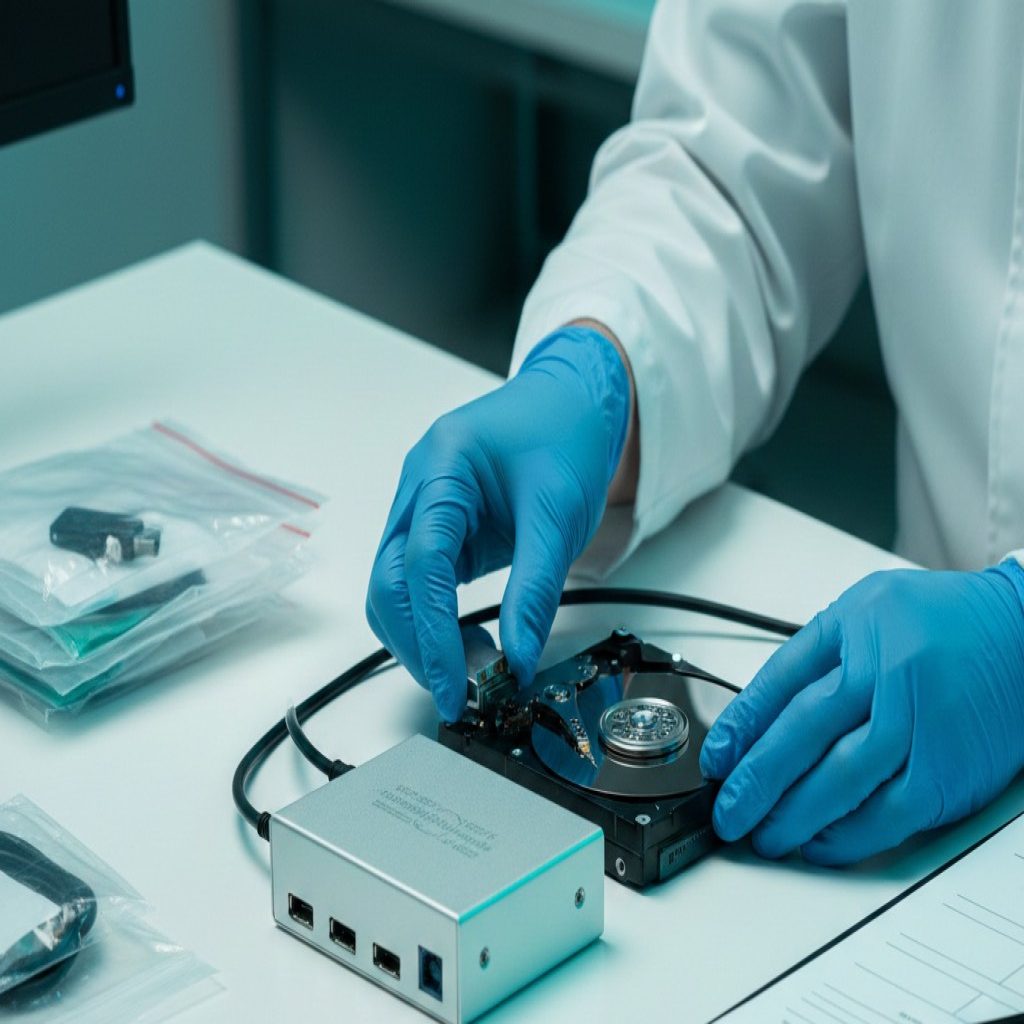
A DFIR investigation follows a structured methodology that parallels criminal investigation: preserve the scene, collect evidence, analyze evidence, reconstruct events, and report findings. The first priority is evidence preservation — ensuring that volatile data (system memory, network connections, running processes) is captured before it is lost, and that persistent data (disk images, log files, database records) is preserved in a forensically sound manner that maintains its admissibility as evidence.
Disk forensics remains the foundation. Investigators create bit-for-bit copies (forensic images) of affected systems’ storage using tools like FTK Imager or the open-source dc3dd, working from write-blocked source drives to prevent any modification of the original evidence. These images are analyzed using platforms like Magnet AXIOM, OpenText EnCase Forensic (EnCase’s developer Guidance Software was acquired by OpenText in 2017), X-Ways Forensics, or the open-source Autopsy toolkit. Analysts examine file system artifacts: recently accessed files, deleted files (recoverable from unallocated disk space), browser history, email archives, registry entries (on Windows), and file metadata timestamps (creation, modification, access) that help reconstruct the attacker’s timeline of activities.
Memory forensics — analyzing captures of system RAM — has become equally critical. Modern attackers operate extensively “in memory,” using fileless malware, PowerShell-based toolkits, and process injection techniques that leave minimal disk artifacts. Volatility, the open-source memory forensics framework, allows investigators to extract running processes, network connections, loaded DLLs, registry hives, encryption keys, and command-line histories from memory dumps. Velociraptor, originally developed by former Google engineer Mike Cohen (who also built GRR Rapid Response and the Rekall memory forensics framework at Google) and acquired by Rapid7 in 2021, provides an agent-based forensic collection platform that can deploy across thousands of endpoints simultaneously, collecting forensic artifacts at enterprise scale without the logistical impossibility of physically imaging every machine.
Advertisement
Cloud Forensics: Where Traditional Methods Break Down
The migration of enterprise infrastructure to cloud platforms (AWS, Azure, GCP) has fundamentally challenged traditional DFIR methodologies. In a cloud environment, there are no physical disks to image. Virtual machines can be ephemeral — auto-scaling groups create and destroy instances continuously. Traditional disk forensics assumes persistent, accessible storage; cloud architecture often eliminates both assumptions. An attacker who compromises a containerized application running on Kubernetes may leave traces in container logs that exist only until the container is recycled, which may happen minutes after the compromise.
Cloud forensics requires a different approach centered on log analysis rather than disk imaging. AWS CloudTrail logs every API call made within an AWS account; Azure Activity Logs and Google Cloud Audit Logs provide equivalent records for their platforms. These logs capture who did what, when, and from where — essentially a surveillance camera for cloud infrastructure activity. Investigators analyzing a cloud breach will reconstruct the attacker’s actions primarily through API logs: what IAM roles were assumed, what S3 buckets were accessed, what EC2 instances were launched, what data was downloaded.
However, cloud log forensics faces its own challenges. CloudTrail logs are typically delivered within approximately five minutes of an API call, and the free Event History view retains only the last 90 days of management events. If an organization has not configured long-term log retention (using S3 buckets with lifecycle policies), critical evidence may be unavailable by the time an investigation begins. Many organizations discover during a breach investigation that their cloud logging was insufficient — VPC Flow Logs were not enabled, S3 access logging was turned off, or CloudTrail was configured for management events only (missing data events like individual S3 object access). The forensic preparation that makes cloud investigations possible — comprehensive logging, centralized log storage, immutable log archives — must be configured before the breach occurs. Retroactive enablement recovers nothing.
The Legal Dimension: Chain of Custody and Court-Admissible Evidence
Digital forensic evidence frequently enters legal proceedings — criminal prosecutions, civil litigation, regulatory enforcement actions, and insurance claims. For evidence to be admissible in court, investigators must maintain a documented chain of custody: an unbroken record of who collected the evidence, how it was collected, where it was stored, who accessed it, and what tools were used to analyze it. Any gap in the chain of custody can be used by opposing counsel to challenge the evidence’s integrity, potentially rendering months of investigation work inadmissible.
The practical implications shape every aspect of a DFIR investigation. Forensic images must be created using validated tools and verified with cryptographic hashes (MD5 and SHA-256) documented at the time of collection. The original evidence (source drives, memory dumps) must be stored in tamper-evident packaging with access logs. Analysis must be conducted on forensic copies, never originals. Findings must be reproducible — another qualified examiner using the same tools on the same evidence should reach the same conclusions. Expert witnesses may be called to testify about their methodology, and attorneys for the opposing side will probe for any procedural shortcut or deviation from accepted forensic practice.
For organizations in Algeria, where digital evidence law is still developing, understanding these standards is relevant for both domestic and international proceedings. Algerian courts accept digital evidence under the Code of Criminal Procedure (as amended by Law 06-22), and Law 09-04 on cybercrime provides for the use of digital evidence in cybercrime prosecutions. However, the specific technical standards for forensic evidence collection and preservation are not codified in Algerian law to the same degree as in jurisdictions like the US (Federal Rules of Evidence), UK (ACPO Good Practice Guide for Digital Evidence), or the EU (ENISA guidelines). Organizations preparing for potential incidents should ensure their forensic procedures meet international standards — particularly if the investigation may involve cross-border elements or international legal proceedings.
The DFIR Career Path
The demand for DFIR professionals exceeds supply by a significant margin globally. Mandiant, CrowdStrike, and other top-tier firms continuously recruit, and internal corporate DFIR teams at financial institutions, technology companies, and government agencies compete for the same talent pool. Entry-level DFIR analysts in the US market earn $90,000-$110,000; senior investigators and team leads command $150,000-$250,000; and principals at elite firms or independent consultants specializing in high-profile breach investigations can earn significantly more.
The certification landscape includes GIAC certifications (GCFE for forensic examiner, GCFA for forensic analyst, GNFA for network forensic analyst), the EnCE (EnCase Certified Examiner), CFCE (Certified Forensic Computer Examiner), and vendor-specific certifications from AWS, Azure, and GCP for cloud forensics. However, certifications are entry tickets rather than differentiators — what distinguishes DFIR professionals is hands-on experience analyzing real incidents, publishing research, contributing to open-source tools, and demonstrating analytical reasoning under pressure.
For aspiring DFIR professionals in Algeria and across the MENA region, the path is increasingly accessible. Free forensic tools (Autopsy, Volatility, Velociraptor), free training platforms (CyberDefenders, Blue Team Labs Online, SANS Cyber Ranges), and free forensic challenge datasets (the NIST CFReDS repository, the Digital Forensic Research Workshop image galleries) provide the technical foundation. Remote work opportunities with international firms make geographic location less of a barrier than it was a decade ago. The combination of growing global demand, accessible training resources, and remote work availability makes DFIR one of the most promising cybersecurity career paths for technically inclined professionals regardless of location.
Advertisement
🧭 Decision Radar (Algeria Lens)
| Dimension | Assessment |
|---|---|
| Relevance for Algeria | High — Algerian organizations face growing breach risks requiring professional investigation; DFIR career opportunities are globally accessible via remote work |
| Infrastructure Ready? | No — no established DFIR consultancy market in Algeria; reliance on international firms for major investigations; Algeria’s legal framework (Law 09-04) supports digital evidence but technical standards are underdeveloped |
| Skills Available? | Partial — Algerian cybersecurity professionals can access free tools (Autopsy, Volatility) and training platforms (CyberDefenders); practical experience requires lab investment and CTF participation |
| Action Timeline | Immediate for individual career development; 12-24 months for building organizational DFIR preparedness |
| Key Stakeholders | Algerian financial sector, government security agencies, law enforcement (DGSN cyber units), universities, cybersecurity training providers |
| Decision Type | Educational |
Quick Take: DFIR is the cybersecurity discipline that matters most when everything else fails. Understanding how forensic investigations work, preparing the logging and evidence preservation infrastructure before a breach, and building forensic skills are investments that pay off precisely when they are needed most. For Algeria, the dual opportunity is organizational preparedness and individual career development in a high-demand global field.
Sources & Further Reading
- Mandiant (Google Cloud) – Incident Response Services
- Google Closes $5.4B Mandiant Acquisition — TechCrunch
- Mandiant Exposes APT1: One of China’s Cyber Espionage Units — Google Cloud Blog
- FireEye Discovered SolarWinds Breach While Probing Own Hack — Data Center Knowledge
- Sophos Completes $859M Acquisition of Secureworks — TechMonitor
- Rapid7 and Velociraptor Join Forces
- Volatility Foundation — Memory Forensics Framework
- AWS CloudTrail FAQs
- Incident Response Market Report 2025 — The Business Research Company
- GIAC Digital Forensics and Incident Response Certifications
- CyberDefenders — Free Blue Team Training
- NIST CFReDS — Computer Forensic Reference Data Sets
- Algeria Law 09-04 on Cybercrime — WIPO Lex
- ENISA — Digital Forensics Evidence Guidelines





Advertisement