Beyond Government Programs: Where Algerian Tech Actually Happens
When international reports discuss Algeria’s digital transformation, they tend to focus on top-down initiatives — the SNTN-2030 national digital strategy, startup fund allocations, ministerial announcements. These programs matter, but they are not where most Algerian developers learn their craft, find their first collaborators, or land their first opportunities. That happens in conference rooms borrowed from coworking spaces, university amphitheaters repurposed on Saturdays, and Discord servers that never sleep.
Algeria’s grassroots tech community has grown from a handful of isolated groups into a networked ecosystem spanning multiple cities, hundreds of events per year, and tens of thousands of active participants. The 2024 State of Software Engineering in Algeria survey — which collected input from 517 developers — documented at least 17 active Google Developer Groups alone, alongside dozens of university clubs, professional associations, and online communities such as DZ Developpeurs, which counts over 156,000 members on Facebook. This growth has happened largely without institutional funding, corporate sponsorship models, or centralized coordination. It is organic, messy, volunteer-driven, and — by multiple measures — the single most effective developer education system operating in Algeria today.
Understanding this ecosystem is essential for anyone trying to hire Algerian developers, partner with Algerian startups, or invest in the country’s digital future. The formal institutions tell you what Algeria plans to do. The communities tell you what Algeria is already doing.
—
The Major Players: GDG, WTM, and the Global Network Effect
Google Developer Groups (GDG) represent the most visible layer of Algeria’s tech community. As of mid-2024, Algeria has 17 active GDG chapters spread across cities including Algiers, Oran, Constantine, Tizi Ouzou, and beyond. GDG Algiers, the largest chapter and one of the most active GDGs in the MENA region, hosts regular meetups and organizes DevFest Algiers — an event that has run for over eleven consecutive years and draws significant attendance from across the country. GDG chapters collectively host dozens of events per year, covering topics from Android development and cloud computing to machine learning and web performance.
The GDG model works in Algeria for a specific reason: Google provides the brand credibility, event tooling, and occasional speaker budgets that local organizers cannot access independently, while the organizers contribute the local knowledge, venue relationships, and community trust that Google cannot build remotely. It is a genuine symbiosis. The Google brand helps boost event visibility and attendance in ways that unbranded community events covering identical topics typically cannot achieve on their own.
Women Techmakers (WTM) Algeria has become an important on-ramp for women entering Algeria’s tech ecosystem. The Algiers chapter, based at ESI (the Higher National School of Computer Science), hosts workshops, mentorship circles, and the annual International Women’s Day celebration that has become a flagship event. In a country where women represent nearly half of engineering students — 48% according to UNESCO data — yet comprise less than 15% of the overall workforce, WTM’s role in bridging the education-to-employment gap is critical. The gap between STEM graduation rates and workforce participation reflects systemic barriers including limited professional mobility, few leadership opportunities, and an absence of visible role models in the tech sector.
—
Advertisement
University Coding Clubs: The Talent Pipeline Nobody Talks About
If GDG chapters are Algeria’s tech community living room, university coding clubs are its nursery. Nearly every major Algerian university now has at least one student-run tech club, and the most active ones — like the Club Scientifique de l’ESI (CSE), GDSC USTHB, and the Micro Club at USTHB — function as parallel education systems that fill the gaps left by outdated curricula.
The Micro Club at USTHB, founded on March 5, 1985, is the first scientific club in Algeria and one of the oldest tech clubs on the continent. Over four decades, it has produced an outsized number of Algeria’s successful developers and entrepreneurs. The club hosts regular workshops covering development, cybersecurity, game development, and design, manages an annual hackathon, and maintains a mentorship network connecting current students with alumni across the tech industry. Its longevity demonstrates something important: Algeria’s tech community is not a recent phenomenon sparked by the startup hype cycle. It has deep roots.
The CSE at ESI Algiers, founded in 2008, is another heavyweight. Described as one of the biggest scientific clubs in Algeria, CSE claims to have organized Algeria’s first hackathon and continues to run major events including the Leapfrog Hackathon and various startup competitions.
GDSC (Google Developer Student Clubs) chapters operate at multiple Algerian universities — including ESI Sidi Bel Abbes, USTO Oran, the University of Batna 2, and the University of M’Sila — following a structured curriculum that combines technical workshops with project-based learning. The GDSC Solution Challenge, a global competition where student teams build technology solutions for UN Sustainable Development Goals, has attracted participation from Algerian teams, giving students exposure to international competition standards and global developer networks.
—
Hackathons: From Weekend Projects to Startup Launchpads
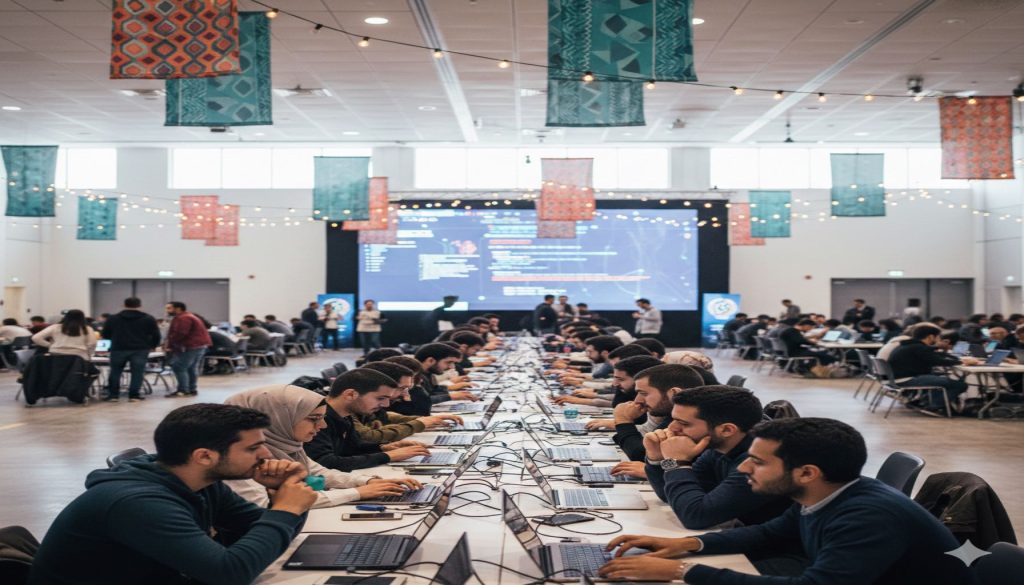
Algeria’s hackathon scene has matured from novelty events into a genuine ecosystem that feeds the startup pipeline. Djezzy, Algeria’s major mobile operator, launched its first national innovation hackathon “Tech Innov” in November 2025, bringing together students, researchers, and project leaders from universities and startups across the country at the Sidi Abdellah Technological University Campus. Djezzy also ran the “Impact Challenge” in partnership with Algeria Startup Challenge, offering grants and mentorship to startups developing digital inclusion solutions. These corporate-backed events signal growing recognition that hackathons are talent showcases, not just weekend novelties.
NASA Space Apps Challenge has become another pillar of the Algerian hackathon calendar. Algeria has participated regularly in this global event — the world’s largest annual hackathon, which in 2025 drew over 114,000 participants across 551 locations in 167 countries. Algeria has hosted local events in cities including Algiers and Oran, and the space and science theme aligns with Algeria’s growing interest in satellite technology and earth observation through the Algerian Space Agency (ASAL).
Beyond these flagship events, a circuit of hackathons runs nearly year-round. The Algerian Engineering Competition (AEC) has been organized simultaneously across six wilayas — Algiers, Oran, Tlemcen, Constantine, Annaba, and Ouargla — focusing on leapfrog technologies with industrial applications. Techstars Startup Weekend operates in Algiers. Individual university clubs organize domain-specific events around fintech, healthtech, and e-government. The cumulative effect is a developer population that is unusually comfortable with rapid prototyping, cross-functional teamwork, and pitching under pressure — skills that formal education rarely develops.
The Algerian Startup Fund (ASF), established in October 2020 with a capital of 2.4 billion dinars and a portfolio of over 100 funded startups across 20 business sectors, provides a downstream pathway for the most promising hackathon projects. Many of the founding teams that secured ASF backing first connected at community events and hackathons — a pattern that underscores the ecosystem’s role as a startup incubator in all but name.
—
The Gaps: What Algeria’s Communities Still Need
For all its energy, Algeria’s tech community ecosystem faces structural challenges that limit its impact. Funding is the most obvious: nearly every community operates on volunteer labor and zero budget. Venue costs are absorbed by sympathetic universities or coworking spaces. Speaker travel is self-funded or covered by personal networks. Swag, food, and event logistics come out of organizers’ pockets. This model produces burnout — organizer turnover is high, with chapter leads frequently stepping down after one to two years of unpaid effort.
Corporate sponsorship, which sustains tech communities in Morocco (where companies like OCP, Inwi, and Attijariwafa Bank regularly sponsor hackathons, AI challenges, and educational programs) and Egypt, is still in its early stages in Algeria. Algerian companies with the resources to sponsor — Sonatrach, Cevital, major banks — have been slow to recognize developer communities as talent pipelines worth investing in. This is beginning to change. Djezzy ran multiple tech community initiatives in 2025, including the Tech Innov hackathon and the Impact Challenge. Yassir, Algeria’s largest homegrown tech company — backed by $193 million in funding and operating in 45 cities across six countries — regularly hosts and sponsors tech events. Companies like Sylabs and Makers Lab have also emerged as consistent community supporters. But the gap with regional peers remains wide.
Geographic concentration is another challenge. Algiers hosts a disproportionate share of all tech community events, with Oran and Constantine sharing much of the remainder. Developers in Ghardaia, Bechar, Tlemcen, and the southern wilayas have limited access to in-person community. Online communities partially bridge this gap — the DZ Developpeurs Facebook group alone connects over 156,000 members — but the peer learning, networking, and serendipitous connections that happen at physical events do not fully replicate online. Initiatives like the Algerian Engineering Competition, which organized hackathons simultaneously across six cities, offer a model for geographic distribution that could be systematically expanded.
—
Advertisement
🧭 Decision Radar
| Dimension | Assessment |
| Relevance for Algeria | High — grassroots communities are the primary developer education and networking infrastructure |
| Action Timeline | Immediate — communities are active now but need institutional support to scale sustainably |
| Key Stakeholders | GDG/WTM organizers, university coding clubs, corporate sponsors, Ministry of Digital Economy, coworking spaces |
| Decision Type | Educational |
| Priority Level | High |
Quick Take: Algeria’s grassroots tech communities are the most effective developer education system in the country, operating almost entirely on volunteer effort. Corporate Algeria is leaving talent pipeline value on the table by under-investing in sponsorship. The ROI on even modest community engagement is disproportionately high.
Sources & Further Reading
- GDG Algiers — Google Developer Groups
- DevFest Algiers 2024 — GDG Algiers
- The State of Software Engineering in Algeria — Tech Communities
- Women Techmakers Algiers
- Micro Club USTHB
- Club Scientifique de l’ESI (CSE)
- Djezzy Tech Innov Hackathon 2025 — Allotech DZ
- Djezzy Impact Challenge 2025 — TechAfrica News
- NASA Space Apps Challenge 2025
- Algerian Startup Fund (ASF)
- Algeria SNTN-2030 Digital Transformation Strategy — We Are Tech
- Algerian Women Break Engineering Monopoly — Al-Fanar Media / UNESCO





Advertisement