The Arabic AI Gap That MCP Can Help Close
Arabic is spoken by more than 422 million people across 27 countries, yet it accounts for only about 1% of online content despite Arabic speakers representing 5% of the global population. This data asymmetry has real consequences for AI: leading models achieve strong accuracy in Modern Standard Arabic (MSA), but performance drops significantly when processing dialectal Arabic, according to research compiled by WideBOT and academic studies on Arabic LLM benchmarks.
For Algerian developers, this gap is both a challenge and an opportunity. Algeria’s linguistic landscape — spanning MSA, Algerian Darija (Darja), Tamazight, and French — creates unique requirements that global LLMs handle poorly out of the box. The Model Context Protocol offers a practical architectural pattern for bridging this gap without training custom models from scratch.
What MCP Is and Why It Matters for Arabic AI
The Model Context Protocol, originally developed by Anthropic and released as an open standard in late 2024, provides a standardized interface for connecting AI applications to external data sources and tools. Think of it as a universal adapter between LLMs and the outside world — databases, APIs, file systems, web services, and custom processing pipelines.
As of March 2026, MCP has moved from experimental to production-ready. The community ecosystem has grown to over 5,800 MCP servers, with major platforms including OpenAI, Google, and Vercel integrating support. SDKs exist for Python, TypeScript, C#, and Java, covering the primary languages used by Algerian developers.
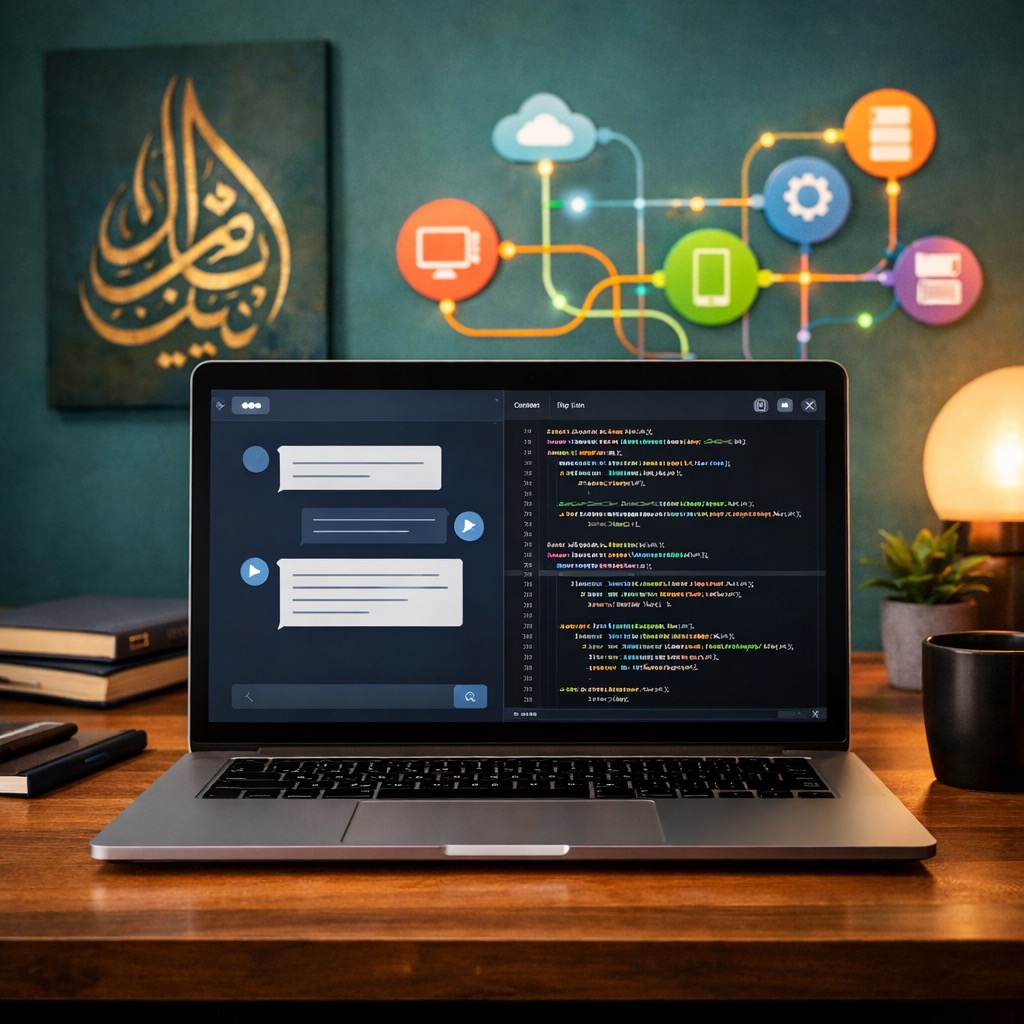
The protocol follows a client-server architecture. An MCP host (like Claude Desktop, Cursor, or a custom application) connects to MCP servers that expose specific capabilities — tools, resources, and prompts. This separation means you can build Arabic-specific processing as an MCP server and connect it to any compatible AI application.
Three MCP Architectures for Arabic Language Tools
Architecture 1: Arabic Dialect Preprocessing Server
The most immediate application for Algerian developers is building an MCP server that preprocesses Arabic text before it reaches an LLM. Algerian Darija mixes Arabic roots with French loanwords, Tamazight vocabulary, and local slang — patterns that confuse models trained primarily on MSA.
An MCP server handling this could expose tools for dialect detection (identifying whether input text is MSA, Darija, or Tamazight), transliteration normalization (converting Latin-script Darija common in social media into Arabic script), and diacritization (adding missing diacritics to reduce ambiguity, a critical challenge since most digital Arabic text omits them entirely).
The server connects to the LLM application via MCP’s standard JSON-RPC protocol. The LLM calls the dialect preprocessing tool before generating its response, producing output that accurately reflects the input dialect.
Architecture 2: Algerian Knowledge Base Connector
Arabic AI tools are only as good as the data they can access. An MCP server that connects LLMs to Algerian-specific knowledge bases — government databases, local business directories, educational resources, legal texts — gives AI applications contextual grounding that no general-purpose model provides.
For example, an MCP server wrapping Algeria’s official gazette (Journal Officiel) could expose tools for searching legal texts, extracting relevant regulations, and providing Arabic summaries of French-language administrative documents. The LLM gets structured access to authoritative Algerian data without needing that data baked into its training corpus.
Architecture 3: Multilingual Routing Pipeline
Algeria’s trilingual reality (Arabic, French, Tamazight) means many practical AI applications need to handle mixed-language input gracefully. An MCP server can act as a language router — detecting the language mix of incoming text, routing to appropriate processing tools, and assembling responses that match the user’s linguistic context.
This is particularly relevant for customer service applications, government chatbots, and educational tools where users naturally code-switch between languages within a single conversation.
Advertisement
Building Your First Arabic MCP Server: A Practical Path
The MCP specification uses JSON-RPC 2.0 over standard I/O (stdio) or HTTP with Server-Sent Events. For Algerian developers starting out, the Python SDK offers the most accessible entry point, given Python’s dominance in NLP tooling and the availability of Arabic-specific libraries.
Step 1: Start with existing Arabic NLP tools. Libraries like CAMeL Tools (from NYU Abu Dhabi) provide morphological analysis, dialect identification, and diacritization for Arabic. AraBERT and QARIB offer pre-trained models for sentiment analysis and named entity recognition. Wrapping these as MCP tools makes them available to any MCP-compatible AI application.
Step 2: Add Algerian-specific data layers. Connect to local APIs and datasets. The State of Software Engineering in Algeria survey data, Algerian government open data portals, and Algerian Arabic text corpora can serve as resources exposed through your MCP server.
Step 3: Test with real dialectal data. The critical test for any Arabic AI tool is how it handles dialect. Collect sample Darija text from Algerian social media, customer service transcripts, or community forums. Use these as test cases to evaluate whether your MCP preprocessing pipeline improves LLM output quality.
Algerian Developers Already in the Game
Algeria’s AI ecosystem is small but growing in relevant directions. Nojoom.ai has built an entirely Algerian generative AI platform that includes Thuraya, an Arabic-language AI search engine, and Suhail, a document analysis tool. Dr. Taha Zerrouki at the University of Bouira has been advancing NLP research for Arabic language processing, with published work on stemming, text-to-speech, and sign language translation. FarmAI won second prize at Huawei’s global Tech4Good competition with AI-powered agricultural tools.
With 57,702 students enrolled across 74 AI master’s programs at 52 Algerian universities, the talent pipeline exists. What has been missing is a practical, standardized way to connect that talent to production AI systems — which is precisely what MCP provides.
The remote work ecosystem also creates a natural distribution channel. According to the State of Software Engineering in Algeria survey, 29% of Algerian developers work for foreign companies remotely. MCP servers built by Algerian developers for Arabic language processing can serve international clients directly, creating export revenue from intellectual property rather than just labor.
The Monetization Question
Arabic NLP tools built as MCP servers have a clear market. Any company serving Arabic-speaking customers — in e-commerce, banking, government services, healthcare — needs AI that handles Arabic accurately. The current gap between MSA performance and dialectal performance means there is genuine demand for specialized processing.
Algerian developers have a structural advantage here: native fluency in Algerian Darija, professional competency in MSA and French, and proximity to the specific dialect challenges that global AI companies struggle with. An MCP server that reliably improves LLM accuracy on North African Arabic dialects is a product, not just a project.
MENA region technology spending is projected to reach $169 billion in 2026 according to Gartner, with Gulf states committing hundreds of billions to AI infrastructure — a significant portion of which requires Arabic language capabilities. MCP servers that solve specific Arabic AI challenges can plug into this market through the protocol’s standardized interface — no custom integrations or enterprise sales teams required.
What Comes Next
The MCP ecosystem is expanding weekly. As more AI applications adopt the protocol, the distribution potential for Arabic-specific MCP servers grows automatically. For Algerian developers, the practical next steps are clear: pick a specific Arabic language challenge (dialect detection, diacritization, domain-specific knowledge access), build an MCP server that addresses it, and ship it to the growing MCP marketplace.
The tools exist. The talent exists. The market demand exists. What MCP adds is the connective tissue — a standard way to make Arabic AI capabilities available to any application, anywhere, through a protocol that the entire industry is converging on.
Frequently Asked Questions
What is the Model Context Protocol and how does it help Arabic AI development?
MCP is an open standard originally developed by Anthropic that provides a universal interface for connecting LLMs to external data sources and tools. For Arabic AI, it allows developers to build preprocessing servers that handle dialect detection, diacritization, and transliteration — wrapping existing Arabic NLP libraries so any MCP-compatible AI application can use them. As of March 2026, over 5,800 community-built MCP servers exist with SDKs in Python, TypeScript, Java, and C#.
Why do Algerian developers have an advantage in building Arabic AI tools?
Algerian developers possess native fluency in Algerian Darija, professional competency in MSA and French, and direct exposure to the trilingual code-switching patterns that global AI models struggle with. This linguistic intuition is difficult to replicate from outside the region. Combined with 57,702 students in AI programs and 29% of developers already working internationally, Algeria has both the talent and the market access to build commercially viable Arabic NLP tools.
How can an Algerian developer monetize an Arabic MCP server?
An MCP server that improves LLM accuracy on North African Arabic dialects is a product that plugs into the $169 billion MENA tech spending market through MCP’s standardized interface. Companies serving Arabic-speaking customers in e-commerce, banking, and government need dialect-aware AI processing. Developers can distribute through the MCP marketplace, offer as a subscription service, or license to enterprise clients — all without building custom integrations for each customer.
Sources & Further Reading
- The Complete Guide to Model Context Protocol (MCP): Building AI-Native Applications in 2026 — DEV Community
- Arabic Language and Artificial Intelligence: Challenges of Arabic NLP in 2026 — WideBOT
- The Landscape of Arabic Large Language Models — Communications of the ACM
- Data and Machine Learning — The State of Software Engineering in Algeria
- Model Context Protocol Specification — modelcontextprotocol.io
🔗 Related Intelligence

The Algerian Developer Stack: What Languages, Frameworks
Algerian Developers and the Five Levels of AI Coding: Where Are We?
Algeria Builds Sovereign AI Models Faithful to National Values and Languages
The Algerian Arabic AI Gold Rush: Why Darija and Tamazight Could Power the Next LLM