A National Innovation Call Targets Water Intelligence
In March 2026, Algeria launched a national call for innovation projects specifically targeting AI and smart technology deployment in water management. The initiative, coordinated by the Ministry of Post and Telecommunications alongside the Ministry of Hydraulic Resources, invites startups, micro-enterprises, university researchers, incubators, and Algerian talent abroad to propose solutions across four priority areas: reducing water leaks and distribution waste, improving energy efficiency in desalination, expanding water reuse capacity, and deploying smart irrigation systems.
The call represents a concrete policy shift. For the first time, Algeria’s water strategy explicitly integrates AI, IoT sensors, and predictive analytics as core infrastructure components rather than experimental add-ons. Proposals must demonstrate measurable impact metrics, with a particular emphasis on solutions that can scale across Algeria’s diverse geography — from Mediterranean coastal cities to Saharan oasis communities.
How AI Tackles Algeria’s Water Leakage Crisis
Algeria loses an estimated 40-50% of treated water through distribution network leaks — a figure common across North Africa but devastating for a country where water scarcity has triggered rationing in several wilayas. Traditional leak detection relies on manual inspections and pressure monitoring, methods that are slow, costly, and imprecise across Algeria’s 130,000+ kilometers of distribution pipes.
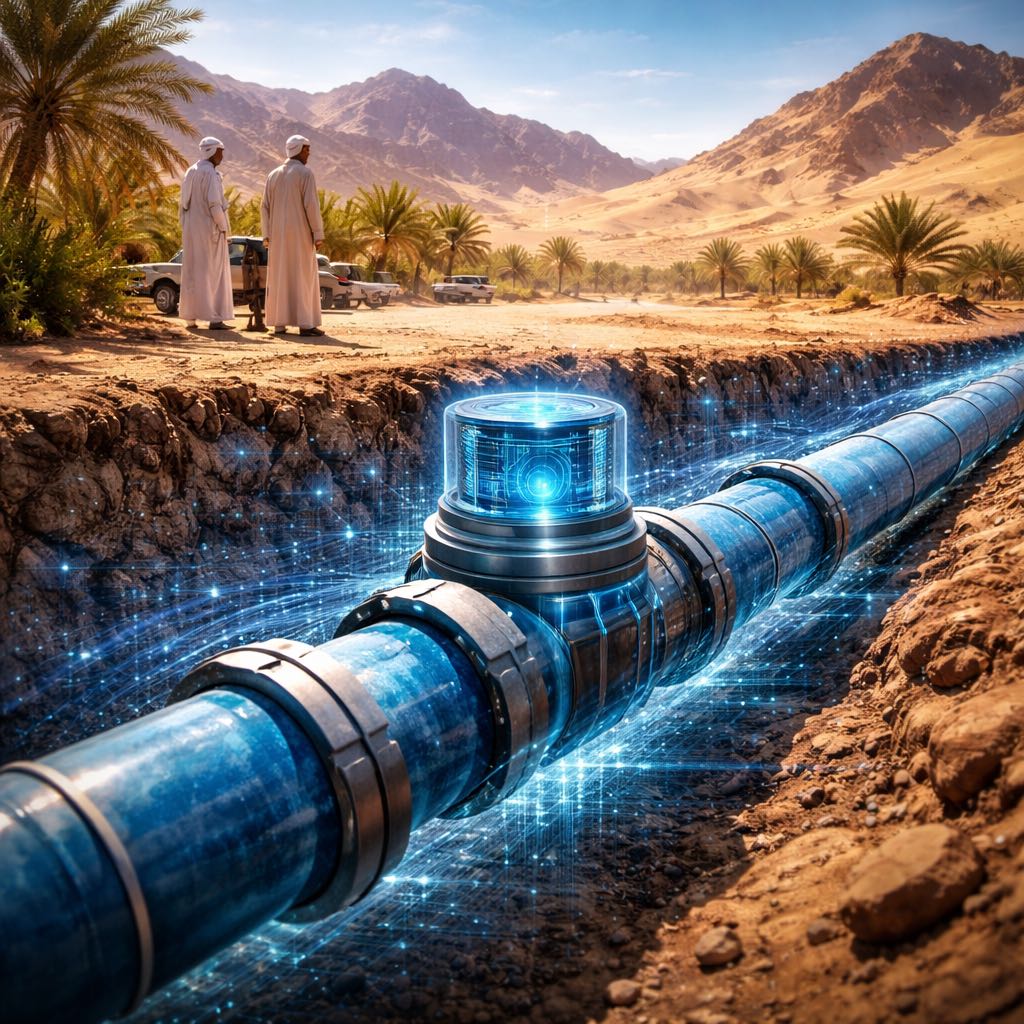
AI-powered leak detection changes this equation fundamentally. Systems like QoW-Pro, developed by Algerian researchers and published in the Journal of Renewable Energies, combine IoT sensors deployed at network junctions with machine learning algorithms that analyze flow patterns, pressure anomalies, and acoustic signatures in real time. When a leak develops, the AI flags the precise location within minutes rather than the days or weeks required for manual detection.
The economic case is compelling. International benchmarks show that AI leak detection systems typically reduce non-revenue water by 15-25% within the first two years of deployment. For Algeria, where the Algerian Water Authority (ADE) manages infrastructure serving over 44 million people, even a 10% reduction in losses translates to hundreds of millions of cubic meters of recovered water annually.
Desalination Expansion: Seven New Plants by 2030
Running parallel to the AI initiative is an ambitious desalination expansion. In January 2026, Minister of Hydrocarbons and Mines Mohamed Arkab presided over contract signings for seven new desalination stations to be built between 2025 and 2030 in Tlemcen, Mostaganem, Tizi Ouzou (two stations), Chlef, Jijel, and Skikda. State energy giant Sonatrach leads the construction effort.
The target is transformative: by 2030, Algeria plans to increase desalination capacity to approximately 5.8 million cubic meters per day, covering roughly 60% of the country’s freshwater requirements. This represents a dramatic jump from the current 18% share. Algeria already operates 13 large-scale reverse osmosis plants along its Mediterranean coast, and the new stations will nearly double installed capacity.
AI enters the desalination picture through energy optimization. Reverse osmosis is energy-intensive, consuming 3-5 kilowatt-hours per cubic meter. Machine learning models trained on real-time data from membrane sensors, water quality monitors, and energy meters can dynamically adjust operating parameters — membrane pressure, feed flow rates, chemical dosing — to minimize energy consumption while maintaining output quality. Pilot programs internationally have demonstrated energy savings of 10-20% through AI-driven optimization.
Advertisement
IoT Sensors and Digital Twins for Network Management
Beyond leak detection and desalination, Algeria’s water AI strategy encompasses digital twin technology for network planning and predictive maintenance. A digital twin creates a virtual replica of the physical distribution network, continuously updated with real-time sensor data, enabling operators to simulate scenarios — population growth, seasonal demand spikes, infrastructure failures — before they occur.
The University of Bouira and the Centre for Renewable Energies Development (CDER) have published research on integrating IoT-based real-time water monitoring systems with AI analytics, demonstrating how low-cost sensor networks can provide continuous water quality assessment and flow monitoring across distributed networks. These academic contributions provide a foundation for industrial-scale deployment.
Algeria’s water utility infrastructure is also benefiting from the country’s expanding fiber-optic backbone. Algerie Telecom’s nationwide network and the upcoming 5G rollout provide the connectivity backbone required for thousands of IoT sensors to transmit data to centralized AI platforms in real time.
Climate Adaptation Drives Urgency
Algeria’s water crisis is fundamentally a climate crisis. Rainfall has declined by 20-30% across northern Algeria over the past three decades, and dam reservoir levels have dropped to critical levels in multiple wilayas. The 2021-2023 drought cycle forced water rationing in Algiers, Tizi Ouzou, and Bejaia, exposing the fragility of rain-dependent water supply.
The national innovation call explicitly frames AI and smart technology as climate adaptation tools. Solutions that enhance climate change resilience — drought prediction, demand forecasting, aquifer monitoring — receive priority consideration. This framing aligns with the broader SNTN-2030 digital strategy, which positions AI as a cross-cutting enabler for national development goals.
Challenges and Implementation Realities
Despite the ambition, Algeria’s water AI deployment faces practical hurdles. The country’s distribution networks include aging infrastructure — some pipes dating to the colonial era — where sensor installation requires significant civil works. Import restrictions and currency controls complicate procurement of specialized IoT hardware. And the AI talent pool, while growing through university programs and the national AI council’s initiatives, remains thin relative to the scale of infrastructure that needs digitization.
International partnerships offer a partial solution. Algeria’s collaboration with companies like Huawei on telecommunications infrastructure could extend to smart water systems, while the diaspora talent pool — explicitly targeted by the innovation call — brings expertise developed in European and North American water utilities.
Frequently Asked Questions
How much water does Algeria lose through distribution leaks?
Algeria loses an estimated 40-50% of treated water through distribution network leaks, a figure common across North Africa. AI-powered leak detection aims to reduce non-revenue water by 15-25% within two years of deployment.
What is Algeria’s desalination target for 2030?
Algeria plans to increase its desalination capacity to approximately 5.8 million cubic meters per day by 2030, which would cover roughly 60% of the country’s freshwater needs, up from the current 18%.
How does AI improve desalination efficiency?
Machine learning models analyze real-time data from membrane sensors, water quality monitors, and energy meters to dynamically optimize operating parameters, reducing energy consumption by 10-20% while maintaining water quality output.
///
Sources & Further Reading
- Algeria Launches National Innovation Call to Deploy AI and Smart Technology in Water Management — iAfrica
- Algeria’s Sonatrach Leads New Desalination Drive for Water Security by 2030 — Fanack Water
- IoT and AI for Real-time Water Monitoring and Leak Detection — Journal of Renewable Energies
- Algeria to Build 7 New Desalination Plants Between 2025 and 2030 — Global Flow Control
- 8 Trends That Could Transform Global Water Accessibility — Oliver Wyman