Why 700MHz Matters for Algeria
Algeria covers 2.38 million square kilometers, making it Africa’s largest country by area. Yet ARPCE’s coverage obligations have historically measured population coverage rather than geographic coverage, incentivizing operators to concentrate infrastructure in dense urban corridors — Algiers, Oran, Constantine, Annaba — while leaving vast swaths of the Hauts Plateaux, Saharan communities, and mountainous Kabylie regions with degraded or absent broadband service.
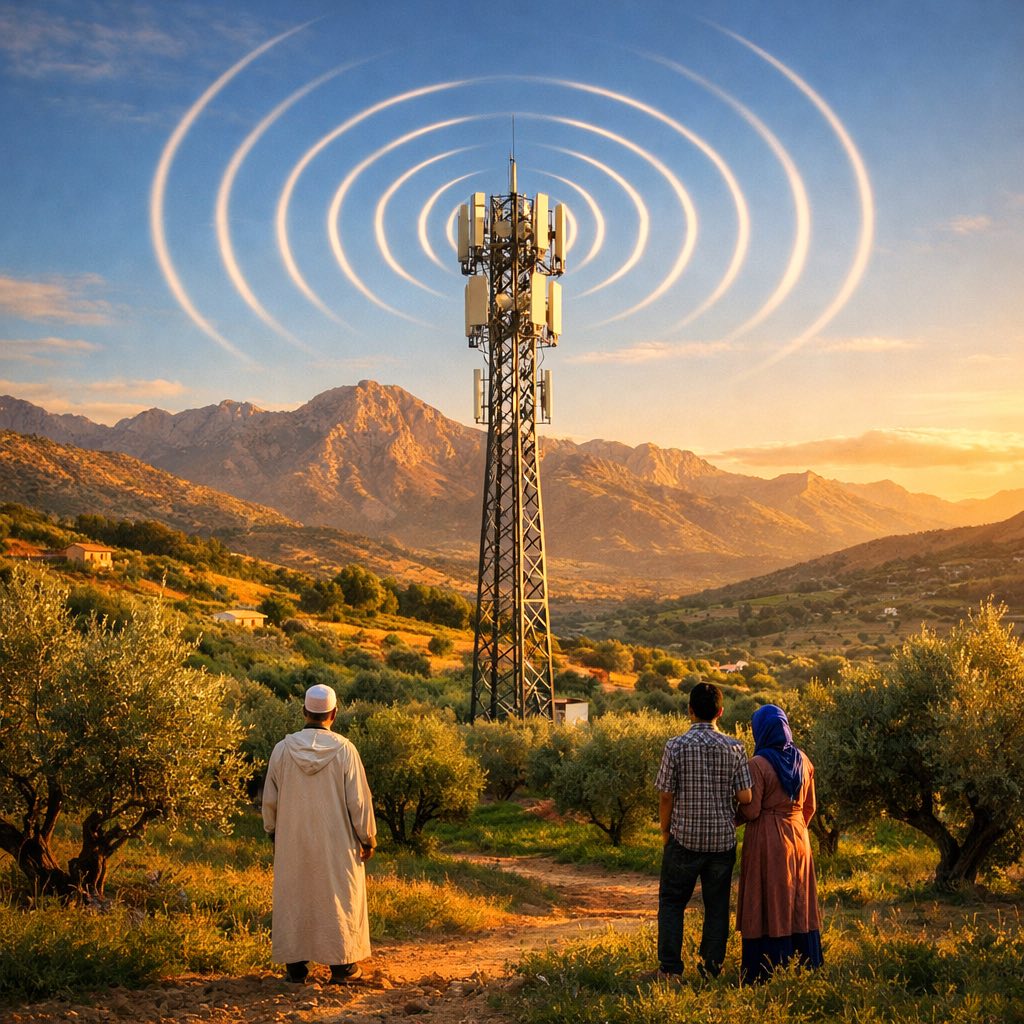
The 700MHz band, often called the “digital dividend” because it was freed up by the transition from analog to digital television broadcasting, offers a structural solution. A single 700MHz cell tower covers roughly four times the area of an 1,800MHz tower, dramatically reducing the number of base stations needed to serve dispersed populations. This propagation advantage — the signal penetrates buildings better and travels farther — makes it the most economically viable frequency for rural broadband deployment.
Globally, the International Telecommunication Union (ITU) has designated the 694-790MHz range as the second digital dividend for mobile broadband, and over 130 countries have allocated or plan to allocate this band. Algeria’s opportunity lies in leveraging this international momentum while tailoring deployment to its unique geography.
Algeria’s Current Spectrum Landscape
Following the November 2025 5G spectrum auction, ARPCE awarded 15-year licenses to the three national operators — ATM Mobilis, Ooredoo Algeria, and Djezzy — for a combined 62.1 billion DZD (~$460 million) in upfront license fees. The 5G rollout, with commercial services launching in December 2025, targets urban areas with Mobilis reporting peak speeds of 1.2 Gbps during trials.
However, the 5G allocation focused on mid-band and high-band frequencies suited for urban capacity, not rural coverage. Algeria’s current mobile networks operate across 2 GSM bands, 1 UMTS band, and 6 LTE bands, but lack dedicated sub-1GHz spectrum for 4G/5G rural deployment. The E-GSM band (880-935MHz) currently allocated to all three operators provides some low-frequency coverage, but the 700MHz band remains the most efficient option for extending broadband to underserved areas.
The 4,500-Zone Expansion Plan
The government’s mobile network expansion plan targets 4,500 additional zones by 2027, focusing on communities of 500 to 2,000 residents. This initiative aims to connect approximately one million people who currently rely on legacy 2G/3G service or have no mobile broadband access at all.
The expansion plan operates alongside Algeria’s aggressive fiber optic rollout. Algerie Telecom reported over 2 million FTTH subscribers by April 2025, with fiber reaching approximately 27% of households. The government targets complete neighborhood fiber coverage by 2026 and full copper phase-out by 2027. For rural areas too remote for fiber, wireless broadband via low-frequency spectrum becomes the only economically feasible option.
Advertisement
Regulatory and Technical Challenges
Three challenges shape Algeria’s 700MHz deployment timeline. First, the digital switchover from analog television must be completed or substantially advanced to free the 700MHz band. Algeria’s digital TV migration has progressed, but the full clearance of broadcast incumbents from the band requires coordination between ARPCE, the broadcasting authority, and television operators.
Second, ARPCE must design auction conditions that balance revenue generation with coverage obligations. Pure revenue-maximizing auctions can lead operators to pay excessive upfront fees, reducing their capital available for infrastructure deployment. Countries like Indonesia and Bangladesh have adopted coverage-weighted auction designs where operators commit to specific rural deployment timelines in exchange for reduced spectrum fees.
Third, the economics of rural deployment remain challenging. Satellite backhaul via Algeria’s Alcomsat-1 satellite feeds some of the most remote cell sites, but the operational cost of maintaining towers in extreme Saharan conditions — temperatures exceeding 50 degrees Celsius, sandstorms, limited grid power — constrains expansion. Solar-powered base stations and shared infrastructure models can reduce per-site costs but require regulatory frameworks that ARPCE is still developing.
Economic Impact of Rural Connectivity
The economic case for rural broadband in Algeria extends beyond telecommunications revenue. Digital connectivity enables precision agriculture monitoring in the Hauts Plateaux farming regions, telemedicine services for communities hundreds of kilometers from the nearest hospital, e-government service delivery that reduces the need for physical travel to administrative centers, and mobile banking for populations currently excluded from formal financial services.
The World Bank estimates that a 10% increase in broadband penetration in developing countries correlates with a 1.38% increase in GDP growth. For Algeria, closing the rural digital divide is not merely a telecommunications objective — it is an economic development imperative that affects agriculture, healthcare, education, and financial inclusion simultaneously.
What Comes Next
The sequence of regulatory actions matters. ARPCE must finalize the digital dividend clearance timeline, design the 700MHz allocation framework (whether auction, administrative assignment, or hybrid), and set coverage obligations that ensure operators serve rural communities rather than concentrating on profitable semi-urban areas.
Algeria’s three operators have the financial capacity to invest — the combined 5G license fees demonstrate willingness to commit significant capital. The question is whether regulatory design creates the right incentives for rural deployment, or whether 700MHz spectrum becomes another urban capacity layer.
Frequently Asked Questions
What is the 700MHz “digital dividend” and why is it important for Algeria?
The 700MHz band is radio frequency spectrum freed up by the transition from analog to digital television broadcasting. It is critically important for Algeria because signals at this frequency travel four times farther than higher-frequency bands like 1,800MHz and penetrate buildings more effectively. For a country with 2.38 million square kilometers of territory and dispersed rural populations, 700MHz enables broadband coverage with fewer towers at lower cost than any alternative frequency.
When will Algeria allocate the 700MHz band to mobile operators?
No official timeline has been announced for a dedicated 700MHz allocation. The process depends on completing the digital TV switchover to clear broadcast incumbents from the band, ARPCE’s regulatory design work, and coordination with the 4,500-zone expansion plan targeting completion by 2027. Countries in the MENA region are at various stages of 700MHz deployment, with Algeria positioned to learn from early adopters.
How does 700MHz deployment relate to Algeria’s 5G rollout?
The November 2025 5G spectrum auction focused on mid-band and high-band frequencies optimized for urban capacity and speed. The 700MHz band serves a different purpose: extending coverage to rural and remote areas where higher frequencies are economically impractical. The two are complementary — 5G delivers speed in cities while 700MHz delivers reach in the countryside. Some countries deploy 5G on 700MHz for wide-area low-band coverage, a possibility Algeria could explore.
Sources & Further Reading
- Algeria Concludes 5G Spectrum Auction — Spectrum Tracker
- Algeria Plans Mobile Network Expansion to 4,500 New Areas by 2027 — Ecofin Agency
- Algeria Reaches 1.5 Million Households Connected to Fiber-Optic — SAMENA
- Algeria Wireless Frequency Bands and Carriers — FrequencyCheck
- ITU Digital Dividend for Mobile Broadband