Two Salary Realities in One Country
Algeria’s technology sector operates on two completely different pay scales, and the gap between them tells the story of a labour market in transition.
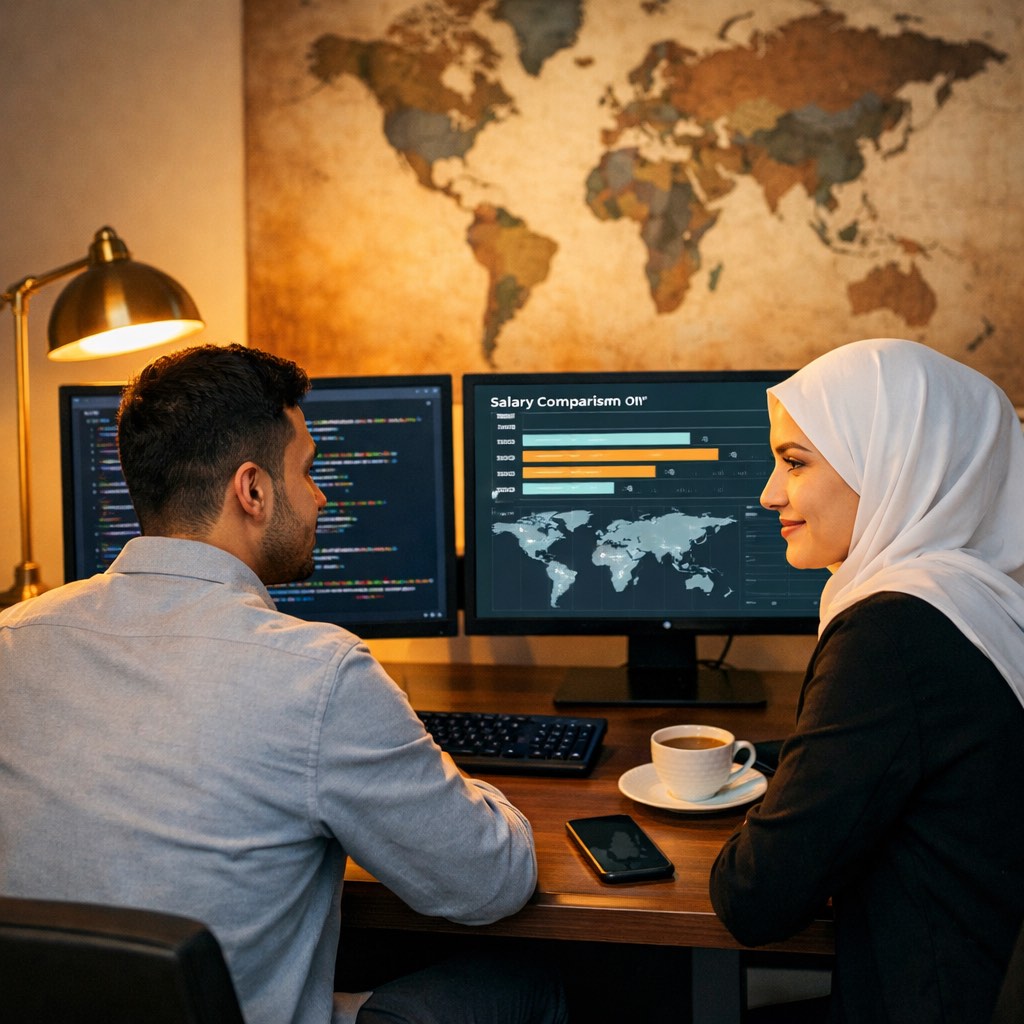
According to the State of Software Engineering in Algeria survey, the median salary for developers working at Algerian companies is approximately 163,000 DZD per month, roughly 1,100 EUR. Senior engineers with six to ten years of experience at local firms earn around 250,000 to 300,000 DZD per month. These figures represent solid middle-class incomes in Algeria, but they pale beside what the same developers could earn working remotely.
Developers working for foreign companies from Algeria tell a different story entirely. The same survey reveals that remote salaries start at approximately 500 EUR per month for entry-level and junior roles, rise to around 1,000 EUR for mid-level developers, and reach levels matching European and Gulf country medians for seniors. Top earners working for international companies report salaries up to 85,000 EUR per year.
The multiplier is stark. A senior developer working remotely for a European client can earn three to five times what the same role pays at an Algerian company.
Who Is Working Remotely
The survey data provides a detailed profile of Algeria’s remote developer workforce. Twenty-nine percent of respondents work for foreign companies, and the composition breaks down as follows:
- 46% are full-time employees of foreign companies
- 42% are freelancers working on contracts
- 12% are part-time employees
Web developers represent the largest segment among remote workers, reflecting global demand patterns. The majority are based in Algiers, Oran, and Constantine, though remote work by definition does not require proximity to any employer.
Glassdoor data for 2026 estimates the typical pay range for software engineers in Algeria between 52,292 and 104,063 DZD per year for locally employed roles, while RemotePeople reports that remote positions in Algeria range from $3,800 to $7,600 per month, with some reaching $28,300 per month for specialised roles.
The Purchasing Power Advantage
What makes remote work particularly attractive for Algerian developers is not just the nominal salary difference. It is the purchasing power multiplier.
Algeria’s cost of living is significantly lower than Western Europe, North America, or the Gulf states. A developer earning 2,000 EUR per month from a French client lives at a standard equivalent to someone earning four to five times that amount in Paris. Housing, food, transportation, and daily expenses consume a fraction of the income, leaving substantial savings capacity.
This dynamic creates both opportunity and tension. Developers with international clients can afford to be selective about projects, invest in their own education, and build financial security. But the same dynamic drains talent from local companies that cannot compete on compensation, creating a brain drain within Algeria’s own borders.
Advertisement
How Local Companies Are Responding
Algerian technology companies are not passive observers of this salary divergence. Several strategies are emerging.
Salary adjustment. Companies competing for experienced developers have begun benchmarking against regional rather than purely local rates. While matching international salaries is not feasible for most local firms, offering 50 to 70 percent of regional rates reduces the pull factor significantly, especially when combined with benefits that remote work does not provide.
Non-monetary compensation. Local companies increasingly offer structured career development, team culture, office environments, and project stability as differentiators. Many developers report that remote freelancing, while lucrative, can be isolating and unpredictable. Companies that offer compelling technical challenges and strong teams retain developers who might earn more elsewhere.
Hybrid models. Some Algerian companies have adopted hybrid approaches, hiring developers at above-local-market rates while serving international clients. This allows them to pay competitive salaries funded by international revenue while keeping teams anchored in Algeria.
The Infrastructure That Makes It Possible
Remote work at scale requires reliable internet infrastructure, and Algeria has been investing heavily. Algeria Telecom’s 400 Gbps optical backbone connects major cities with sufficient bandwidth for video conferencing, collaborative coding, and continuous integration workflows. Expanding 4G coverage provides fallback connectivity, and the rollout of higher-speed mobile data continues.
Payment infrastructure remains a friction point. Algerian developers receiving international payments must navigate currency conversion, banking restrictions, and limited access to international payment platforms. CIB-enabled cards support some international transactions, but many remote workers rely on intermediary payment services or direct bank transfers.
The regulatory environment for remote work is still developing. Algeria’s labour laws were not designed for employees working for foreign companies from domestic locations, creating ambiguity around taxation, social security contributions, and employment protections.
Salary Benchmarks by Role and Experience
Based on aggregated data from multiple sources, here is what Algerian developers can expect in 2026:
| Role | Local Company (DZD/month) | Remote/Foreign (EUR/month) |
|---|---|---|
| Junior Developer (0-2 years) | 60,000 – 100,000 | 500 – 1,000 |
| Mid-Level Developer (3-5 years) | 120,000 – 200,000 | 1,000 – 2,500 |
| Senior Developer (6-10 years) | 200,000 – 350,000 | 2,500 – 5,000 |
| Lead/Principal (10+ years) | 300,000 – 500,000 | 4,000 – 7,000+ |
These ranges vary significantly by specialisation. Machine learning engineers, DevOps specialists, and cybersecurity professionals command premiums at both ends of the scale. The highest-reported remote salaries, up to 85,000 EUR per year, correspond to senior engineers at well-funded European or North American companies.
What This Means for Algeria’s Tech Ecosystem
The remote work salary premium is not inherently good or bad for Algeria’s technology sector. It creates tension, but it also creates capacity.
Developers earning international salaries pay higher consumption taxes, invest in local real estate, and some eventually launch their own companies. The skills and practices they absorb from international teams flow back into the local ecosystem through mentorship, open-source contributions, and hiring when they become founders.
The risk is a hollowing-out scenario where every experienced developer works remotely for foreign clients, leaving local companies unable to staff projects at any price. Preventing this requires local companies to build compelling value propositions beyond salary, including technical challenges, equity participation, leadership pathways, and genuine career development.
Frequently Asked Questions
How much do Algerian developers earn working remotely for foreign companies?
According to the State of Software Engineering in Algeria survey, remote salaries for foreign companies start at approximately 500 EUR per month for entry-level roles and rise to European-median levels for senior engineers. Top earners report up to 85,000 EUR per year. Engineers with six to ten years of experience earn around 2,500 EUR per month, roughly three times the salary of equally experienced developers at Algerian companies. Of remote workers, 46% are full-time employees, 42% are freelancers, and 12% work part-time.
What percentage of Algerian developers work remotely for international clients?
The State of Software Engineering in Algeria survey found that 29% of respondents work for foreign companies remotely from Algeria, with web developers representing the largest segment. This figure likely understates the total, as freelancers working through platforms may not participate in developer surveys at the same rate as employed professionals. The majority of remote workers are based in Algiers, Oran, and Constantine.
How can Algerian developers start earning international remote salaries?
The most common entry points are international freelance platforms, direct applications to remote-first companies, and professional networking on LinkedIn. Key prerequisites include strong English communication skills, a portfolio demonstrating production-quality work, and familiarity with tools and workflows used by international teams such as Git, CI/CD pipelines, and agile project management. Developers should also resolve payment infrastructure challenges early by establishing international-capable bank accounts or payment channels.
Sources & Further Reading
- Salaries and Remuneration — State of Software Engineering in Algeria
- Remote Working — State of Software Engineering in Algeria
- Software Developer Salaries in Algiers, Algeria 2026 — Glassdoor
- Average Salary in Algeria for 2026 — RemotePeople
- Hiring and Paying in Algeria: Average Salary 2026 — HelloPebl
- Software Engineer Salary in Algeria — Levels.fyi